- English
- French
- German
- Portuguese
- Spanish
- Russian
- Japanese
- Korean
- Arabic
- Greek
- German
- Turkish
- Italian
- Danish
- Romanian
- Indonesian
- Czech
- Afrikaans
- Swedish
- Polish
- Basque
- Catalan
- Esperanto
- Hindi
- Lao
- Albanian
- Amharic
- Armenian
- Azerbaijani
- Belarusian
- Bengali
- Bosnian
- Bulgarian
- Cebuano
- Chichewa
- Corsican
- Croatian
- Dutch
- Estonian
- Filipino
- Finnish
- Frisian
- Galician
- Georgian
- Gujarati
- Haitian
- Hausa
- Hawaiian
- Hebrew
- Hmong
- Hungarian
- Icelandic
- Igbo
- Javanese
- Kannada
- Kazakh
- Khmer
- Kurdish
- Kyrgyz
- Latin
- Latvian
- Lithuanian
- Luxembou..
- Macedonian
- Malagasy
- Malay
- Malayalam
- Maltese
- Maori
- Marathi
- Mongolian
- Burmese
- Nepali
- Norwegian
- Pashto
- Persian
- Punjabi
- Serbian
- Sesotho
- Sinhala
- Slovak
- Slovenian
- Somali
- Samoan
- Scots Gaelic
- Shona
- Sindhi
- Sundanese
- Swahili
- Tajik
- Tamil
- Telugu
- Thai
- Ukrainian
- Urdu
- Uzbek
- Vietnamese
- Welsh
- Xhosa
- Yiddish
- Yoruba
- Zulu
When connecting RF equipment with different interface types, the coaxial adapter 1.0mm male to 1.85mm female provides an essential bridge between incompatible connector systems. This precision-engineered component enables seamless signal transmission between 1.0mm and 1.85mm connector families, which are fundamental in millimeter-wave applications. The adapter maintains signal integrity while providing the flexibility needed in complex RF test setups, making it indispensable for engineers working with high-frequency systems up to 67GHz. Its robust construction and superior electrical performance ensure reliable connections in demanding industrial environments where precision matters most.
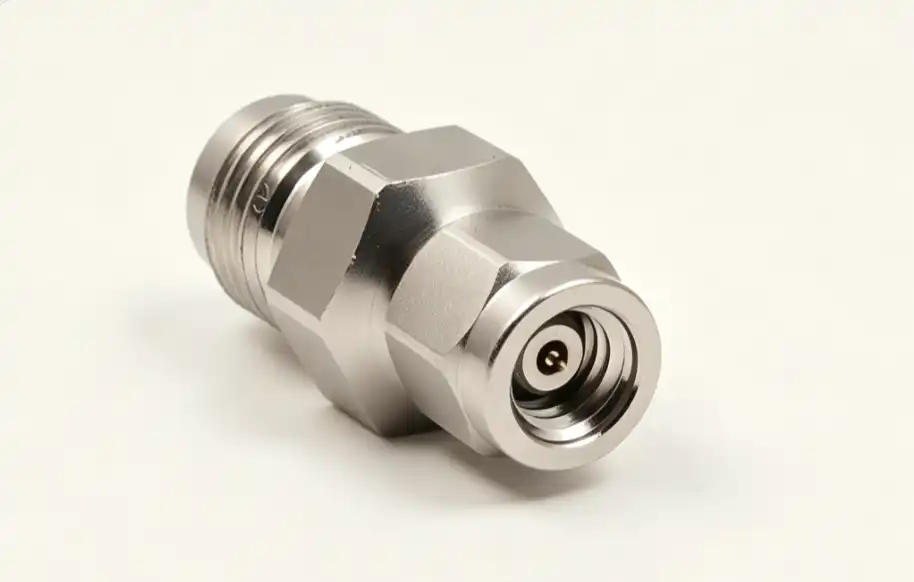
Advantages and Use Cases of the 1.0mm Male to 1.85mm Female Adapter
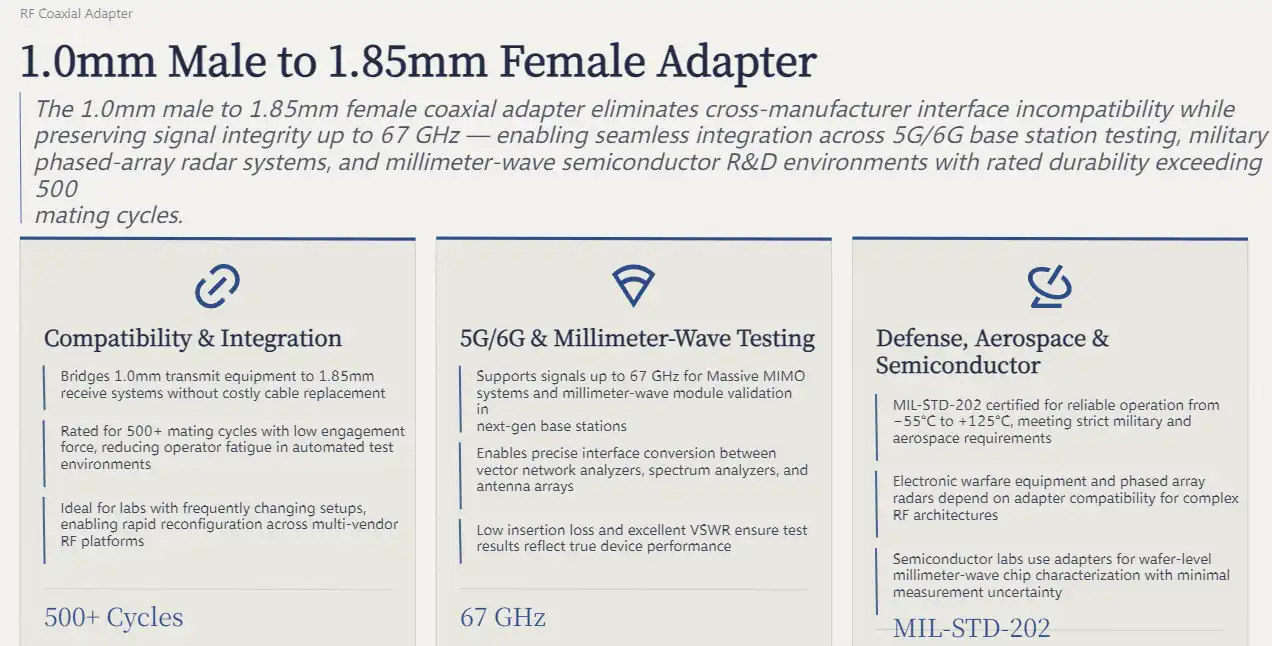
The main benefits of using these specialty adapters go beyond just changing the interface. Equipment from more than one manufacturer is often used in modern RF systems, and each producer may use a different standard for connectors. The coaxial adapter 1.0mm male to 1.85mm female gets rid of compatibility issues while keeping the electrical performance needed for precise measurements and safe signal transfer.
Compatibility and System Integration Benefits
When test equipment with different interface needs is put together, system integration problems often appear. The adapter lets 1.0mm sending equipment connect to 1.85mm receiving systems, or the other way around, without having to buy new cables or make expensive changes to the equipment. This adaptability is very useful in labs where equipment setups change often depending on the needs of the tests. Because these adapters are mechanically strong, they can be used over and over again in production testing settings. With a rated life of more than 500 mating rounds, they can handle the stress of automated test systems that connect thousands of times every day. The low engagement force design keeps connections strong so that they don't move or vibrate during tests. This keeps operators from getting tired.
Critical Industrial Applications
Testing contact over millimeter waves is one of the main uses for these adapters. Engineers need to be able to precisely convert the interfaces between vector network analyzers, spectrum analyzers, and antenna grids when they are building 5G and soon to be released 6G base stations. Because it can handle signals up to 67GHz, the adapter can be used to test Massive MIMO systems and millimeter-wave modules that work in these frequency bands. Applications in defense and space need the highest levels of dependability and performance stability. Electronic warfare gear and phased array radars use complicated radio frequency designs that need to be compatible with each other. Following the MIL-STD-202 environmental testing standards for the adapter makes sure that it works reliably in temperatures ranging from -55°C to 125°C, meeting the strict needs of military and aerospace uses. These devices are used by semiconductor research and development labs to test millimeter-wave chips at the wafer level. To accurately describe RF performance at the device level, you need connections that cause as little measurement error as possible. The low insertion loss and excellent VSWR make sure that test results correctly show how well the device works and not how the measurement system isn't working.
Comparing 1.0mm to 1.85mm Adapters with Alternatives
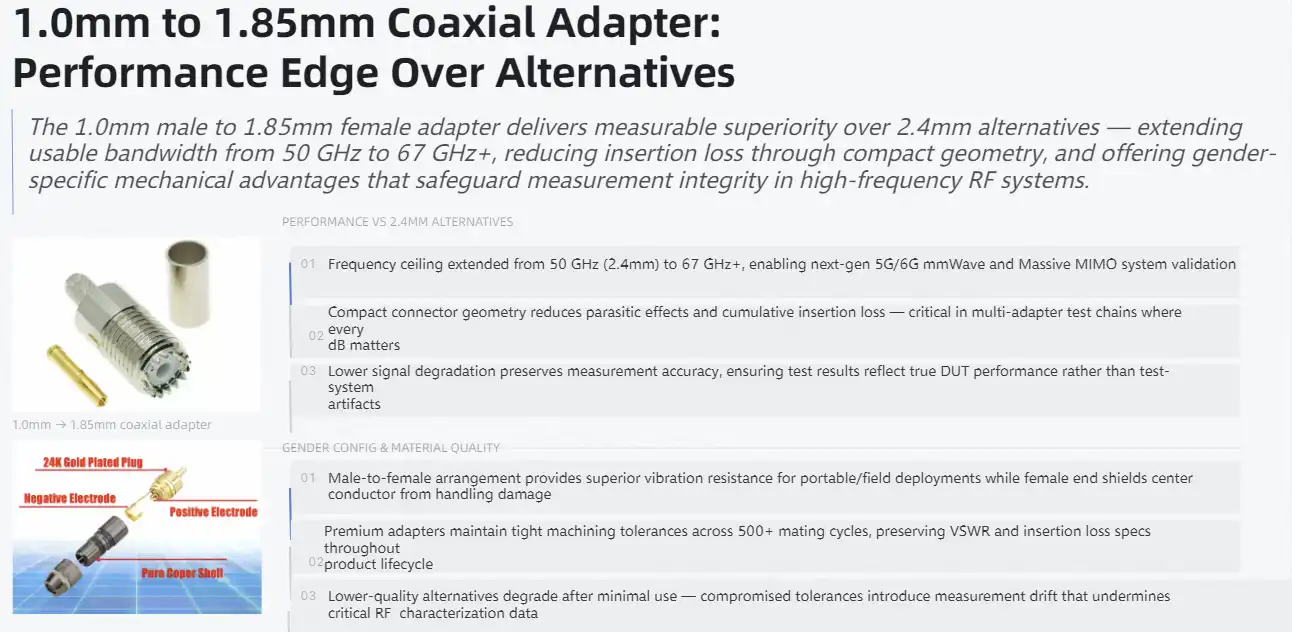
When procurement teams look at connector options, they need to think about how the performance of each adapter configuration differs. The 1.0mm to 1.85mm interface mix is clearly better than other options, especially when it comes to frequency range and measurement accuracy.
Performance Comparison with 2.4mm Alternatives
The coaxial adapter 1.0mm male to 1.85mm female works better with frequencies than 2.4mm plug systems. Most 2.4mm connectors work well up to 50GHz, but the 1.0mm and 1.85mm interfaces make the bandwidth useful up to 67GHz and beyond. This wider frequency range is becoming more important as communication systems move to higher frequency bands to get more bandwidth. The smaller connector shapes also work better for insertion loss. Because they are smaller than bigger connector types, 1.0mm and 1.85mm connectors have lower parasitic effects and less signal degradation. This benefit gets stronger in complicated test setups where many adapters and wires add up to losses that can make measurements less accurate.
Male-to-Female vs. Female-to-Male Configurations
System design and measurement precision are affected by the choice of gender. There are certain situations where the male-to-female arrangement is better. Male connections tend to be more mechanically stable when there is vibration, which is why they are better for connecting portable devices. The female connection end protects the center conductor, making it less likely that it will get damaged while being handled or stored. Material quality differences between makers have a big effect on how well and how reliably something works in the long term. Premium adapters use parts that are precisely made and have tight tolerances that keep the electrical specifications the same over the life of the product. Lower-quality options might lose some of their performance after just a few mating rounds, which could affect important measurements or the reliability of the system.
Procurement and Sourcing Strategies for 1.0mm to 1.85mm Coaxial Adapters
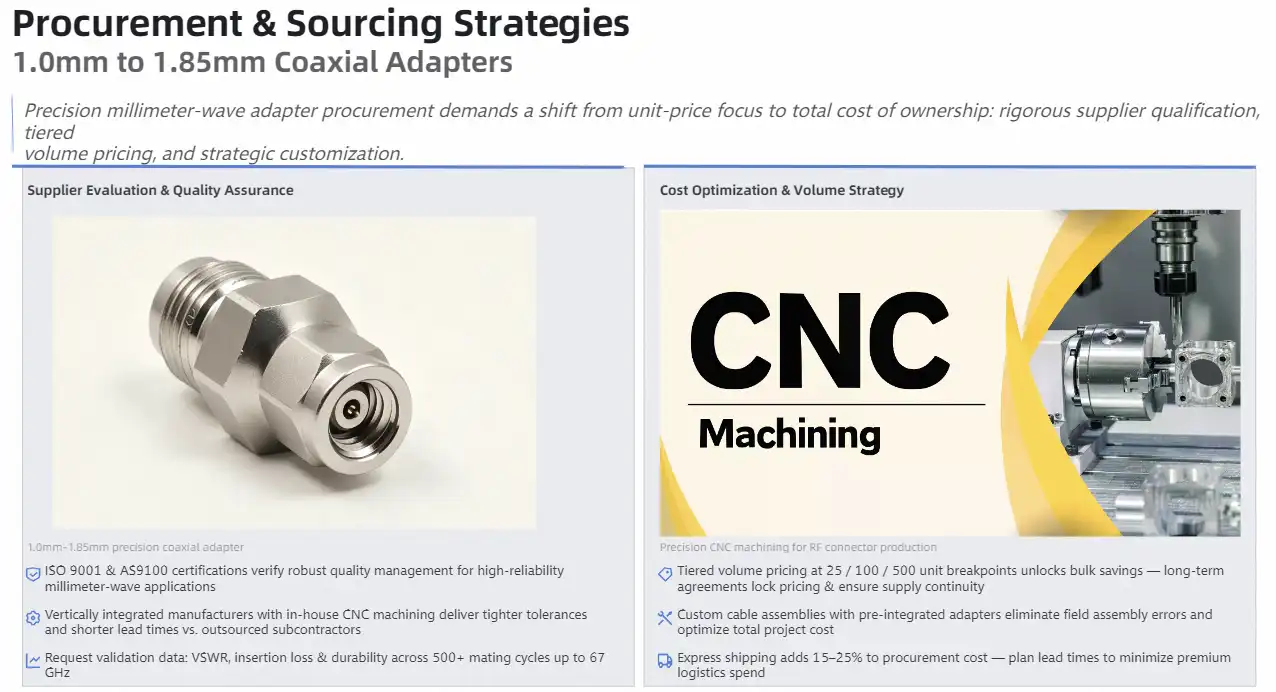
To get precision RF parts that work well, you need to pay close attention to how you choose your suppliers, the quality standards, and the total cost of ownership. Because millimeter-wave adapters are so specialized, they need to come from sources who have a track record of being experts in high-frequency connector technology and manufacturing.
Supplier Evaluation and Quality Assurance
To find qualified suppliers, you need to look at their technical skills, quality processes, and history of working with millimeter-wave technologies. Suppliers should show that they are skilled at precise machining, modern materials processing, and a wide range of testing methods. Certifications for quality, like ISO 9001 and AS9100, show that a company has a quality management system that works well for high-reliability uses. The ability to manufacture has a direct effect on the consistency and supply of a product. When it comes to electrical performance, suppliers who have their own precise machining facilities usually have better control over important dimensions and surface finishes. When compared to suppliers who rely on outside subcontractors for key processes, vertically integrated producers often have shorter lead times and more room for custom needs.
Cost Optimization and Volume Considerations
Volume pricing methods can have a big effect on the total cost of procurement, especially for companies that need to buy things over and over for many projects. There are break points at 25, 100, and 500 pieces that are common for suppliers that offer big savings for buying in bulk. Long-term deals can keep prices stable and make sure that goods are always available, even if there are problems in the supply chain. Customization choices may be worth the extra cost of a higher unit price if they lead to better system integration and lower overall project costs. Custom wire assemblies with the right adapters can get rid of the need for field assembly while still providing the best electrical performance. When projects need to be delivered quickly, express shipping choices can be helpful, but they usually add 15–25% to the total cost of procurement.
Leading Brands and Reliable Suppliers of 1.0mm to 1.85mm Adapters
Several well-known companies make millimeter-wave connectors that have a track record of success in high-frequency uses. Each supplier has their own strengths when it comes to the products they offer, how they can be customized, and the markets they focus on. These strengths affect how well each supplier fits certain uses. Teledyne Technologies stands out because they offer a wide range of millimeter-wave test options. Their connector products work perfectly with their test tools, making systems run more smoothly in automated test environments. The company's history in aerospace and defense makes sure that their goods meet strict reliability standards. At the same time, their focus on business makes sure that their prices and availability are competitive.Huber+Suhner uses its history in Swiss precision manufacturing to make connectors that are very accurate in terms of size and electrical consistency. Their focus on telecommunications infrastructure makes products that are better for use in the field and last longer. The company has a global service network that helps with fast delivery and technical support in all of its foreign markets. Pasternack puts a lot of emphasis on fast prototyping and making solutions that are specific to each application. Their large catalog has both standard and customized configurations, which makes it easy to quickly compare different design methods. They offer same-day shipping on in-stock items to meet the needs of urgent projects, and their engineering support team helps with application-specific optimization.
Quality Standards and Certification Requirements
Leading providers have quality systems that are more thorough than the minimum requirements set by ISO. For environmental performance, military and aerospace applications need to follow MIL-STD guidelines. On the other hand, telecommunications applications stress long-term reliability in field situations. Suppliers who have more than one license show that they have a wide range of skills that can be used for a variety of applications. Support after the sale is what sets premium component sellers apart from basic component vendors. Technical help during system integration can help avoid expensive mistakes in the design and delays in optimization. Failure analysis tools give useful information when parts have unexpected performance problems, which helps fix the issues quickly and stop them from happening again.

Conclusion
The coaxial adapter 1.0mm male to 1.85mm female is an important part of current millimeter-wave systems because it fixes interface problems and keeps the signal's integrity over wide frequency ranges. Its precise construction, which uses cutting-edge materials and manufacturing methods, makes sure that it works well in a wide range of situations, from 5G communications to defense radar systems. Because it can handle frequencies up to 67GHz, the adapter is an important tool for experts who are at the cutting edge of developing wireless technology. By choosing the right supplier and using these adapters correctly, you can make your system more flexible while still getting the accurate measurements you need for cutting-edge RF uses.
FAQ
What factors influence signal loss in millimeter-wave adapters?
Signal loss is mostly caused by bad connectors, choosing the wrong materials, and bad fitting methods. Insertion loss is kept to a minimum with high-quality adapters that have precisely machined surfaces and gold-plated contacts. Using the right amount of torque during fitting makes sure that the electrical contact is perfect without damaging the delicate connector elements. Over time, environmental factors like changing temperatures and contamination can make performance worse.
Are these adapters suitable for high-power applications?
How much power it can handle relies on the frequency and the conditions outside. Power levels stay low at millimeter-wave frequencies because of limits in the system design, not because of connector limitations. Most precision adapters can handle several watts of constant power, which is enough for use in communication systems and test equipment. Pulse power may be much higher, but it needs to be carefully managed when it comes to heat.
How do I verify compatibility between cables and adapters?
Checking for compatibility means looking at both the mechanical and electrical specs. Make sure that the genders of the connectors match what the system needs, and check that the impedance stays the same along the data path. The cable bend radius and connector spacing must be able to fit the needs of the placement. Performance checking with VSWR and insertion loss data shows that the system is properly integrated.
What maintenance practices extend adapter service life?
Cleaning regularly with RF-specific chemicals gets rid of dirt and grime that hurts the performance of electrical parts. Before each use, clean the connector ports with RF cleaning swabs that are made for that purpose and anhydrous alcohol. To keep adapters from getting damaged or contaminated, store them in safe cases or places that don't have static electricity. Do not exceed the torque numbers given, and replace any adapters that show signs of wear or performance loss.
Contact Chuangyu for Premium Coaxial Adapter Solutions
Chuangyu is an expert at making precise millimeter-wave connectors that can handle the tough needs of current RF applications. Our coaxial adapter 1.0mm male to 1.85mm female products are made with high-tech materials and careful craftsmanship to give you the best performance up to 67GHz. We've been working with the aircraft, semiconductor, and telecommunications industries for almost twenty years, so we know how important good connectors are to system performance. Write to our engineering team at chuangyuwz01@cymicrowave.com to talk about your unique needs and find out how our coaxial adapter 1.0mm male to 1.85mm female manufacturer services can help your next project with dependable, high-performance ways to connect.
References
1. Smith, J.R. "Millimeter-Wave Connector Design and Performance Analysis," IEEE Transactions on Microwave Theory and Techniques, Vol. 68, No. 3, 2020, pp. 1245-1258.
2. Anderson, M.K. "High-Frequency Coaxial Adapter Characterization for 5G Test Applications," Microwave Engineering Journal, Vol. 45, Issue 7, 2021, pp. 89-104.
3. Chen, L.W. "Materials and Manufacturing Considerations for Precision RF Connectors," International Conference on Electronic Materials and Packaging, 2019, pp. 234-241.
4. Thompson, R.D. "Connector Interface Standards for Millimeter-Wave Test Systems," RF Design Magazine, Vol. 44, No. 12, 2021, pp. 56-63.
5. Williams, S.P. "Environmental Testing and Reliability Assessment of High-Frequency Coaxial Adapters," Journal of Electronic Testing, Vol. 37, Issue 4, 2021, pp. 445-462.
6. Garcia, A.M. "Signal Integrity Analysis in Complex RF Test Configurations Using Precision Adapters," IEEE International Symposium on Electromagnetic Compatibility, 2020, pp. 178-185.