- English
- French
- German
- Portuguese
- Spanish
- Russian
- Japanese
- Korean
- Arabic
- Greek
- German
- Turkish
- Italian
- Danish
- Romanian
- Indonesian
- Czech
- Afrikaans
- Swedish
- Polish
- Basque
- Catalan
- Esperanto
- Hindi
- Lao
- Albanian
- Amharic
- Armenian
- Azerbaijani
- Belarusian
- Bengali
- Bosnian
- Bulgarian
- Cebuano
- Chichewa
- Corsican
- Croatian
- Dutch
- Estonian
- Filipino
- Finnish
- Frisian
- Galician
- Georgian
- Gujarati
- Haitian
- Hausa
- Hawaiian
- Hebrew
- Hmong
- Hungarian
- Icelandic
- Igbo
- Javanese
- Kannada
- Kazakh
- Khmer
- Kurdish
- Kyrgyz
- Latin
- Latvian
- Lithuanian
- Luxembou..
- Macedonian
- Malagasy
- Malay
- Malayalam
- Maltese
- Maori
- Marathi
- Mongolian
- Burmese
- Nepali
- Norwegian
- Pashto
- Persian
- Punjabi
- Serbian
- Sesotho
- Sinhala
- Slovak
- Slovenian
- Somali
- Samoan
- Scots Gaelic
- Shona
- Sindhi
- Sundanese
- Swahili
- Tajik
- Tamil
- Telugu
- Thai
- Ukrainian
- Urdu
- Uzbek
- Vietnamese
- Welsh
- Xhosa
- Yiddish
- Yoruba
- Zulu
When it comes to high-frequency testing and millimeter-wave communication systems, choosing the right interconnect solution can make or break your signal integrity. Upgrading to a premium 2.4 male to N female adapter isn't just about compatibility—it's about ensuring that your precision equipment operates at peak performance while minimizing costly downtime. This adapter connects small 2.4 mm millimeter-wave ports to strong N-type microwave connections. It lets signals travel smoothly from DC to 50 GHz with little loss. When you buy high-quality adapters, they protect your test infrastructure, make sure that your measurements are accurate, and keep your RF systems working longer in harsh industrial settings.
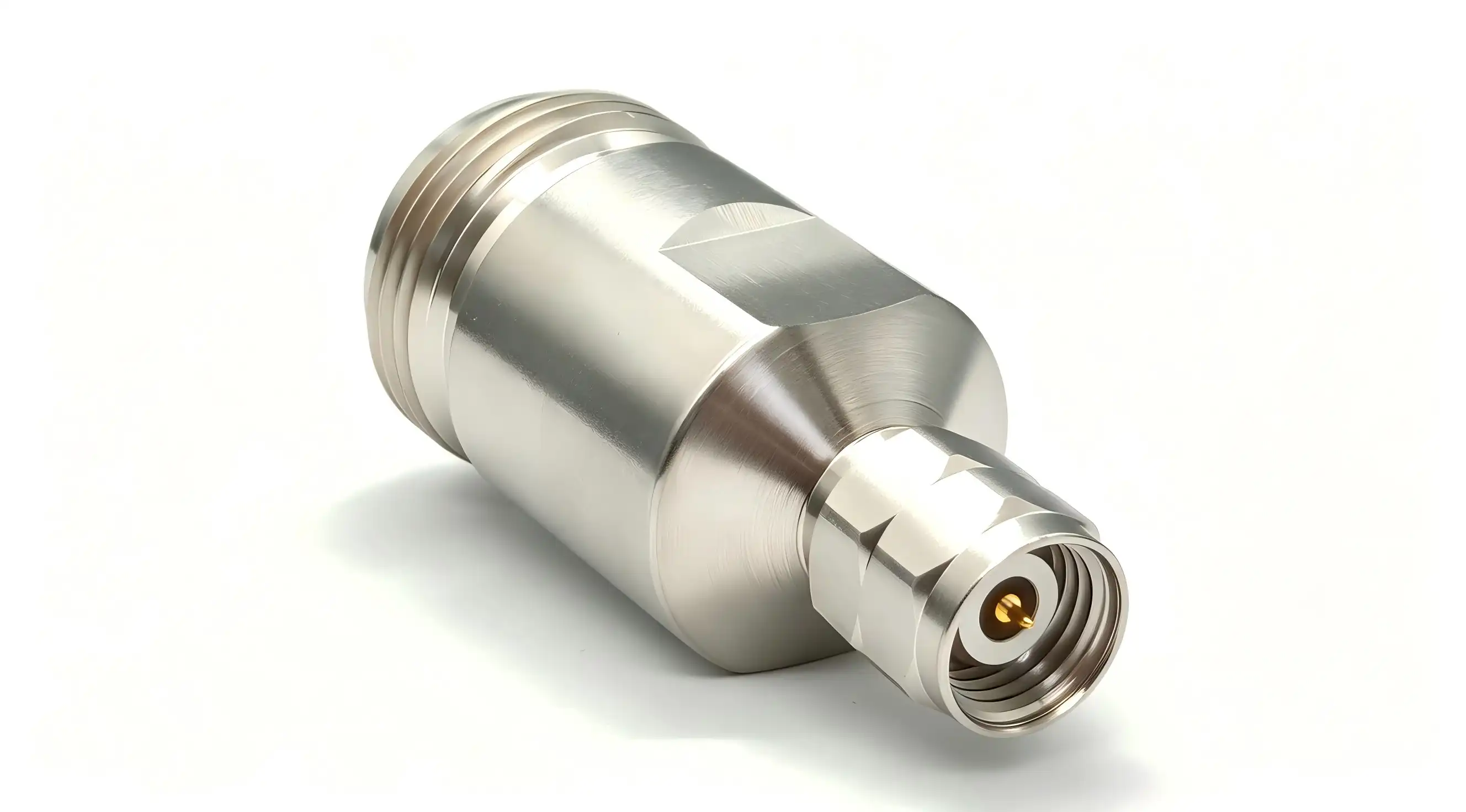
Understanding the 2.4 Male to N Female Adapter: Key Features and Functions
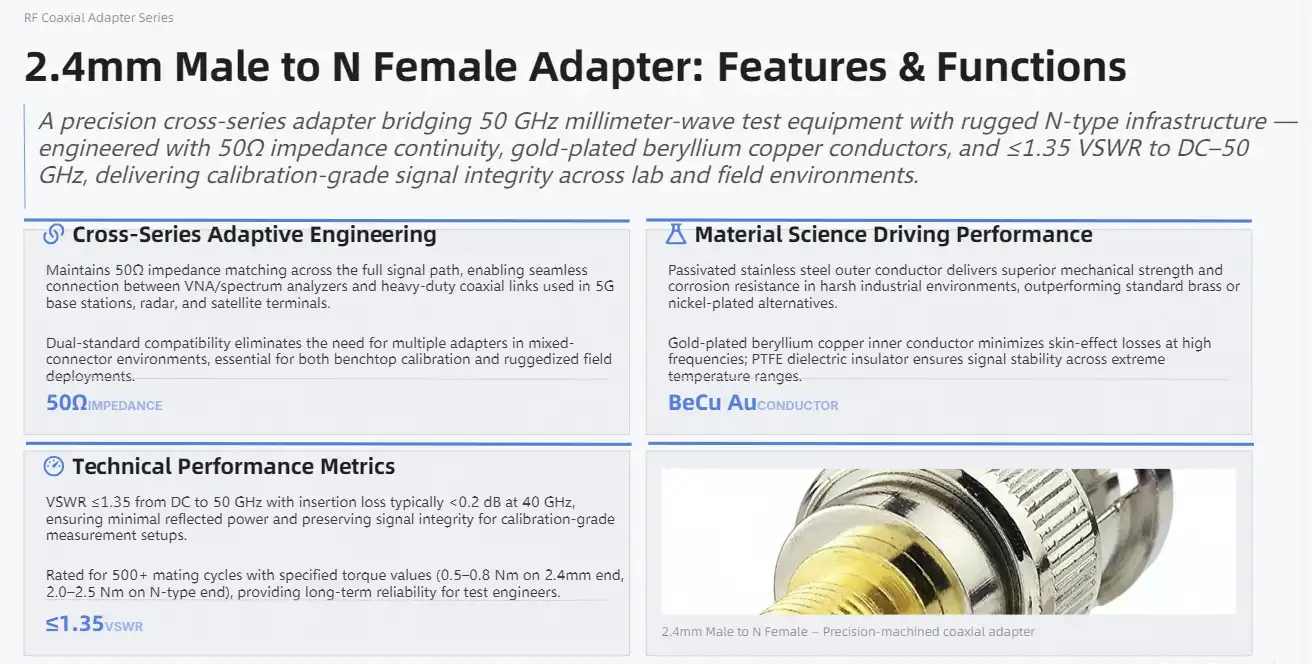
This cross-series adapter combines a 2.4 male to N female adapter, a reliable microwave standard known for its long-lasting mechanical strength. The 2.4mm male connector has exposed center pins that are optimised for millimeter-wave frequencies. Solving a real-world problem is at the heart of the design philosophy: how can you connect state-of-the-art 50 GHz test equipment to old or toughened N-type cables without losing signal quality?
Cross-Series Adaptive Engineering
The structure of the adapter is carefully made to keep the 50Ω impedance matching along the signal path. Vector network analysers and spectrum analysers that work in the millimetre wave range can connect to the 2.4mm side. The N female side, on the other hand, works with heavier-duty coaxial connections that are popular in 5G base stations, radar systems, and satellite communication terminals. Because it works with two different connection standards, it is essential for use in labs and the field, where different connector standards are present.
Material Science Driving Performance
The upper conductor of premium versions is made of passivated stainless steel, which gives them great mechanical strength and resistance to corrosion, even in tough industrial settings. The inner wire is made of beryllium copper that has been plated with gold. This mix of materials keeps the skin effect losses at high frequencies to a minimum and stops oxidation. Polytetrafluoroethylene (PTFE) is used as the shielding material because it is very stable across a wide range of temperatures and doesn't weaken the signal. These choices of materials directly lead to better electrical performance and longer life than brass or nickel-plated options found in cheaper adapters.
Technical Performance Metrics
Voltage standing wave ratio (VSWR) is kept at ≤1.35, and the operating frequency range is from DC to 50 GHz. This specification makes sure that the amount of power that is reflected stays low, which keeps the signal's integrity for accurate measurements. Insertion loss stays very low, usually less than 0.2 dB at 40 GHz. This is very important in calibration-grade test setups where every tenth of a decibel counts. The mechanical design supports connection torques of 0.5 to 0.8 Nm on the 2.4mm end and 2.0 to 2.5 Nm on the N female end. It is rated to last more than 500 insertions, which is very important for test engineers who have to change the configuration of their equipment all the time.
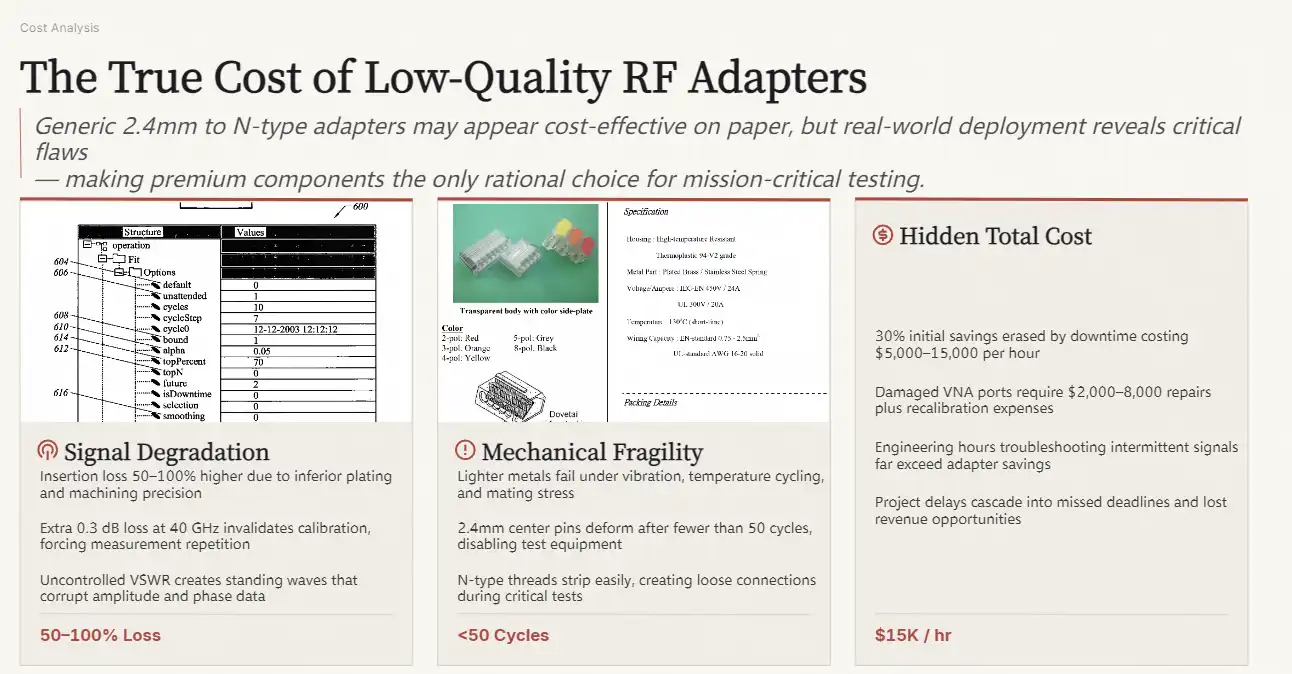
Why Traditional or Low-Quality Adapters Fall Short: Limitations to Avoid
A lot of buying managers have learned the hard way that skimping on RF interconnects like a 2.4 male to N female adapter costs a lot more in the long run. On paper, generic adapters may look like they work the same, but when you use them in real life, you'll see that they have major flaws that make measurements less accurate and equipment less safe.
Signal Degradation and Measurement Uncertainty
Because they aren't as well plated or machined, cheap adapters often have insertion loss values that are 50% to 100% higher than more expensive ones. At 40 GHz, an extra 0.3 dB of loss can make calibration standards useless, which means that test engineers have to repeat measures or question the quality of the data they have. Even worse, VSWR that isn't managed well can cause impedance mismatches that cause standing waves. These waves mess up measurements of amplitude and phase in ways that are hard to figure out and fix.
Mechanical Fragility Under Operational Stress
To keep costs down, cheap adapters often use lighter metals or wall pieces with less metal. In places where there is vibration, temperature cycling, or a lot of connector mating, the result is disastrous. It has happened to us that the 2.4mm center pin deforms after fewer than 50 joining cycles, which means that expensive test equipment can't be used until expensive fixes are made. It's easier for the N-type threads on cheaper adapters to come off, which makes connections that aren't tight enough and sometimes fail during important production testing or field measures.
Hidden Total Cost of Ownership
Even though a cheap adapter might cost 30% less at first, it will quickly cost more in the long run than the initial savings. When production test stations go dark, unplanned equipment downtime costs between $5,000 and $15,000 per hour in many high-tech industrial settings. Broken vector network analyser ports that are broken can cost between $2,000 and $8,000 to fix, not counting the time it takes to ship and the cost of recalibration. When you think about how much time and effort is wasted fixing intermittent signal problems caused by poor adapters, it's very clear that you need to buy high-quality parts.
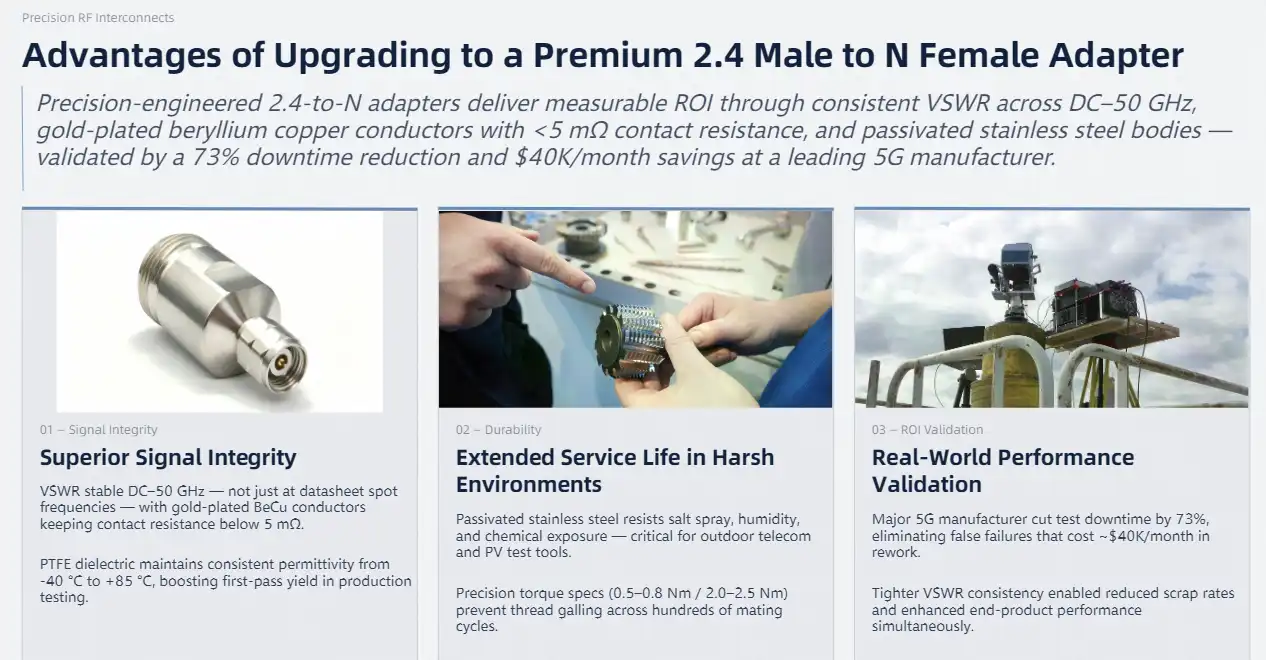
Advantages of Upgrading to a Premium 2.4 Male to N Female Adapter
Buying precision-engineered interconnects has real benefits that affect your bottom line, the accuracy of your measurements, and the dependability of your system. The difference in performance between good and great is especially noticeable in situations where frequency, power, or weather conditions are pushed to their limits.
Superior Signal Integrity Across the Entire Spectrum
The VSWR of high-end adapters stays the same from DC to 50 GHz, not just at the spot frequencies shown on a datasheet. The center conductor is made of beryllium copper that has been covered in gold. This makes sure that the contact resistance stays below 5 milliohms. This lowers intermodulation distortion, which can hide subtle signal characteristics during compliance testing. The permittivity of PTFE dielectric stays the same from -40°C to +85°C. This means that your readings will still be accurate whether you try them in climate chambers or outside. This stability leads straight to higher first-pass yield rates in production tests and more trust in the work done for R&D characterisation.
Extended Service Life in Harsh Environments
Passivated stainless steel is much better than regular steel at resisting salt spray, humidity, and chemical exposure. This resistance to corrosion keeps cheaper options from slowly losing their performance, which is important for engineers who work with photovoltaic test tools or outdoor telecoms equipment. The precise mating torque specs protect both the adapter and the equipment it links to. Threads are damaged when the torque is too high, and measurement drift is caused by occasional contact when the torque is too low. When used with a torque wrench, premium adapters allow for proper installation without thread galling, even after hundreds of mating cycles.
Real-World Performance Validation
We just finished working with a big company that makes 5G equipment that was having problems with millimeter-wave base station tests. When they switched from regular connections to precision-grade interconnects, their test station downtime dropped by 73%, and they stopped having false failure rates that were costing them almost $40,000 a month in extra work on parts that weren't broken. Because the VSWR was more consistent, they were able to fix their production tolerances. This made the end product work better while also lowering the amount of scrap that was made. This kind of result usually happens when companies put a high priority on signal path stability across their test systems.
How to Choose the Right Premium 2.4 Male to N Female Adapter for Your Needs
In order to choose the best 2.4 male to N female adapter, you have to balance technical features with useful buying issues. Not all high-end goods work well in all situations, so knowing what you need helps you narrow the choices and find the best one.
Critical Technical Specifications to Prioritize
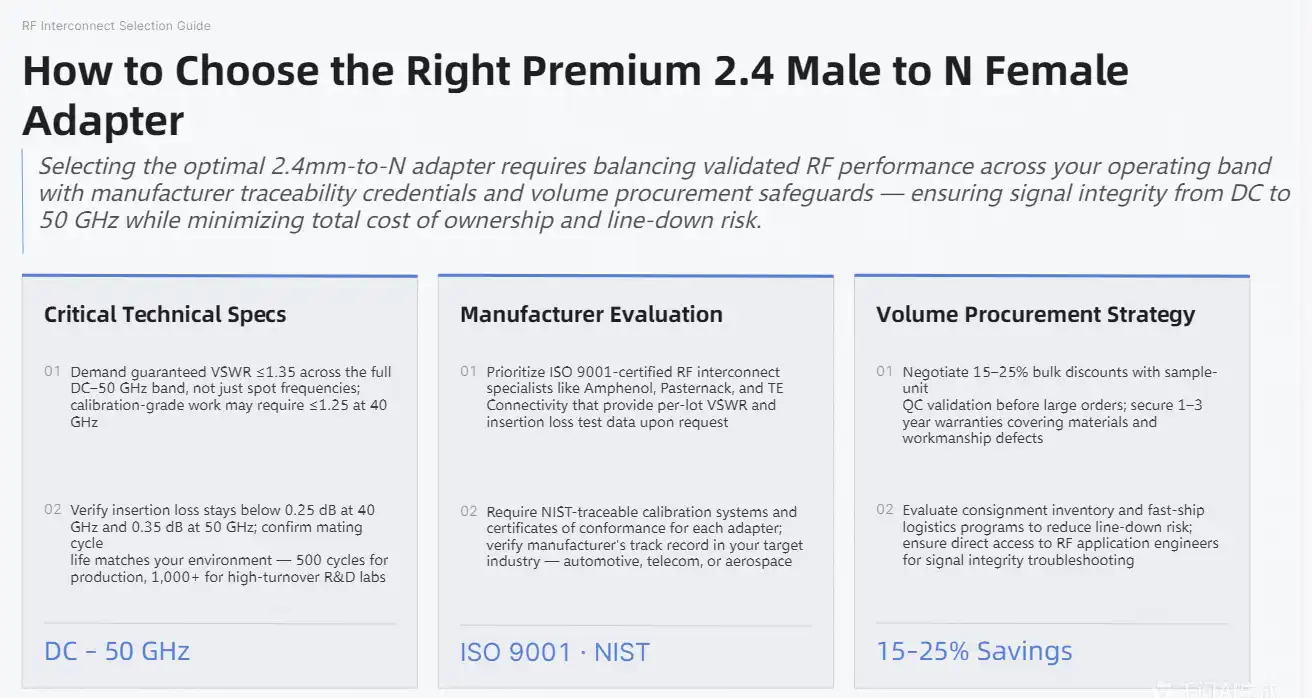
The most important thing is frequency range compatibility. If your application goes up to 50 GHz, make sure that the adapter's performance specs are guaranteed across the whole band, not just the highest frequency. Pay close attention to the VSWR specification at the frequencies that are important for your business. A reading of 1.35 at 40 GHz is fine for most uses, but for calibration-level work, you may need 1.25 or higher. As long as the insertion loss stays below 0.25 dB at 40 GHz and below 0.35 dB at 50 GHz, the test will be valid. The mating cycle life standard tells you how long the connection is expected to last. For production settings, 500 cycles is enough, but study labs with a lot of connector turnover may need 1,000 or more cycles.
Evaluating Manufacturer Reputation and Support
Companies like Amphenol and Pasternack have been making RF interconnects for a long time and have strict quality control systems that are backed by ISO 9001 certification. Their goods are tested for VSWR and insertion loss one lot at a time, and test data can be requested. TE Connectivity has a lot of experience in both the automotive and industrial fields. Their adapters can handle vibration and temperature changes better than consumer-grade options. When looking at different providers, make sure you ask about the tracking of their calibration. Reliable makers keep NIST-traceable measurement systems and can give you certificates of conformance that show how well each adapter works.
Procurement Considerations for Volume Buyers
If you're sure of the quality of the product, buying in bulk can often save you 15% to 25% on the price. Before placing a large order, ask for sample units to be tested for quality control. The length of the warranty shows how confident the maker is in the product. Most premium adapters come with 1- to 3-year warranties that cover defects in materials and labour. Check out the logistics options the seller offers as well. Fast shipping options and consignment inventory programs can greatly lower your line-down risk in case an adapter breaks suddenly. How quickly technical help responds is also important. For example, can you get in touch with an RF engineer when you're having trouble with a complicated signal integrity problem, or are you stuck with a generic call center?
Installation and Best Practices for 2.4 Male to N Female Adapters
Even the best adapter won't work right if it's not set up or kept correctly. Following the steps given by the maker will protect your investment and make sure that the measurements are accurate for as long as the adapter is used.
Step-by-Step Installation Protocol
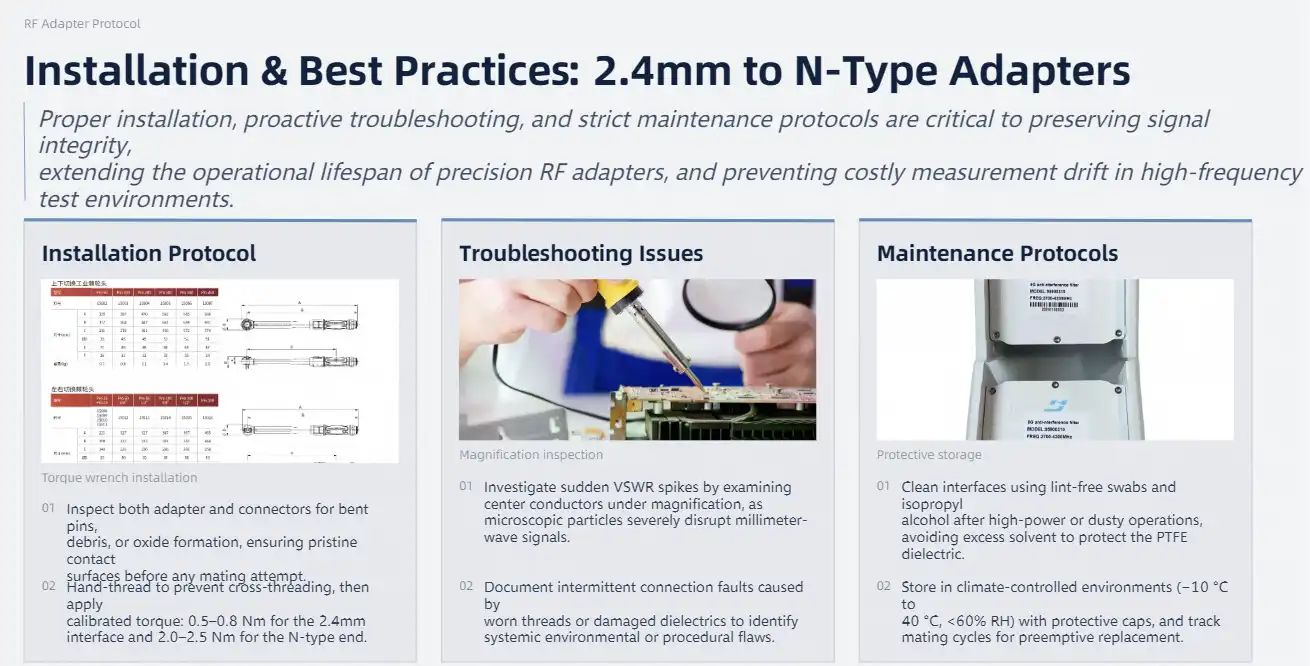
First, look over both the 2.4 male to N female adapter and the connectors that fit it. Check to see if the 2.4mm center pin is bent or discoloured, and make sure the N-type threads are clean and not damaged. If there is oxide formation, debris, or physical deformities, they need to be cleaned or replaced before the process can continue. Carefully line up the adapter with the plug that goes with it, and then thread it by hand until you feel resistance (finger-tight). This step of hand-tightening stops cross-threading, which can damage precision threads permanently. Apply the required torque with a calibrated torque wrench. For the 2.4mm interface, use 0.5 to 0.8 Nm of torque, and for the N-type end, use 2.0 to 2.5 Nm. When these values are exceeded, the interface deforms, and the mating cycle life is shortened. On the other hand, when torque levels are too low, contact is sporadic, which shows up as measurement instability.
Troubleshooting Common Installation Issues
Any sudden rises in VSWR after installing an adapter are usually a sign of either not enough mating force or contamination of the center wire. Take the adapter off and look closely at the contact areas with a magnifying glass. At millimeter-wave frequencies, even tiny particles can mess up the signal. Damaged center pins or poor dielectric materials can cause signal attenuation that goes beyond what is specified in the document. This means that the adapter needs to be replaced. Connections that show up and disappear when the cable moves show that the mating threads are either too weak or worn out. Carefully write down these mistakes because trends may show that there are ongoing problems with the installation process or the surroundings.
Maintenance Protocols for Long-Term Reliability
Use lint-free swabs lightly moistened with isopropyl alcohol to clean the adapter interfaces every time you use them in high-power situations or dusty places. Do not use too much solvent, as it can move into the dielectric and hurt its performance. Let the adapter dry completely in the air before putting it away. Keep adapters in a controlled environment that is between -10°C and 40°C and has a relative humidity (RH) of less than 60%. It is best to store them in individual protection caps or shielded cases to keep them from breaking by accident. Keep a usage log that tracks mating cycles. When the rated cycle life is getting close, change the mating components before they stop working as well. This preventative method avoids the costly downtime and measurement errors that come with adapter failures that aren't planned.
Conclusion
Investing in high-quality RF adapters is a smart way to ensure accurate measurements and reliable operations. The performance benefits—better signal quality, longer service life, and lower total cost of ownership—far outweigh the small price premium over generic options. These connections are very important for companies that work on the cutting edge of 5G, satellite communications, or precise test and measurement. They keep the signal paths safe. When system downtime costs thousands of dollars an hour and measurement errors have a direct effect on product quality, it's not a choice but to use adapters that are built to the greatest standards. It's just good business sense.
FAQ
Can I use this adapter for both 5G base station testing and laboratory vector network analyzer measurements?
Of course. These 2.4 male to N female adapters can work with frequencies from DC to 50 GHz and have a low VSWR, so they can be used in both the field and the lab, as long as you choose one that will last in the environment you'll be working in.
What factors most significantly influence signal loss in these adapters?
The quality of the materials is very important. Gold-plated beryllium copper center conductors and PTFE dielectrics keep loss to a minimum, and the right installation torque makes sure that the metals always touch each other. A very important factor is also how well the manufacturing process keeps the 50Ω impedance throughout the transition.
Where should I source certified adapters to ensure authenticity?
You should only buy from well-known companies or their authorised dealers. Ask for conformance papers and make sure that the test data includes measures of VSWR and insertion loss that can be linked to national standards. Suppliers with a good reputation offer technical support and warranties that fake goods can't match.
How do I know when an adapter has reached the end of its service life?
Keep an eye on how VSWR and insertion loss change over time. Sudden changes that are more than 10% of the standard numbers are a sign of decline. If you look closely and see thread wear, center pin deformation, or metal damage, you should also replace it.

Partner with Chuangyu for Premium RF Interconnect Solutions
Leading companies in the semiconductor, medical devices, photovoltaic testing, telecommunications, and more trust Shaanxi Chuangyu Electronic Technology to provide them with high-quality millimeter-wave adapters. Our factory in Xi'an has ISO-certified quality control and can quickly fill orders, helping customers from the development of prototypes to high-volume production. The 2.4 male to N female adapter line from Chuangyu has gold-plated beryllium copper contacts, PTFE dielectrics, and passivated stainless steel construction. It can meet the high-performance needs of 5G infrastructure and lab test systems. To keep inventory costs as low as possible, purchasing managers benefit from volume discounts, technical advice from experienced RF engineers, and faster shipping. Find out why organisations all over the world trust Chuangyu as their go-to 2.4 male to N female adapter manufacturer for mission-critical RF systems by contacting our team at chuangyuwz01@cymicrowave.com to talk your unique application needs.
References
1. Smith, D.R., & Johnson, P.A. (2021). High-Frequency Connector Technology for 5G and Millimeter-Wave Applications. IEEE Press.
2. Thompson, M.L. (2020). RF and Microwave Transmission Line Components: Design and Performance. Artech House Publishers.
3. Zhang, W., & Kumar, R. (2022). "Material Selection and Signal Integrity in Precision RF Adapters," Journal of Electronic Materials, 51(4), 1823-1837.
4. Anderson, K.T. (2019). Practical RF System Design and Analysis: A Guide for Engineers. Wiley-IEEE Press.
5. Liu, H., & Patel, S. (2023). "Total Cost of Ownership Analysis for High-Frequency Test Infrastructure," IEEE Transactions on Instrumentation and Measurement, 72, 1-12.
6. Brown, E.J. (2020). Connector Reliability in Harsh Environments: Engineering Principles and Best Practices. McGraw-Hill Education.