- English
- French
- German
- Portuguese
- Spanish
- Russian
- Japanese
- Korean
- Arabic
- Greek
- German
- Turkish
- Italian
- Danish
- Romanian
- Indonesian
- Czech
- Afrikaans
- Swedish
- Polish
- Basque
- Catalan
- Esperanto
- Hindi
- Lao
- Albanian
- Amharic
- Armenian
- Azerbaijani
- Belarusian
- Bengali
- Bosnian
- Bulgarian
- Cebuano
- Chichewa
- Corsican
- Croatian
- Dutch
- Estonian
- Filipino
- Finnish
- Frisian
- Galician
- Georgian
- Gujarati
- Haitian
- Hausa
- Hawaiian
- Hebrew
- Hmong
- Hungarian
- Icelandic
- Igbo
- Javanese
- Kannada
- Kazakh
- Khmer
- Kurdish
- Kyrgyz
- Latin
- Latvian
- Lithuanian
- Luxembou..
- Macedonian
- Malagasy
- Malay
- Malayalam
- Maltese
- Maori
- Marathi
- Mongolian
- Burmese
- Nepali
- Norwegian
- Pashto
- Persian
- Punjabi
- Serbian
- Sesotho
- Sinhala
- Slovak
- Slovenian
- Somali
- Samoan
- Scots Gaelic
- Shona
- Sindhi
- Sundanese
- Swahili
- Tajik
- Tamil
- Telugu
- Thai
- Ukrainian
- Urdu
- Uzbek
- Vietnamese
- Welsh
- Xhosa
- Yiddish
- Yoruba
- Zulu
When selecting a GPO coaxial connector test probe for high-frequency RF applications, understanding the technical specifications, structural integrity, and application compatibility becomes paramount. These specialized test probes serve as critical links between measurement equipment and devices under test, particularly in environments demanding precision signal transmission up to millimeter-wave frequencies. Before committing to a purchase, R&D engineers and procurement managers should evaluate impedance matching capabilities, frequency response characteristics, material durability, and supplier credentials to ensure the probe aligns with specific testing requirements while delivering long-term reliability and measurement accuracy.
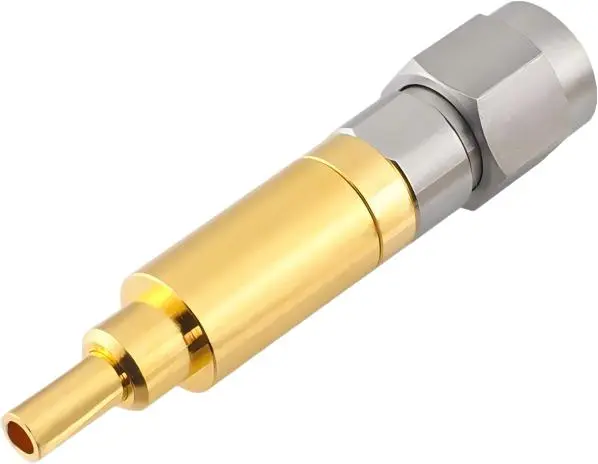
Key Factors to Consider Before Purchasing GPO Coaxial Connector Test Probes
Technical details need to be carefully looked over before choices about buying are made. Probes that aren't matched up correctly can lead to wrong measurements, damage to sensitive test points, or failure too soon under heavy use.
Frequency Range and Impedance Matching Requirements
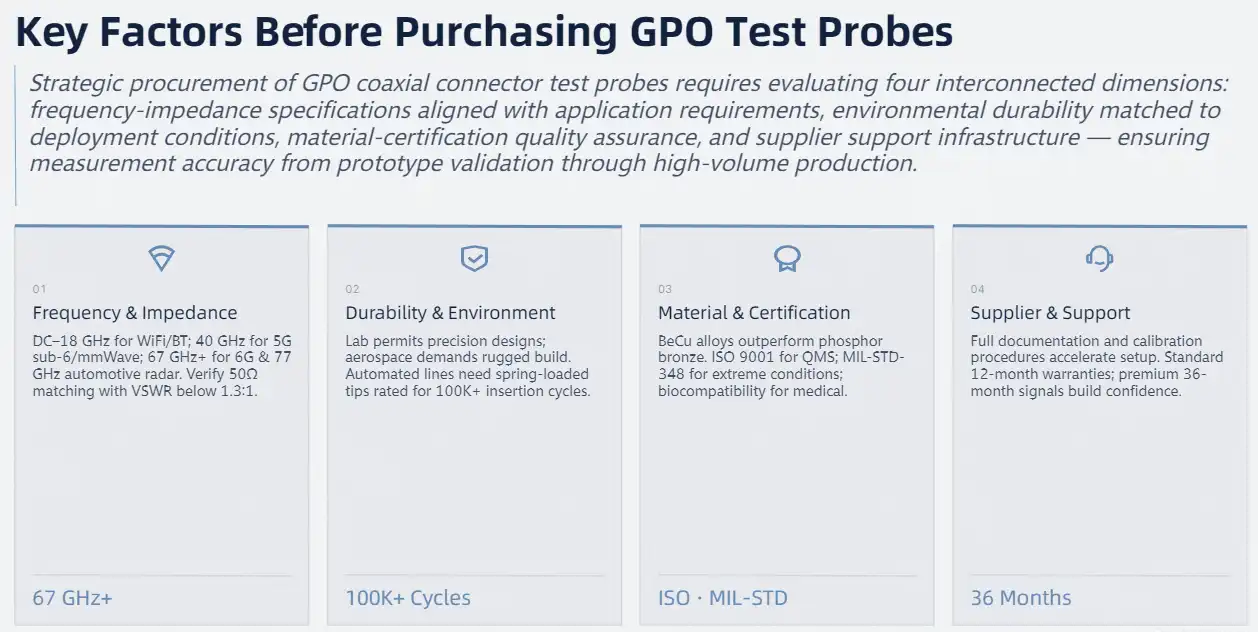
The frequency response features of a GPO coaxial connector test probe tell you if it is right for your testing needs. Probes for beginners may be able to cover DC to 18 GHz, which is enough for checking WiFi and Bluetooth modules. Mid-range probes can reach up to 40 GHz and can be used for 5G sub-6GHz and mmWave applications. Premium probes can reach 67 GHz or higher, which is needed for research into the next generation of 6G, 77 GHz radar systems for cars, and parts of satellite communications.
The validity of a measurement is directly affected by how well the impedance matches up. In most RF applications, the characteristic impedance is 50 ohms, but 75 ohms are used in some specialised systems. Make sure that the probe's impedance specs match those of your test tools and the device being tested so that the VSWR (Voltage Standing Wave Ratio) stays below acceptable levels, usually 1.3:1 or better across the frequency range.
Application-Specific Durability and Environmental Considerations
Conditions in the lab are very different from those in the field for testing or on automated production lines. Labs that keep the temperature stable and don't shake much let you use tiny tools that are designed for accurate measurements. For testing in the field in aircraft or the car industry, the design needs to be tough enough to handle high temperatures, mechanical shock, and environmental contaminants.
Automated test equipment needs probes that can be inserted and removed hundreds of thousands of times without losing their effectiveness. In high-cycle applications, spring-loaded contact mechanisms and hardened probe tips make the device last longer. Probes with changeable tips are useful in production settings because they lower long-term costs when the tips wear out.
Material Quality and Certification Standards
Material specifications have a direct effect on how long a probe lasts and how stable its performance is. Beryllium copper alloys have the best spring properties and conductivity, but some manufacturers use phosphor bronze instead because it's cheaper, but the performance is worse. The starting cost and useful life of gold plating are both affected by its thickness. Thicker plating lasts longer without wearing down, but it costs more in materials.
Certifications in an industry back up claims of quality and ensure consistent production. Systematic quality management is shown by ISO 9001 approval, and performance under tough conditions is checked by military standards like MIL-STD-348. When testing implantable devices or surgical instruments, companies that make medical devices should make sure that probes meet the necessary biocompatibility and sterilisation standards.
Evaluating Supplier Reputation and Support Infrastructure
Picking a supplier involves more than just looking at the product specifications. It also involves looking at things like expert help, warranty coverage, and long-term availability. Manufacturers who have been around for a while keep full product documentation, application notes, and calibration processes that make setting up and fixing problems faster.
The terms of the warranty show that the manufacturer trusts the product to work well. Standard 12-month warranties cover problems with the way the product was made, while 36-month warranties show that the product was built with the utmost care. Make it clear if guarantees cover normal wear and tear like probe tips or only major problems.
When measurement errors happen, or application-specific help is needed, how quickly technical support responds is very important. Suppliers who offer application engineering support help improve tool selection and integration, which cuts down on the need for expensive testing with products that don't work together.
Comparing GPO Coaxial Connector Test Probes: Making an Informed Choice
Figuring out the relative benefits of various probe designs and makers helps you make the best choice for your needs and your budget.
Technical Performance Benchmarking
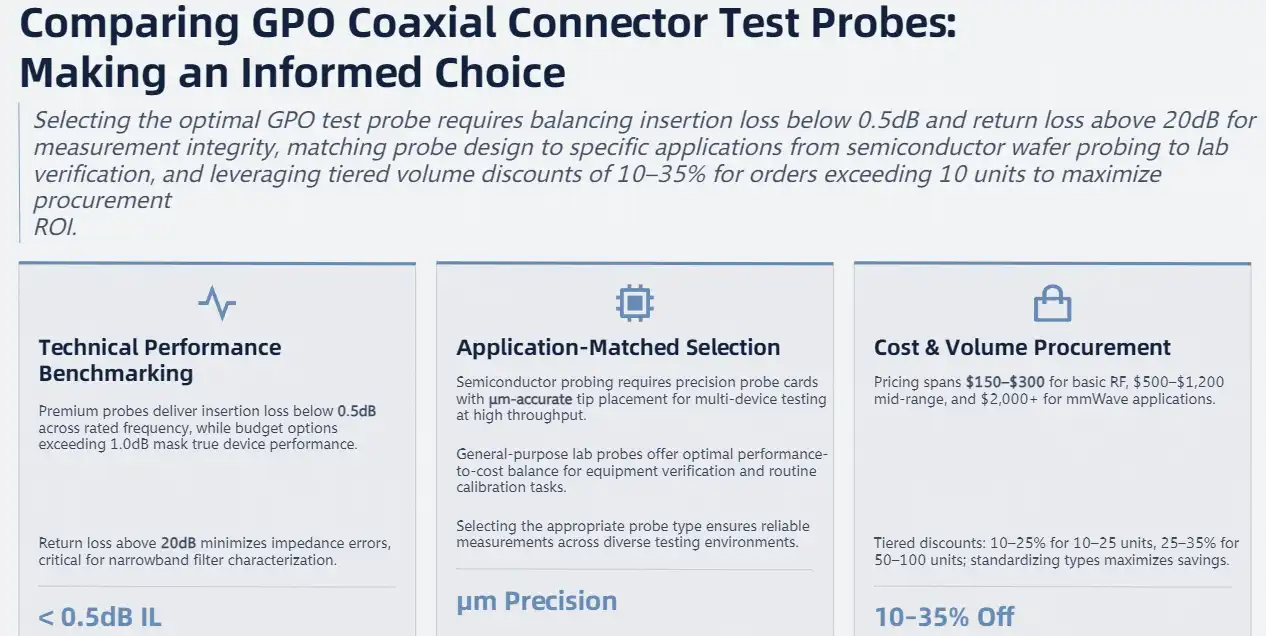
When comparing different products, insertion loss specifications show how the signal is weakened by the probe assembly. When measuring, high-quality probes have insertion loss below 0.5 dB across their rated frequency range, while low-cost probes may have insertion loss of 1.0 dB or higher, which could hide how well the device is working.
Specifications for return loss show how well the probe keeps impedance matching. Premium probes have return loss greater than 20 dB across their frequency range. This means that measurement errors caused by changes in resistance are kept to a minimum. When characterising narrowband filters or matching networks, it can be hard to use cheaper options with return loss of about 15 dB because they introduce more measurement variability.
Application-Matched Probe Selection Guidance
For semiconductor chip probing, you need special probe cards with tips that are placed exactly where the pads on the silicon dies are. These systems have several probes that can be placed accurately within micrometres. This lets several devices or differential signal pairs be tested at the same time. Cost per probe goes up a lot, which is explained by higher throughput in production testing.
When testing communication equipment in the lab, GPO coaxial connector test probe general-purpose probes that cover a wide range of frequencies and don't need to last too long are helpful. These probes are a good mix of performance and price. They provide accurate measurements that can be used for design verification and troubleshooting without the high costs that come with more specialised uses.
Cost Analysis and Volume Procurement Strategies
Prices for individual GPO coaxial connector test probes vary a lot depending on their frequency range, reliability, and where the maker stands in the market. Probes for simple RF work that are easy to use start at about $150 to $300 per unit. Each mid-range probe that covers a wide frequency range costs between $500 and $1,200. High-end millimetre-wave probes with very specific features cost more than $2,000 each.
When setting up multiple test stations or making inventory for production, volume buying deals cut per-unit costs by a large amount. Manufacturers usually offer tiered discounts, with 10–25% off for orders of 10–25 units, 25–35% off for orders of 50–100 units, and special prices for orders of 100 units or more. Using the same probe type for all test uses makes the most of volume discounts and makes training and maintenance easier.
How to Source and Procure GPO Coaxial Connector Test Probes for Your Business
Strategic buying methods make sure that products are real, that prices are fair, and that key test infrastructure parts can always be supplied.
Identifying Qualified Manufacturers and Distributors
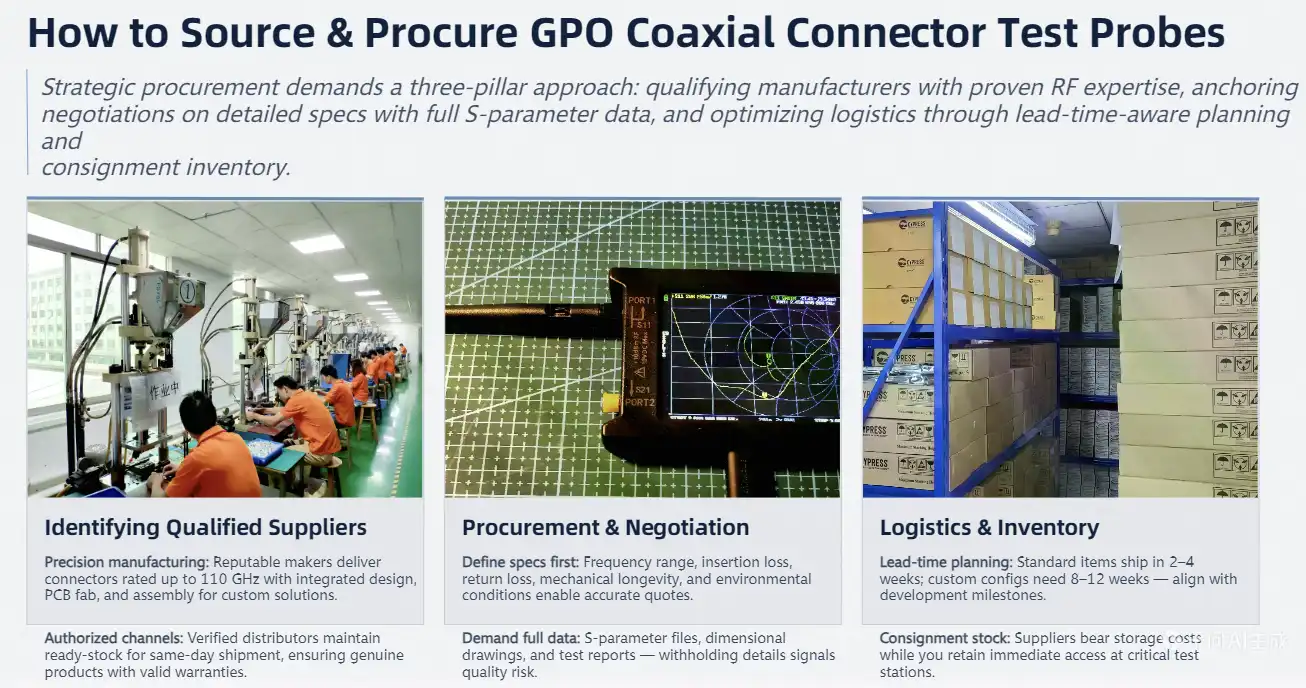
Reputable companies that make RF components have track records that go back decades, and their written technical standards are backed up by test data and application engineering support. Precision RF connectors and test tools are what companies like Chuangyu do best. Their goods meet international standards and can handle frequencies up to 110 GHz. They can do electronic design, PCB manufacturing, and assembly all at the same time, which lets them make custom solutions when standard catalogue products don't exactly meet the needs of an application.
Authorised distributors offer extra ways to get products, which is especially helpful for customers who need to buy a lot of different types of parts at once. When compared to direct manufacturer orders, distributors keep stock on hand so that items can be shipped right away. Check the status of the distributor's authorisation to make sure you're getting real products with valid warranties and not fake ones from the grey market whose origins you can't be sure of.
Procurement Process and Negotiation Tactics
Before price negotiations start, technical specifications should be used to choose the first product. Write down in detail the frequency range needed, the limits of insertion loss and return loss, the expected mechanical longevity, and the working conditions in the surroundings. Specifications that are very specific allow for accurate quotes and keep disagreements about whether products delivered meet requirements from happening in the future.
Ask for technical data packages that include S-parameter files, dimensional drawings, material certifications, and test reports that show the product meets the requirements. Manufacturers with a good reputation always give this information; makers who don't want to share technical details raise quality issues. S-parameter data lets circuit design tools simulate the effects of probes, which lets users guess how well a measurement system will work before they buy the hardware.
Logistics Optimization and Inventory Management
When you buy something, the lead time affects the timing, especially for specialised high-frequency tools that are only made in small numbers. Standard catalogue items usually ship within two to four weeks from well-known manufacturers. Custom configurations, on the other hand, may need eight to twelve weeks for engineering, prototyping, and production. Schedule your purchases so that they fit around these dates, especially if you are helping with product development programs that have set due dates for milestones.
Strategies for stocking inventory weigh the costs of capital against the assurance of availability. Important test stations should have a safety stock to avoid downtime if probes fail without warning. Applications that aren't as important can go longer between replacements with little input in supplies. With consignment inventory programs, sellers pay less to store your goods while you get them right away, but you usually have to agree to a minimum number.
Troubleshooting and Maintaining Your GPO Coaxial Connector Test Probes
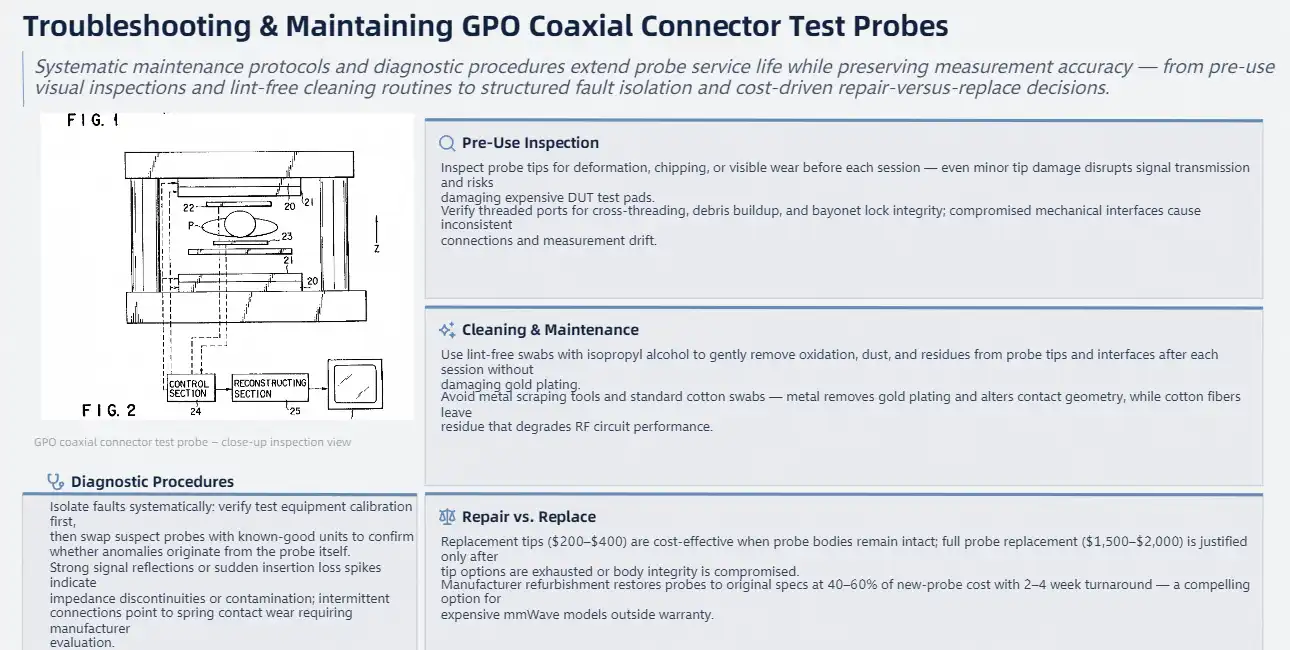
Systematic maintenance protocols and diagnostic procedures make sure that probes work for a longer time and keep measuring accurately throughout their service life.
Pre-Use Inspection Protocols
Each testing session for the GPO coaxial connector test probe should start with a visual inspection. This is especially important in production settings where probes are handled a lot. Check the tips of the probes for deformation, breaking, or wear that can be seen. Even small harm to the tip can stop signals from travelling and could hurt test spots on expensive devices. Gold finishing should look even, with no peeling or discolouration that could mean rust or contamination.
Threaded link ports need to be checked every so often for thread damage, excessive wear, or debris buildup. Cross-threading while connecting hurts both the tool and the equipment, leading to broken connections and inconsistent measurements. Bayonet mechanisms should lock securely without sticking or needing too much force, which means they are in good mechanical condition.
Maintenance Best Practices and Cleaning Procedures
Cleaning regularly stops the buildup of dirt and grime that slows down electrical performance and speeds up wear. Use lint-free swabs wet with isopropyl alcohol to gently clean the probe tips and connection interfaces after each testing session. This cleans the test point contact of oxidation, dust, and residues without damaging the gold plating or leaving fibre debris behind.
Do not use harsh cleaning methods that hurt delicate surfaces. When you scrape probe tips with metal tools, you remove the gold plating and change the shape of the contact areas. Standard cotton swabs have fibres that get caught on probe parts and leave behind residue that affects how well the electrical circuit works. Specialised RF cleaning swabs with tightly woven heads keep things from getting dirty while getting rid of debris effectively.
Diagnostic Procedures for Performance Issues
When measurement anomalies appear, systematic analysis separates whether probes, test equipment, or items under test cause problems. First, check the connections and calibration state of the test tools, as these are more likely to go wrong than probe flaws. Swap suspicious probes with known-good units to see if the problems stay, which would prove that the probes are to blame.
Strong signal reflections or sudden rises in insertion loss are signs of impedance discontinuities or contamination. Thoroughly clean probe and equipment interfaces, then retest. Persistent problems suggest internal probe damage requiring manufacturer evaluation or replacement. Intermittent links point to mechanical wear in spring contacts or loose component assembly.
When to Repair Versus Replace
Economic analysis helps people decide whether to fix something or replace it. Replacement probe tips for high-end types may cost $200 to $400, which is a reasonable price to pay if the probe bodies can still be used. Full probe replacement at $1,500 to $2,000 only makes sense after tip replacement or when probe body integrity is compromised by mechanical damage.
Manufacturers that offer refurbishment services clean, replace, and mechanically inspect used probes to get them back to the way they were when they were first made. Usually, the cost of refurbishment is between 40 and 60% of the price of a new probe. This is a good deal for expensive millimeter-wave models when damage caused by the customer is not covered by the guarantee. With turnaround times of two to four weeks, backup probes must be available to keep production running smoothly.
Conclusion
To choose the right RF test probes, you have to weigh the technical specs against the needs of the application, your budget, and the skills of the provider. Knowing how probes are made, the properties of the materials they're made of, and how well they work lets you make smart choices about which tools to use for different testing tasks. Paying close attention to things like frequency range, impedance matching, durability needs, and supplier credentials can help you avoid mistakes that cost a lot of money and guarantee accurate measurements and reliable operations. Systematic upkeep and troubleshooting processes make probes last longer, which increases the value of investments in these important test infrastructure parts. When technical requirements and supplier evaluation are in sync, companies can measure things that help them come up with new ideas in areas like communications, automotive, aerospace, and emerging technologies.
FAQ
What frequency range should I choose for GPO coaxial connector test probes?
Choose the probe frequency range based on the highest frequency that your devices can work at plus a small amount. Probes that cover DC to 6 GHz are enough for checking WiFi and Bluetooth. 5G millimeter-wave applications need to be able to work at 40 GHz or higher. Probes that can handle at least 80 GHz are needed for testing automotive radar at 77 GHz. Picking probes with a frequency range that is too wide adds to the cost without adding any usefulness to the measurement.
How often should RF test probes be calibrated?
How often calibration is done depends on how often the application is used and how important it is. Calibration every three months is helpful in production areas that are used every day. Lab instruments used for research may only need to be calibrated once a year. Always recalibrate after the probes feel a mechanical shock, you get strange measurement results, or the manufacturer-recommended time has passed. For quality system compliance, keeping calibration records shows how measurements can be tracked.
Can I use the same probe for different impedance systems?
Probes are made to work with a certain characteristic impedance, which is usually 50 ohms for RF applications and 75 ohms for video systems. When you use probes with different impedances, reflection errors happen that mess up your measurements. Always check that the impedance of the probe matches that of the test tools and the object being tested. There are impedance conversion adapters, but they add extra loss and could make calibration more difficult.

Partner with Chuangyu for Premium RF Test Solutions
Chuangyu is an expert at engineering high-precision radio frequency parts, such as high-frequency test tools that can work with frequencies up to 110 GHz. Our factory in Xi'an combines advanced production techniques with strict quality control to make products that meet international standards for the defence, medical, communications, and photovoltaic industries. As a reliable company that makes GPO coaxial connector test probes, we offer unique options when standard goods don't quite meet your needs. Our technical team can help you with application engineering, which means they can help you choose the right probes and make sure they work well with your other hardware. Email us at chuangyuwz01@cymicrowave.com to talk about your needs and get detailed information about our wide range of probes.
References
1. Smith, J. R. (2021). High-Frequency Connector Technology: Design and Applications for RF and Microwave Systems. Boston: Technical Publishing International.
2. Anderson, M. K., & Chen, L. (2020). "Impedance Matching Techniques in Millimeter-Wave Test Instrumentation." Journal of RF Engineering and Testing, 45(3), 178-194.
3. Williams, P. D. (2022). Precision Test Probing for Semiconductor Applications: Materials, Methods, and Best Practices. San Jose: Electronics Industry Press.
4. European Microwave Association (2021). "Standards and Guidelines for RF Connector Performance Verification." EMA Technical Report TR-2021-08.
5. Zhang, Y., & Thompson, R. A. (2020). "Material Selection Criteria for High-Reliability RF Contact Interfaces in Extreme Environments." IEEE Transactions on Components and Packaging Technologies, 38(7), 892-903.
6. International Electronics Manufacturing Initiative (2022). Best Practices Guide for RF Test Equipment Maintenance and Calibration. Arlington: IEMI Publications.