- English
- French
- German
- Portuguese
- Spanish
- Russian
- Japanese
- Korean
- Arabic
- Greek
- German
- Turkish
- Italian
- Danish
- Romanian
- Indonesian
- Czech
- Afrikaans
- Swedish
- Polish
- Basque
- Catalan
- Esperanto
- Hindi
- Lao
- Albanian
- Amharic
- Armenian
- Azerbaijani
- Belarusian
- Bengali
- Bosnian
- Bulgarian
- Cebuano
- Chichewa
- Corsican
- Croatian
- Dutch
- Estonian
- Filipino
- Finnish
- Frisian
- Galician
- Georgian
- Gujarati
- Haitian
- Hausa
- Hawaiian
- Hebrew
- Hmong
- Hungarian
- Icelandic
- Igbo
- Javanese
- Kannada
- Kazakh
- Khmer
- Kurdish
- Kyrgyz
- Latin
- Latvian
- Lithuanian
- Luxembou..
- Macedonian
- Malagasy
- Malay
- Malayalam
- Maltese
- Maori
- Marathi
- Mongolian
- Burmese
- Nepali
- Norwegian
- Pashto
- Persian
- Punjabi
- Serbian
- Sesotho
- Sinhala
- Slovak
- Slovenian
- Somali
- Samoan
- Scots Gaelic
- Shona
- Sindhi
- Sundanese
- Swahili
- Tajik
- Tamil
- Telugu
- Thai
- Ukrainian
- Urdu
- Uzbek
- Vietnamese
- Welsh
- Xhosa
- Yiddish
- Yoruba
- Zulu
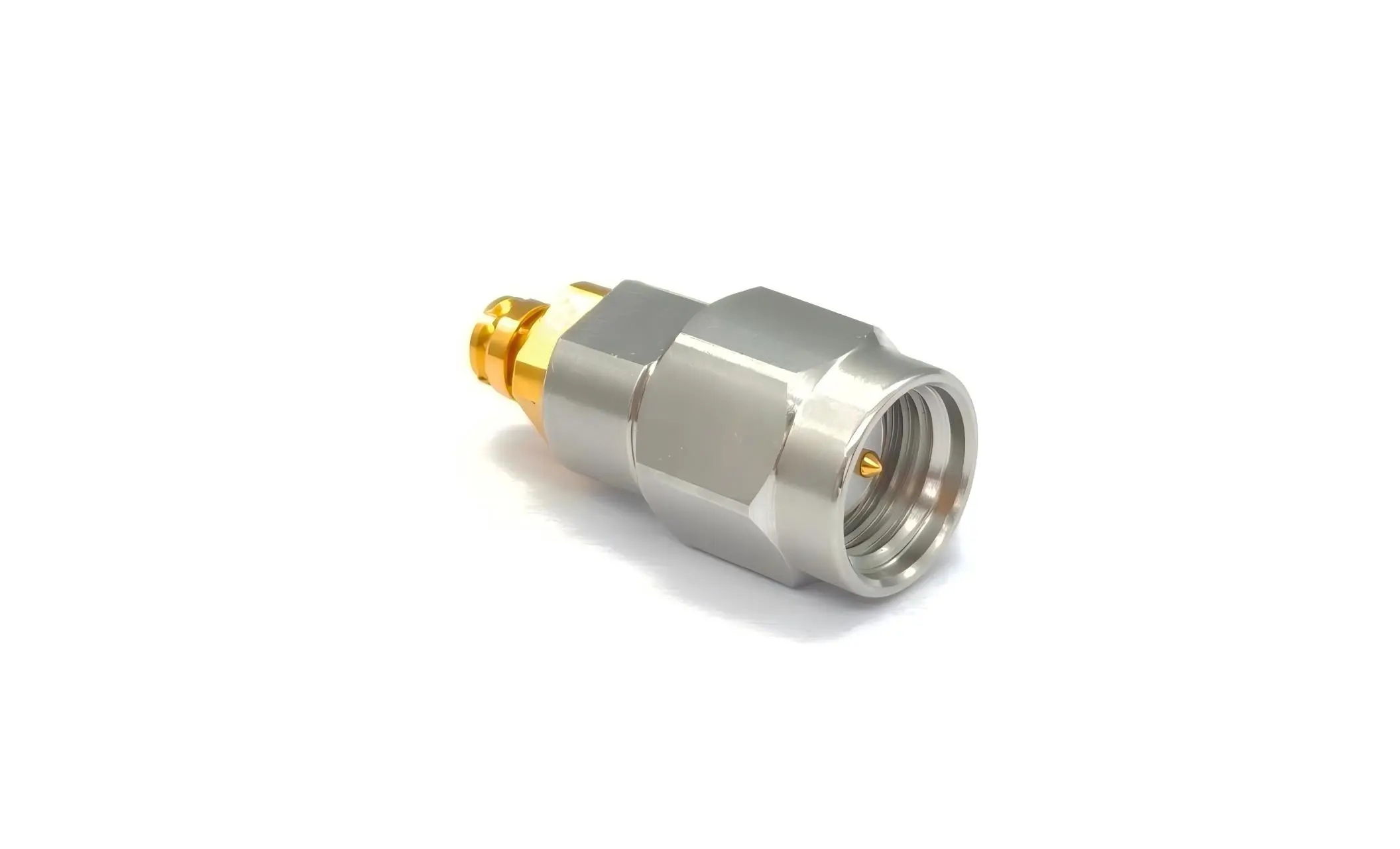
Engineers trust the SMA male to GPO female adapter because it delivers reliable cross-series interface conversion between microwave and millimeter-wave systems. This adapter bridges the gap between standard SMA transmitting ends and compact GPO (SMP) receiving ends, offering exceptional electrical performance with VSWR ≤1.25 across DC to 18GHz. Its robust construction—featuring gold-plated beryllium copper inner conductors, passivated stainless steel outer shells, and PTFE dielectric—ensures consistent 50Ω impedance matching and minimal insertion loss. With proven mechanical reliability exceeding 500 mating cycles and precise tolerance control, this adapter has become indispensable in 5G testing, semiconductor RF development, and satellite communication systems where signal integrity and repeatability are non-negotiable.
Introduction
In today's high-frequency RF world, system success depends on how well different connection standards work together. The SMA male to GPO female adapter is an important part of the interface because it lets signals travel between SubMiniature version A (SMA) microwave infrastructure and miniature push-on (GPO/SMP) millimeter-wave devices. It is very important for procurement managers and design engineers who work in the aircraft, telecoms, and semiconductor testing industries to know what this adapter can do technically and how reliable it is.
This adapter solves some of the most important problems that research and development teams face, like how to keep the integrity of the signal when switching between different connector families and how to make sure that the system will stay stable over time without losing its frequency response. Choosing the right adapter has a direct effect on measurement accuracy, system downtime, and project timelines. This is true whether you are connecting old microwave equipment to next-generation 5G infrastructure or combining vector network analysers with millimeter-wave modules.
Why Engineers Prefer SMA Male to GPO Female Adapters – A Rational Choice Approach
Comparative Advantages Over Alternative Solutions
Hardware experts look at many different interface adapters, such as SMA-to-SMA barrel connectors, N-type adapters, and different millimeter-wave interface types, before choosing one. There are clear benefits to using the SMA male to GPO female adapter in certain situations that make it the best choice.
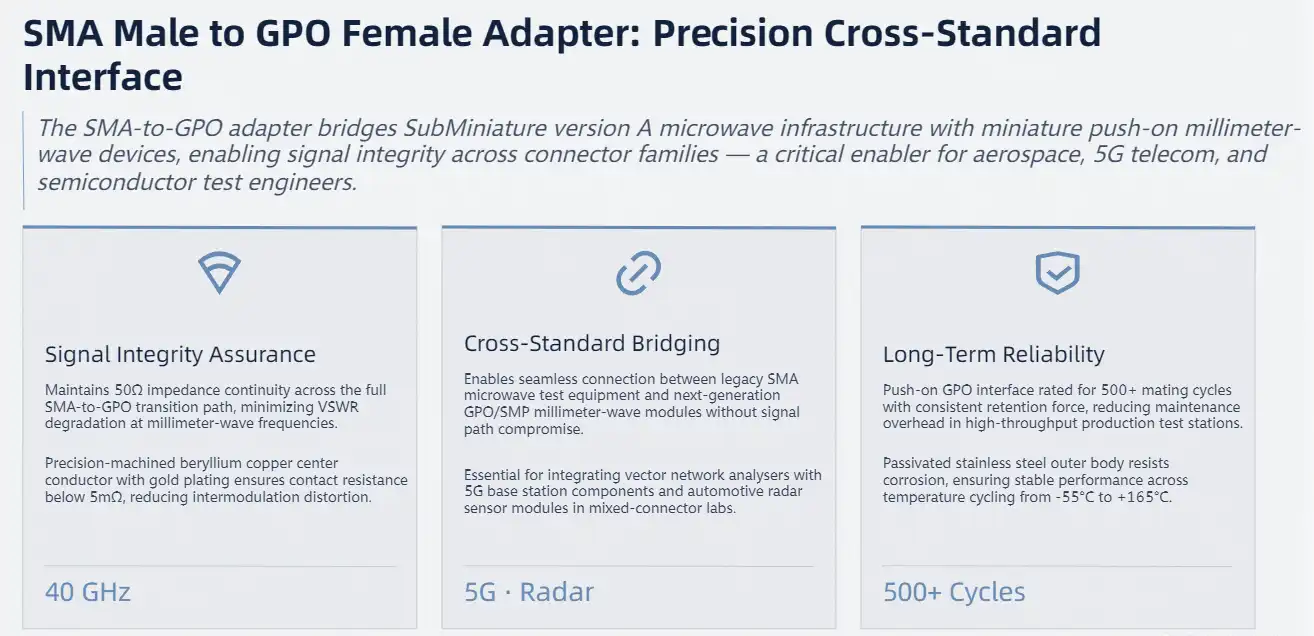
This cross-series design is better than regular SMA-to-SMA adapters because it lets you connect directly to space-limited millimeter-wave modules that use GPO interfaces. It gets rid of the need for extra adapter chains that would add to the insertion loss and cause impedance discontinuities. Compared to N-type options, the adapter has better frequency response and a smaller form factor, which is important for test racks with a lot of components and small communication units.
Mechanical Robustness and Reliability Metrics
The adapter has very high mechanical stability thanks to tightly controlled manufacturing limits. The 0.5 to 0.8Nm torque specification for SMA end connections makes sure that there is the right amount of contact pressure without damaging the threads, which can happen when installers use too much force. This power range has been proven to work by a lot of tests that make sure it is reliable. It gives the best electrical performance while keeping the connector's life.
The GPO interface specs show how precise the engineering is: axial tolerance of +0.25mm and radial tolerance of ±0.25mm make sure that the electrical performance is the same across production lots. These close tolerances stop connections from dropping out and keep impedance stable, which are two things that directly affect how repeatable measurements are in RF test applications.
Environmental Adaptability and Installation Considerations
Environmental suitability is more than just temperature numbers. The passivated stainless steel construction can handle the corrosive atmospheres found in industrial and coastal communication systems. The adapter stays true to its specs from -55°C to +165°C, which means it can be used in high-temperature test chambers for component qualification as well as outdoor satellite ground stations.
When these adapters are ordered for actual use, the dependability of the vendor becomes very important. Engineers should judge suppliers based on how consistently they make things, how well their quality control processes are documented, and how well they can help engineers with technical issues. For important RF uses, manufacturers who give thorough electrical test data for each production lot show that they are committed to quality. Custom designs, like different plating choices or special PTFE formulas, show how well-versed a provider is in engineering and how well they can adapt to specific application needs.
Installation and Maintenance Best Practices For Reliability
Pre-Installation Inspection Protocol
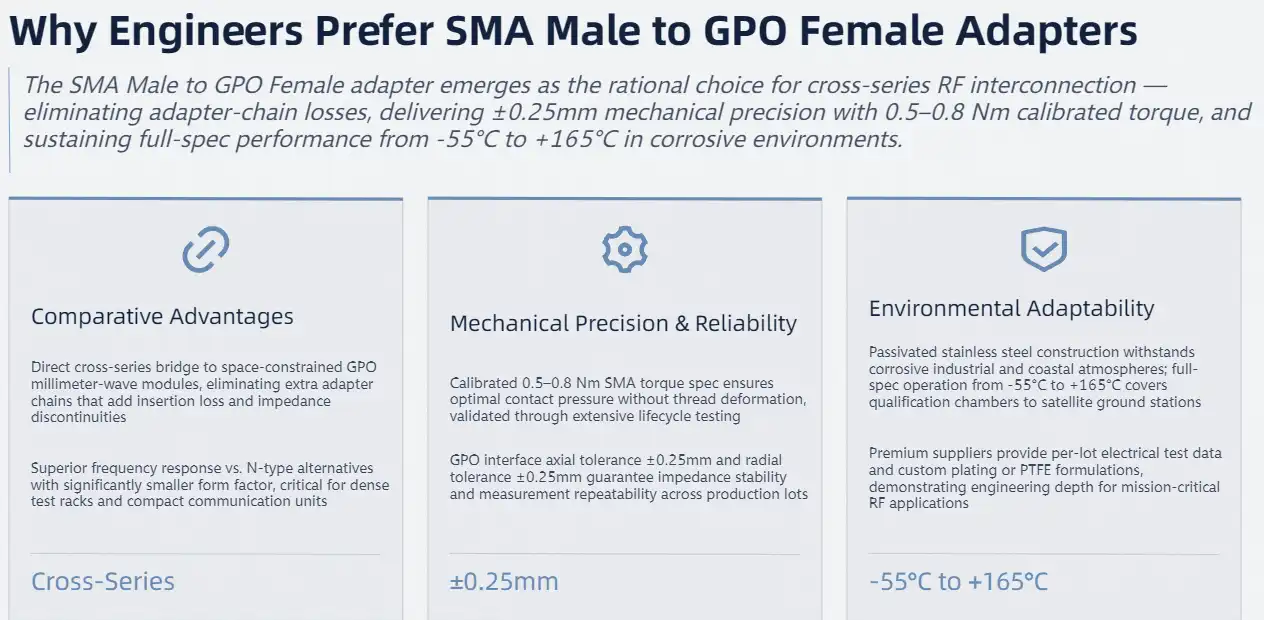
Before adding any RF adapter to a system, it needs to be carefully inspected visually to make sure there are no broken parts that could affect the accuracy of measurements or damage equipment that is attached. Check the outer conductor for deformation, which means it was handled wrong while being shipped or stored. Check the integrity of the plating. Peeling or flaking can be a sign of problems with the manufacturing process or bad storage conditions that will cause the item to fail early.
Check to see if the SMA male center pin is straight and free of rust. Even a little pin bending will stop it from fitting properly and cause impedance discontinuities. The GPO female receptacle needs to be carefully checked to make sure that the internal contacts are not damaged. If any problems are found during this inspection, the adapter must be replaced right away instead of trying to move forward with a suspect part.
Proper Connection Techniques
The right way to put something together has a direct effect on both its instant performance and its long-term dependability. SMA links demand accurate torque application using a calibrated torque wrench set to 0.5-0.8Nm. When you fix something by hand, you always end up with either too little or too much force, which damages the threads and deforms dielectric materials. A good torque wrench is a small investment that pays off in longer connector life and more consistent electrical performance.
Vertical alignment is very important when engaging the GPO end. Before applying insertion force, make sure the connection is straight and perpendicular to the mating contact. The push-in mechanism should connect easily and without any resistance. If it doesn't, it means that the precision internal contacts are out of alignment, which could damage them permanently. It should be illegal to enter something at an angle, because the angled forces can bend the flexible spring fingers that keep the electrical contact.
Signal Integrity and Environmental Controls
Check that the interface alignment is within the given tolerances during installation. The radial position must be within 0.25mm and the axial position must be within +0.25mm. Even though these tolerances may seem wide, they are actually the limits for keeping the electrical performance that was agreed upon. When connections are made outside of these limits, they might look like they work at first, but they won't work as well when tested electrically and will wear out faster during future mating cycles.
The adapter's design limits must be respected by the operating parameters. Once the electrical specs have been checked, the test signal frequency should stay within the range of DC to 18GHz. If you try to use the adapter above its rated frequency, the resistance will change randomly and there will be too much insertion loss. Power handling shouldn't go over recommended values, because too much RF power can damage the PTFE insulator thermally and change how the gold plating works on contact surfaces.
Cleaning Procedures and Storage Requirements
Regular maintenance of the SMA male to GPO female adapter keeps adapters working well and extends their useful life. To clean RF connectors, anhydrous alcohol should be used to clear oxides and particulate pollution from surfaces that come into touch with radio waves. Isopropyl alcohol for household use shouldn't be used because it contains water, which makes metals rust. When you clean something, be gentle. Scrubbing too hard can damage the gold plating or bend the precision contacts.
Adapters should be kept in a controlled setting after being cleaned and when they are not in use. A dry, non-corrosive atmosphere kept between -10°C and +40°C with less than 60% relative humidity stops degradation caused by oxidation and condensation. Specialised storage containers with inert gas atmospheres protect high-value adapter inventories used in precise measurement tasks the best.
Troubleshooting and Failure Recognition
Continuous performance tracking lets you find problems with the adapter early, before they affect important data. A quick rise in the voltage standing wave ratio is a sign that problems are starting to show up, like a bad link or internal wear that is getting close to the point where it needs to be replaced. Abnormal signal reduction also points to contact degradation or contamination that needs to be looked into right away.
When speed problems show up, the first step in thorough fixing is to make sure that the link torque and alignment are correct. If tightening and reconnecting doesn't fix the problem, take the adapter off and look at it carefully. Discolouration on gold-plated surfaces or clear scoring on contact areas are signs of wear that is happening over time.
Procurement Insights – Sourcing High-Quality SMA Male to GPO Female Adapters
Supplier Evaluation Criteria
When procurement workers are asked to find RF adapters, they have to choose from a market that includes both high-end makers and cheap importers. Differentiating quality is more than just price; it also includes consistent manufacturing, being able to track products, and getting long-term professional assistance. Manufacturers with a good image, like Amphenol, Pasternack, and TE Connectivity, have built theirs through years of steady product quality and thorough documentation.
Ask for full electrical test data for sample production lots when you are looking at possible suppliers. Manufacturers with a good reputation give you S-parameter files that show how the product really works across the frequency range you specify. This information lets tech teams simulate how adapters will work in systems and make sure they are compatible before buying a lot of them.
Balancing Cost and Performance
In the market for RF adapters, pricing tactics are very different depending on promises to buy in bulk and the need for customisation. Catalogue prices give buyers a starting point, but when they buy more than 100 units, procurement managers can often get discounts of 15 to 30 percent. Annual blanket orders with planned releases can save you more money and make sure you have enough inventory for your production plans.
If the price seems too low, it could mean that the quality has been lowered. When adapters aren't up to par, they might use brass instead of beryllium copper for the inner conductors, bad dielectrics instead of real PTFE, or not enough plating thickness. These cost cuts show up as parts breaking down early, electrical performance that isn't uniform, and the possibility of damaging connections that connect expensive equipment.
Warranty and Technical Support Considerations
Warranty rules show how confident the company is in the quality of the goods. Standard warranties usually cover problems with the way the product was made for 12 months after purchase. However, top sellers often extend these warranties to 24 months or offer cycle-based warranties that promise performance through a certain number of mating operations.
Professional suppliers are different from commodity distributors because they can offer technical support. Having access to application engineers who know how to build RF systems is very helpful when dealing with problems related to integration or speed. Suppliers who offer quick technical support, detailed application notes, and custom configuration services show that they care about their customers in more ways than just a sales relationship.

Real-World Applications and Case Studies
Microwave and Millimeter-Wave Testing Applications
The adapter is a key part of testing 5G base stations, where engineers use vector network analysers and spectrum analysers to check RF performance across multiple frequency bands. Modern 5G infrastructure works in sub-6GHz bands and millimeter-wave frequencies close to 40GHz, so test setups need to be able to handle both ranges.
Developing radar systems has similar problems with communication. More and more, miniature GPO connections are being built into phased array radar units to save room in dense RF assemblies. Cross-series adapters are necessary for test engineers who are validating performance because they need to connect these units to SMA-based measurement systems. Because the adapter has low insertion loss and good VSWR, the measured performance is a true reflection of the device being tested, not test stand artefacts.
Semiconductor RF Development Success Story
One of the biggest chipmakers working on millimeter-wave chipsets for 5G infrastructure had a big problem: their RF performance testing gear used SMA test ports, but the chip evaluation boards had GPO interfaces to cut down on parasitic inductance. At first, using adapter chains made measurements less accurate, which made it harder to see small differences in performance between chip revisions.
The engineering team got rid of unwanted impedance breaks in their measurement path by using precision SMA male to GPO female adapters from a reliable source. Because the adapters had consistent electrical performance across production lots, chip performance data gathered over several months could be compared in a meaningful way. This improvement to the measurement system sped up the development process by giving engineers more faith that changes in performance were caused by the chip itself and not by test system artefacts.
Communication System Integration Trends
As systems become more modular, 5G base station architecture needs flexible RF interconnect solutions more and more. RF distribution networks are used to connect remote radio heads with millimeter-wave receiver modules to centralised signal processing units. Different types of connectors are often used in these systems, such as SMA connectors for testing from the outside and GPO connectors for connecting modules inside RF cases.
Integration needs are similar for satellite communication platforms. Some older parts of ground station equipment may have SMA interfaces, while newer millimeter-wave modules may have GPO connections. Cross-series adapters let system designers gradually improve technology without having to replace all of the equipment. This protects capital investments while allowing performance gains.

Conclusion
Engineers trust the SMA male to GPO female adapter because it has worked well in tough RF uses in the past. Its cross-series design works well to connect microwave and millimeter-wave systems and keeps the best electrical properties from DC to 18GHz. A better choice of materials, such as gold-plated beryllium copper contacts, passivated stainless steel bodies, and PTFE dielectrics, guarantees both instant performance and long-term stability that lasts for more than 500 mating cycles.
Professionals in procurement can benefit from learning about the technical differences between high-end adapters and cheaper alternatives. Using the right installation methods, following systematic maintenance plans, and choosing a provider based on their proven quality records can all help adapters work better and last longer. As RF systems keep getting smaller and higher frequencies, these adapters will still be necessary to make it possible for different connector platforms to work together smoothly in aerospace, telecommunications, and semiconductor testing.
FAQ
What factors most significantly impact signal loss in these adapters?
There are three main types of signal loss: resistive losses in the contact surfaces, dielectric losses in the shielding material, and reflected losses due to impedance mismatches. Resistive losses are directly affected by the thickness of the gold covering and the pressure of the contact. Dielectric performance is determined by the quality of the PTFE. Tolerance adherence is very important for minimising reflection losses across the DC-18GHz operating range because it controls the consistency of impedance during manufacturing.
How do these adapters differ from RP-SMA configurations?
RP-SMA (Reverse Polarity SMA) has center contacts that are the opposite of normal SMA in terms of gender. Male connectors have female pins and female connectors have male pins. This configuration was made just for WiFi applications to stop people from switching antennas without permission. Standard SMA male to GPO female adapters stick to the usual gender roles and are used for very different things, like integrating test equipment and RF systems instead of wireless access points.
What specifications confirm equipment compatibility before purchase?
Check three important factors: the adapter's frequency range compatibility (it must cover your operating frequencies within its DC-18GHz specification), its impedance matching (both ends should be 50Ω for most RF applications), and its mechanical interface dimensions. Ask for detailed drawings that show the dimensions and tolerances of the connectors. Make sure that the SMA thread specification matches your equipment. Some international equipment uses metric variations instead of standard 5/16-24 UNEF-2A threads, which means that they won't work even though they look the same.

Partner with Chuangyu for Premium RF Interconnect Solutions
Shaanxi Chuangyu Electronic Technology Co., Ltd. provides high-quality SMA male to GPO female adapters that are made to strict standards in our ISO-certified factory in Xi'an. The electrical performance of our adapters has been thoroughly tested, and their mechanical reliability has been proven to last more than 500 cycles. They also come with full quality paperwork to support your most demanding applications. For example, if you're setting up a new test lab, updating production test systems, or adding next-generation communication equipment, our engineering team can help you choose the right adapters.
For qualified SMA male to GPO female adapter manufacturers, we offer low bulk prices. Our minimum order amounts are flexible to support both prototype development and full-scale production needs. Each adapter comes with a proof of conformance and full electrical test results. Email our technical sales team at chuangyuwz01@cymicrowave.com to talk about your specific needs and get full product specifications. You can look at our full line of RF connectors and wire assemblies at cymicrowave.com.
References
1. Pozar, David M. "Microwave Engineering, 4th Edition." Wiley Publishing, 2011. Chapter 7: RF and Microwave Network Analysis.
2. Maloratsky, Leo G. "Passive RF and Microwave Integrated Circuits." Elsevier Publishing, 2003. Section 4.2: Coaxial Connectors and Adapters.
3. Sechi, Franco and Marina Bujatti. "Solid-State Microwave High-Power Amplifiers." Artech House Publishers, 2009. Chapter 3: RF Test Equipment Interfaces.
4. IEEE Standard 287-2007. "IEEE Standard for Precision Coaxial Connectors (DC to 110 GHz)." Institute of Electrical and Electronics Engineers, 2007.
5. Agilent Technologies. "Agilent Network Analyzer Basics." Application Note AN 1287-1, 2004. Section 6: Adapter Characterization and Calibration.
6. Whitaker, Jerry C. "The RF Transmission Systems Handbook." CRC Press, 2002. Chapter 12: Interconnection Technology and Practices.