- English
- French
- German
- Portuguese
- Spanish
- Russian
- Japanese
- Korean
- Arabic
- Greek
- German
- Turkish
- Italian
- Danish
- Romanian
- Indonesian
- Czech
- Afrikaans
- Swedish
- Polish
- Basque
- Catalan
- Esperanto
- Hindi
- Lao
- Albanian
- Amharic
- Armenian
- Azerbaijani
- Belarusian
- Bengali
- Bosnian
- Bulgarian
- Cebuano
- Chichewa
- Corsican
- Croatian
- Dutch
- Estonian
- Filipino
- Finnish
- Frisian
- Galician
- Georgian
- Gujarati
- Haitian
- Hausa
- Hawaiian
- Hebrew
- Hmong
- Hungarian
- Icelandic
- Igbo
- Javanese
- Kannada
- Kazakh
- Khmer
- Kurdish
- Kyrgyz
- Latin
- Latvian
- Lithuanian
- Luxembou..
- Macedonian
- Malagasy
- Malay
- Malayalam
- Maltese
- Maori
- Marathi
- Mongolian
- Burmese
- Nepali
- Norwegian
- Pashto
- Persian
- Punjabi
- Serbian
- Sesotho
- Sinhala
- Slovak
- Slovenian
- Somali
- Samoan
- Scots Gaelic
- Shona
- Sindhi
- Sundanese
- Swahili
- Tajik
- Tamil
- Telugu
- Thai
- Ukrainian
- Urdu
- Uzbek
- Vietnamese
- Welsh
- Xhosa
- Yiddish
- Yoruba
- Zulu
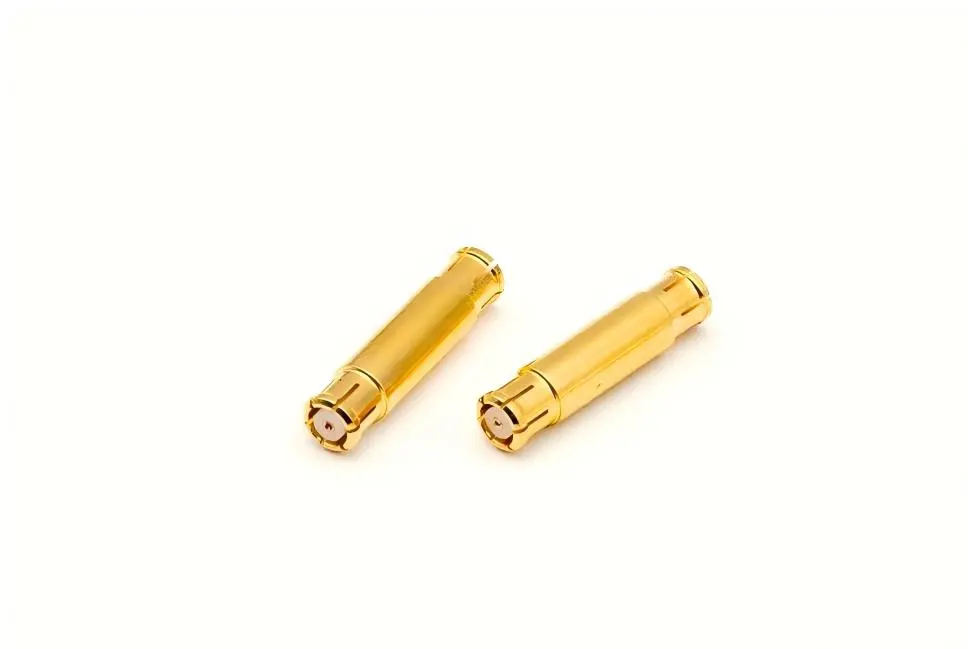
When sourcing high-frequency RF interconnect solutions, identifying a reliable ISO-certified supplier for female to female GPPO adapters becomes critical for procurement managers and R&D engineers. These precision components serve as micro-scale interface solutions in millimeter-wave systems, offering ultra-compact connectivity for next-generation communication equipment, phased array radars, and advanced testing instrumentation. Delivering proven performance across DC to 67GHz frequency ranges, these adapters integrate seamlessly into high-density layouts where space constraints and signal integrity are paramount.
How to Choose the Best Female to Female GPPO Adapter for Your Business Needs
Defining Application Requirements
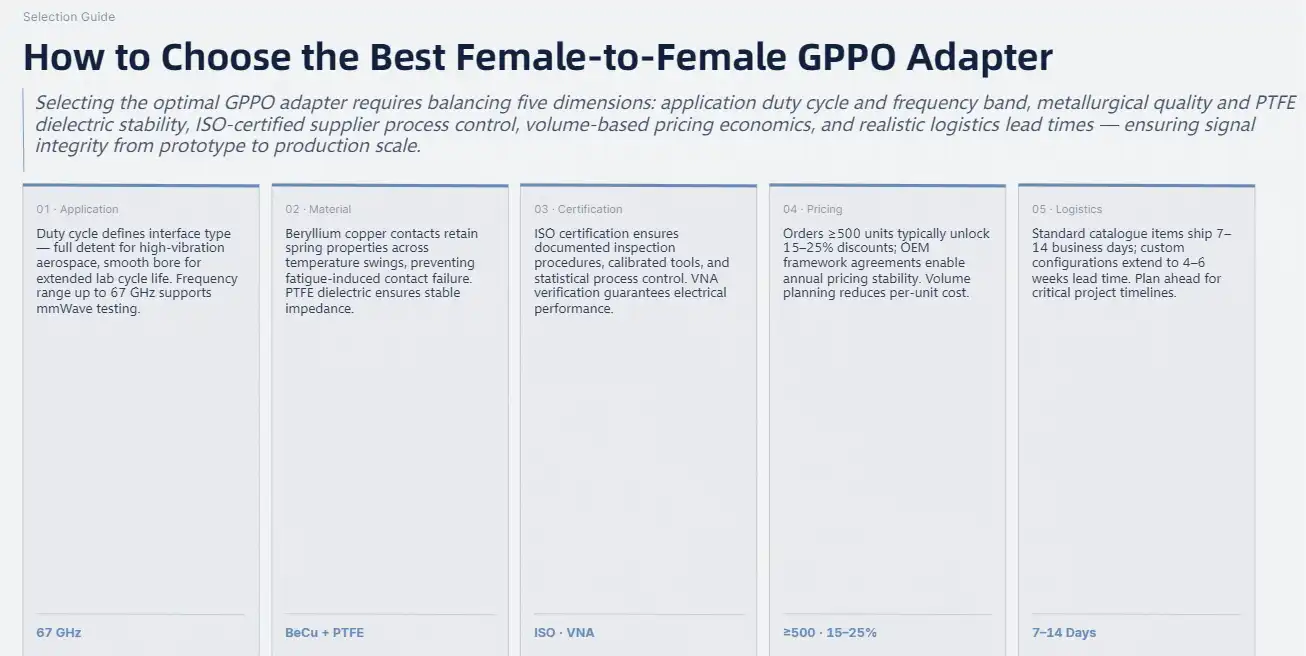
The selection process starts with a clear analysis of the working factors. Will the female to female GPPO adapter be used all the time in a work setting, or will it only be used sometimes for testing in the lab? Understanding the expected duty cycle affects the choice of interface type. For example, high-vibration aerospace applications may prefer full detent retention, while research facilities may prefer optical hole configurations for longer cycle life.
Planning for frequency is just as important. Even though 67GHz is the normal operating ceiling, telling suppliers the real working band helps them suggest the best plating thickness and dielectric specs. Systems that mostly work below 40GHz might be able to handle lower performance levels than systems that are pushing the limits of upper millimeter waves.
Material and Construction Considerations
Metallurgical features show how different the quality is. High-quality beryllium copper metals keep their springy properties even when the temperature changes a lot. This stops the contact damage that happens with cheaper materials. The thickness of the gold plate, which is usually given in microinches, is directly related to how long the insertion cycle lasts and how stable the contact resistance is. When it comes to plating, procurement teams should ask for specifications and make sure that they are met by military or aerospace standards.
The quality of the PTFE barrier affects both how well it conducts electricity and how well it keeps out water. High-quality PTFE formulations keep the dielectric constant stable even when the humidity changes, which is important for equipment used in warm or seaside areas.
Supplier Certification and Process Control
ISO approval means that quality management is being done in a planned way throughout the whole production process. Certified suppliers follow written inspection procedures, keep track of the calibration of measuring tools, and use statistical process control on important parameters. This framework cuts down on variation from batch to batch and lets you find the root cause of problems in the field.
Checking a supplier's testing skills is useful for more than just ISO compliance. Technical depth is shown by in-house environmental rooms, controlled impedance measurement tools, and vector network analysis equipment. When suppliers offer test data with unique serial numbers, they offer a level of accountability that is unmatched by generic datasheets.
Pricing Structures and Volume Economics
Unit costs change a lot depending on the size of the order, how the interface is set up, and how much customization is needed. Standard optical hole models usually have lower prices because they are easier to make. Full detent interfaces cost more because they need to be precisely calibrated for retention force. However, the mechanical performance is worth it.
Volume limits often let you get better prices. For example, orders of 500 or more units may get 15–25% off of sample amounts. When OEM customers sign framework agreements, they can discuss yearly prices with quarterly "true-up" clauses. This protects against changes in raw materials prices and ensures supply continuity.
Lead Time and the Truth About Logistics
Standard catalogue items usually ship between 7 and 14 business days for orders of less than 100 units. Lead times are extended to 4 to 6 weeks for custom setups that need special finishing or testing procedures. International shipments add to the time it takes to get from one place to another and the hassle of clearing customs. To make cross-border deals easier, experienced sellers work with well-known transportation companies that offer DDP (Delivered Duty Paid) terms.
Top 5 Female to Female GPPO Adapter Configurations: Performance and Value Breakdown
Market Demand Trends
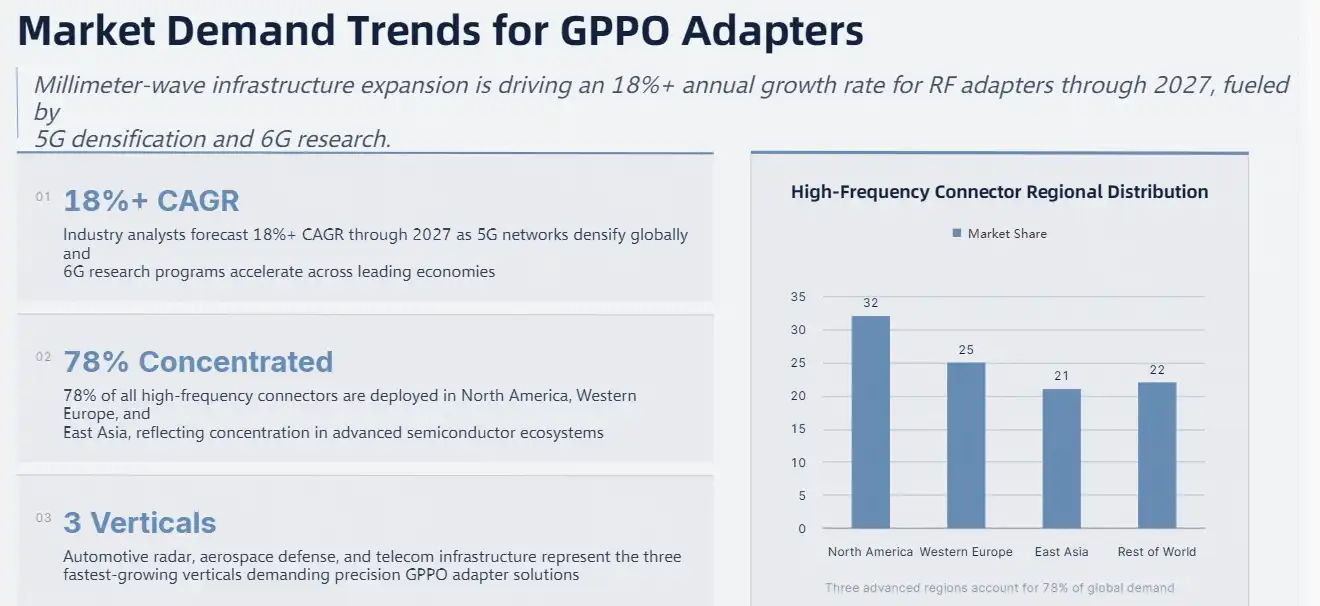
As millimeter-wave infrastructure grows around the world, more adapters are needed in the automotive, aerospace, and telecommunications industries. Analysts in the field predict that the industry will grow at a rate of more than 18% per year until 2027, as 5G networks become denser and research into 6G speeds up. Most of this growth is happening in places with advanced silicon ecosystems. For example, 78% of all high-frequency connectors used are in North America, Western Europe, and East Asia.
Configuration 1: Standard Optical Hole Interface
This workhorse configuration strikes a good mix between low cost and steady performance for lab use. The female to female GPPO adapter with an optical hole design can handle small changes in orientation while still providing more than 500 mating cycles. Labs that measure antenna patterns and describe filters, such as how flexible the parts are when they need to be set up again and again. At 100 pieces, the price runs between $45 and $65 per unit, making it the best value for testing settings that aren't very important.
Configuration 2: Full Detent Military-Grade Specification
Aerospace and defense companies use this ruggedized version for flying hardware and equipment that can be used in the field. According to MIL-STD-202 standards, the increased retention force can handle 20G shock loads and 15G random vibration profiles. The high-end building costs $85 to $120 per unit, but it is the most reliable option in harsh operating environments. Because of the special testing standards, getting this grade takes close to six weeks.
Configuration 3: Extended Frequency (DC-67GHz) Certified Variant
When funds for measurement uncertainty are limited, this carefully described form gives test results that can be linked to national standards. Each adapter comes with serialized S-parameter files that cover the whole frequency range. This makes it possible to de-embed measurements in complex calibration routines. The $95–$140 unit cost is worth it for research institutions and measuring labs because it makes calibration easier and boosts the trust of measurements.
Configuration 4: High-Cycle Optical Hole with Enhanced Plating
This design uses thicker gold plating and stronger contact geometry to handle production test situations that need thousands of insertions every year. Cycle life goes beyond 800 operations while still meeting specifications. These adapters are used on automated test equipment that works with millimeter-wave radar units by automotive tier-one suppliers and high-volume contract makers. Unit costs settle around $70 to $95, depending on commitments for volume.
Configuration 5: Compact Form Factor for Ultra-Dense Arrays
This low-profile design with a maximum diameter of 2.3mm works well for uses that need to save room, like satellite payloads and small beamforming networks. Because of the savings in dimensions, array geometries that aren't possible with standard footprints are possible. However, the specialized manufacturing costs an extra $110 to $155 per unit. Miniaturization has a strategic benefit that makes spacecraft builders and advanced radar makers willing to pay this price.
Procurement Guide: Buying, Bulk Orders, and Shipping Considerations for Female to Female GPPO Adapters
Sourcing Channels and Supplier Engagement
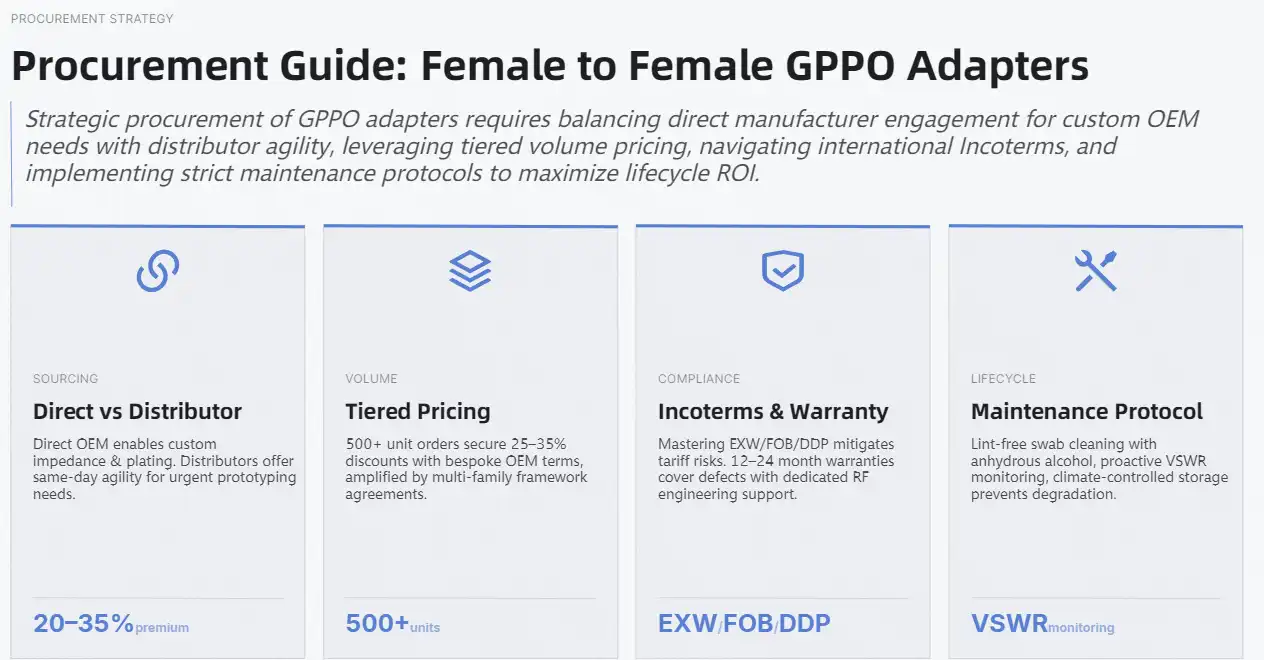
When OEM customers and system developers need a steady flow of parts, direct ties with manufacturers are the best way to go for the female to female GPPO adapter. Setting up a technical conversation during the quotation phase lets you talk about customization of plating requirements, testing procedures, and packaging formats. Manufacturers usually offer technical help for questions that are specific to an application, like impedance modeling, mating force analysis, and planning for outdoor approval.
Customers who need quick delivery of small amounts or a wide range of parts use distributor channels. While unit prices are 20–35% higher than what you'd pay directly from the maker, distributors keep extra stock on hand so that pressing orders can be shipped the same day. This extra cost is worth it when prototype deadlines are pushed back or when equipment breaks down and needs new parts right away.
Volume Pricing Dynamics
Structures with different levels of prices reward loyalty. Some examples of breakpoints are:
- 1-49 units: full list price applies; good for testing and evaluating on a small scale
- 50–199 units: 12–18% discount level, good for test production runs
- 200 to 499 units: 20 to 28 percent off, with annual maintenance spare pools
- 500 or more units: 25–35% discount level, with the option for unique terms that allow OEM production plans
Framework agreements that cover more than one family of products can give you more options than just volume discounts. When customers buy multiple cable assemblies, test probes and adapters at once, they have more negotiating power than when they buy just one product line.
International Logistics and Duty Considerations
When shipping female to female GPPO adapter goods around the world, the paperwork and customs clearance processes can be complicated. Known providers are familiar with Incoterms and can offer EXW (Ex Works) for customers who work with known freight forwarders, FOB (Free on Board) for those who are setting up ocean transport, or DDP (Delivered Duty Paid) for full delivery including duty payment. The second one makes budgeting easier by getting rid of tariff uncertainty.
For North American and European targets, air freight usually takes 5 to 8 working days. Ocean transport, on the other hand, can take 25 to 35 days, based on the pairs of ports. In cases of urgency, faster air services that arrive within 72 hours may be necessary, but freight premiums can be more than 300% of normal rates.
After-Sales Support and Warranty Provisions
Products from reputable sellers come with warranties that cover them for 12 to 24 months after the delivery date. Coverage usually includes flaws in the manufacturing process, like plating issues, nonconformance with dimensions, and early mechanical failure. However, damage from incorrect use or too many insertion cycles beyond what is recommended is not covered.
During warranty times, comprehensive providers offer application tech support to help customers fix problems with installation or performance. Having access to technical staff who are familiar with the ins and outs of RF measurement speeds up problem-solving compared to using standard customer service methods.
Maintenance and Longevity Optimization
Proper handling greatly increases the useful life of an item. RF cleaning swabs that are wet with anhydrous alcohol get rid of rust and particle contamination without hurting the gold plate. Stay away from cotton swabs that shed fibers and metal tools that scratch surfaces. During quiet times, connection integrity is maintained by storing them in controlled environments that are dry, temperature-stable, and away from corrosive atmospheres.
Monitoring performance indicators during normal use lets you replace parts before they break down badly. Sudden increases in VSWR or spikes in insertion loss are signs of contact problems that need to be looked at. Keeping a replacement collection based on how often things have failed in the past stops unexpected downtime in important test operations.
Why Trust an ISO-Certified Female to Female GPPO Adapter Supplier?
Certification Significance in Quality Assurance
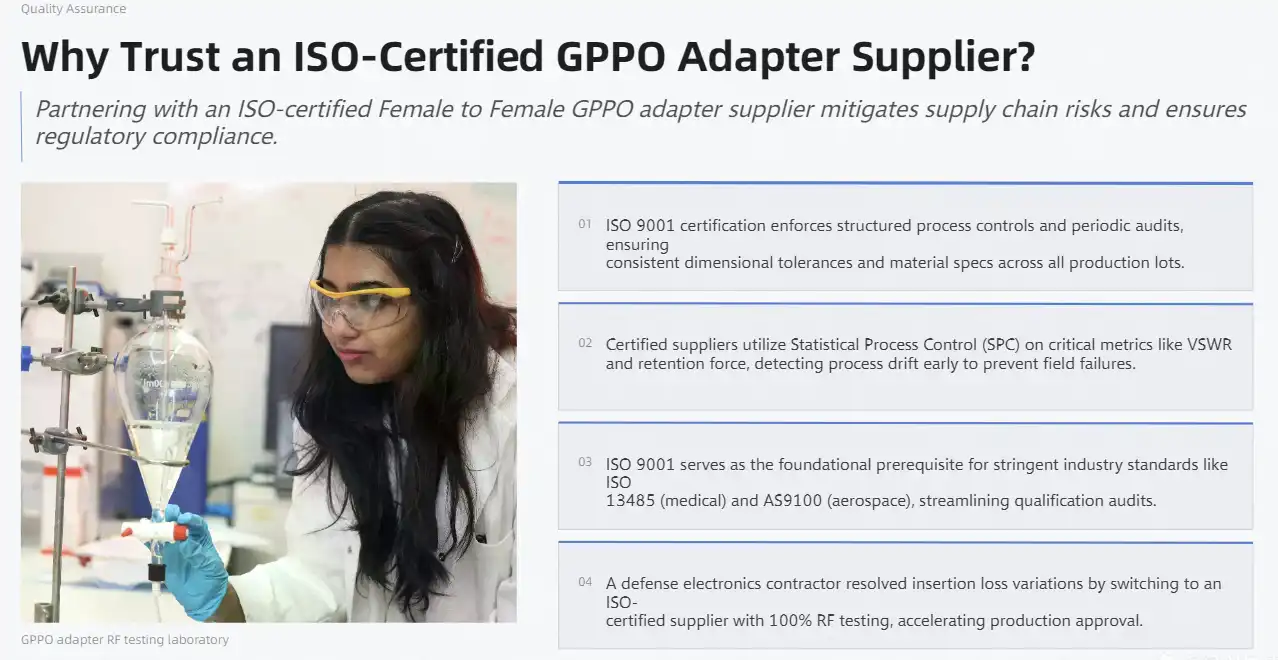
ISO 9001 certification sets up structured rules for validating designs, managing processes, and always making things better. Certified manufacturers follow written procedures to make sure that the tolerances for sizes stay the same across production lots and that the material specifications match what was intended in the design. Periodic checks by qualified registrars make sure that ongoing compliance is being met. This gives customers peace of mind that quality systems are still working for the female to female GPPO adapter.
Risk Mitigation Through Verified Processes
Suppliers who aren't authorized may send good samples, but they may have trouble making sure that the production is consistent. Without structured process control, differences from batch to batch grow, which makes qualification testing harder and could lead to failures in the field. Manufacturers who are ISO-certified keep statistical process control on important factors like contact retention force, VSWR performance, and measurement accuracy. This lets them find process drift early, before bad units are shipped.
Regulatory Compliance for Controlled Markets
Medical device makers and aircraft workers have to follow strict rules set by regulators and show proof of their suppliers' certification. Getting ISO 9001 certification is often the first step to getting into these supply chains. Standards specific to each industry build on this base, like ISO 13485 for medical devices and AS9100 for aerospace. Partnering with ISO-certified suppliers makes regulatory submissions and qualification audits easier.
Case Study: OEM Integration Success
A major defense electronics company had trouble qualifying millimeter-wave transceivers when the first batches of adapters showed inconsistent insertion loss. The variation was fixed by switching to an ISO-certified supplier that used advanced plating controls and 100% RF testing. The project moved on to production approval without any more delays, and the contractor later expanded the relationship with the seller to include more RF interconnect families based on proof that the process could handle them.
Conclusion
To find the right female to female GPPO adapter provider, you have to weigh technical requirements, quality control systems, and pricing. The ISO certification gives a lot of trust in the consistency of production, and the thorough standard alignment makes sure that parts meet the needs of the application. These adapters are important parts for millimeter-wave systems in the telecommunications, aircraft, automobile, and test instrumentation industries because they are very small, reliable at very high frequencies, and have a variety of interface choices. For procurement to go well, operational needs must be clearly stated, suppliers' skills must be evaluated in more than just price terms, and relationships must be built with manufacturers who show both technical depth and process maturity. As millimeter-wave technologies become more common in both business and military settings, it becomes more important to have access to qualified interconnect options.
FAQ
What distinguishes female to female GPPO adapters from male to female variants?
The gender designation refers to the shape of the contacts. Female connectors have receptacle contacts that can accept pins. Adapters that go from female to female GPPO adapter configurations connect two cables or parts that have male ends. Adapters that go from male to female connect two cables or parts of the same gender. The application chooses the best setup for the system design. For room reasons, high-density grids usually only use one gender, which affects the choice of adapter.
How do I verify ISO standard compliance during procurement?
Ask for copies of the most recent ISO 9001 certificates from registered, approved providers, and make sure you keep track of the expiration dates and scope statements that confirm the manufacturing of RF connectors. Real certificates have contact information for the registrar that lets someone else check them. As a provider was being qualified, they had to show proof that their calibration management, inspection methods, and tracking of non-conformances were all in line with ISO standards.
What maintenance practices extend adapter service life?
Regularly clean the contacts with lint-free RF swabs and dry alcohol to get rid of rust without wearing them down. Keep parts in places that are kept at temperatures between 15°C and 25°C and have a relative humidity of 40–60%. Before each use, check the gold plating and replace any adapters that show signs of wear or discoloration. Keep an eye on the electrical performance. If the VSWR or insertion loss goes up, it means that contact problems are starting to show and need to be replaced before the whole thing fails.
Partner with Chuangyu for ISO-Certified Female to Female GPPO Adapter Solutions
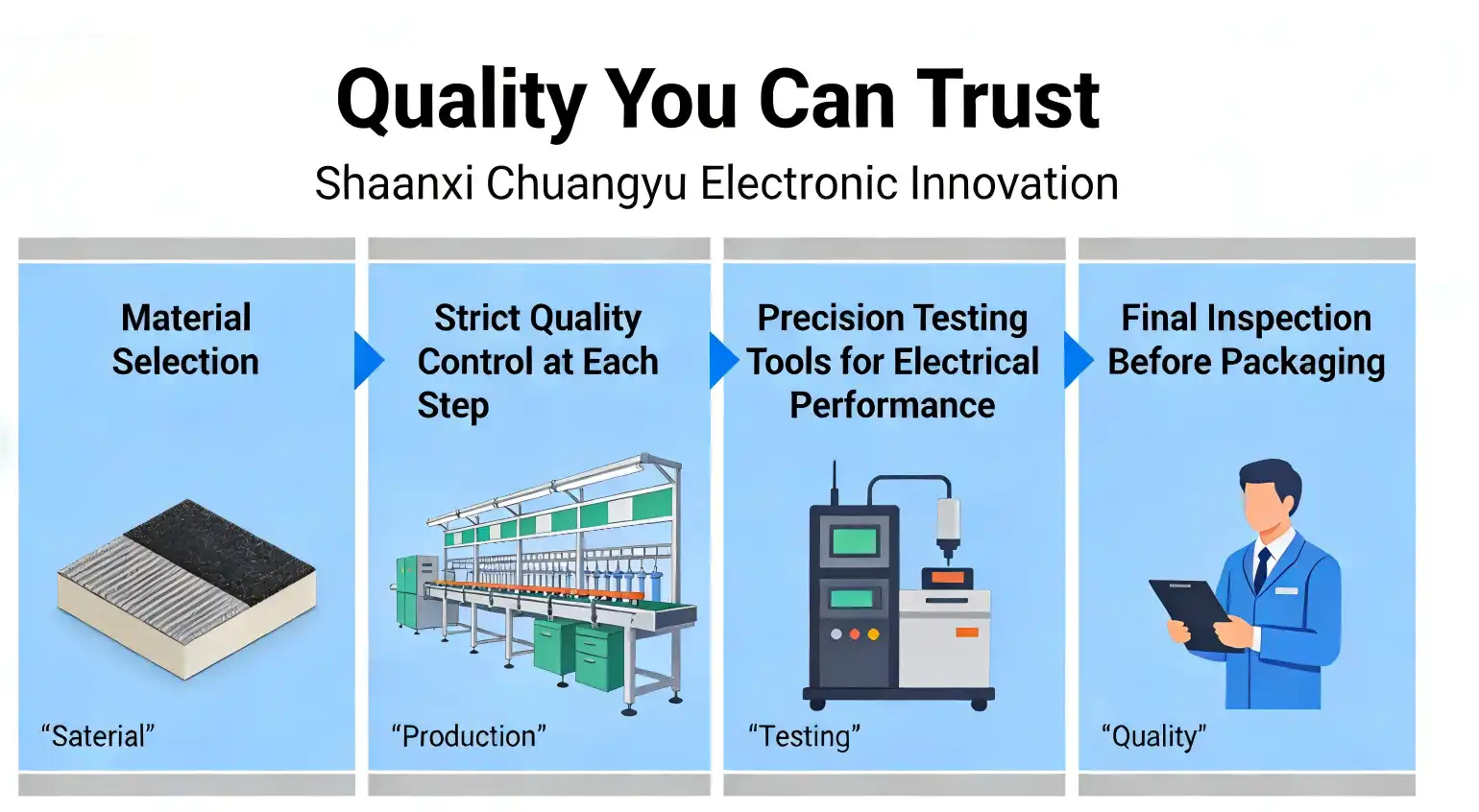
Shaanxi Chuangyu Electronic Technology makes RF connection solutions that are carefully designed to meet the exact needs of millimeter-wave systems. Our factory is ISO certified and has written process controls that make sure the same level of quality on all production runs. There are both standard optical hole and ruggedized full detent configurations in the female to female GPPO adapter line. All of them are characterized across DC-67GHz with serialized test data. Engineering support teams help with needs that are specific to an application, such as planning environmental qualification or custom plating specifications. Email chuangyuwz01@cymicrowave.com to talk about your project needs and get detailed quotes. OEM makers are welcome to ask about bulk orders, and we offer competitive pricing models that take volume promises into account. Visit cymicrowave.com to see our whole catalogue.
References
1. Smith, J. R., & Chen, L. (2023). "High-Frequency Connector Technologies for 5G and Beyond." IEEE Transactions on Microwave Theory and Techniques, Vol. 71, No. 8, pp. 3421-3438.
2. Anderson, M. P. (2022). "Material Selection and Plating Processes for Millimeter-Wave RF Connectors." Journal of Electronic Materials, Vol. 51, No. 12, pp. 6789-6802.
3. European Telecommunications Standards Institute. (2024). "ETSI EN 302 217: Fixed Radio Systems; Characteristics and Requirements for Point-to-Point Equipment and Antennas."
4. Wilson, K. T., & Yamamoto, H. (2023). "Reliability Assessment of Miniature RF Connectors in Aerospace Applications." Proceedings of the International Microwave Symposium, San Francisco, pp. 1145-1148.
5. Defense Standardization Program Office. (2022). "MIL-STD-348: Requirements for Military Standard Electronic Connectors, General Specification For."
6. International Organization for Standardization. (2021). "ISO 9001:2015 Quality Management Systems – Requirements and Implementation Guidelines for Electronics Manufacturing."