- English
- French
- German
- Portuguese
- Spanish
- Russian
- Japanese
- Korean
- Arabic
- Greek
- German
- Turkish
- Italian
- Danish
- Romanian
- Indonesian
- Czech
- Afrikaans
- Swedish
- Polish
- Basque
- Catalan
- Esperanto
- Hindi
- Lao
- Albanian
- Amharic
- Armenian
- Azerbaijani
- Belarusian
- Bengali
- Bosnian
- Bulgarian
- Cebuano
- Chichewa
- Corsican
- Croatian
- Dutch
- Estonian
- Filipino
- Finnish
- Frisian
- Galician
- Georgian
- Gujarati
- Haitian
- Hausa
- Hawaiian
- Hebrew
- Hmong
- Hungarian
- Icelandic
- Igbo
- Javanese
- Kannada
- Kazakh
- Khmer
- Kurdish
- Kyrgyz
- Latin
- Latvian
- Lithuanian
- Luxembou..
- Macedonian
- Malagasy
- Malay
- Malayalam
- Maltese
- Maori
- Marathi
- Mongolian
- Burmese
- Nepali
- Norwegian
- Pashto
- Persian
- Punjabi
- Serbian
- Sesotho
- Sinhala
- Slovak
- Slovenian
- Somali
- Samoan
- Scots Gaelic
- Shona
- Sindhi
- Sundanese
- Swahili
- Tajik
- Tamil
- Telugu
- Thai
- Ukrainian
- Urdu
- Uzbek
- Vietnamese
- Welsh
- Xhosa
- Yiddish
- Yoruba
- Zulu
You need a male to male SMA adapter when connecting two female SMA ports on test equipment, RF cables, or measurement devices. This specialized connector resolves interface polarity mismatches that halt lab workflows, particularly during prototype evaluation, signal path extension, and calibration routines. Engineers frequently encounter scenarios where vector network analyzers, spectrum analyzers, or signal generators feature only female ports, making direct connection impossible without this adapter. The male-to-male SMA adapter bridges this gap by providing protruding center pins on both ends, enabling seamless integration across RF testing environments from DC to 18 GHz.
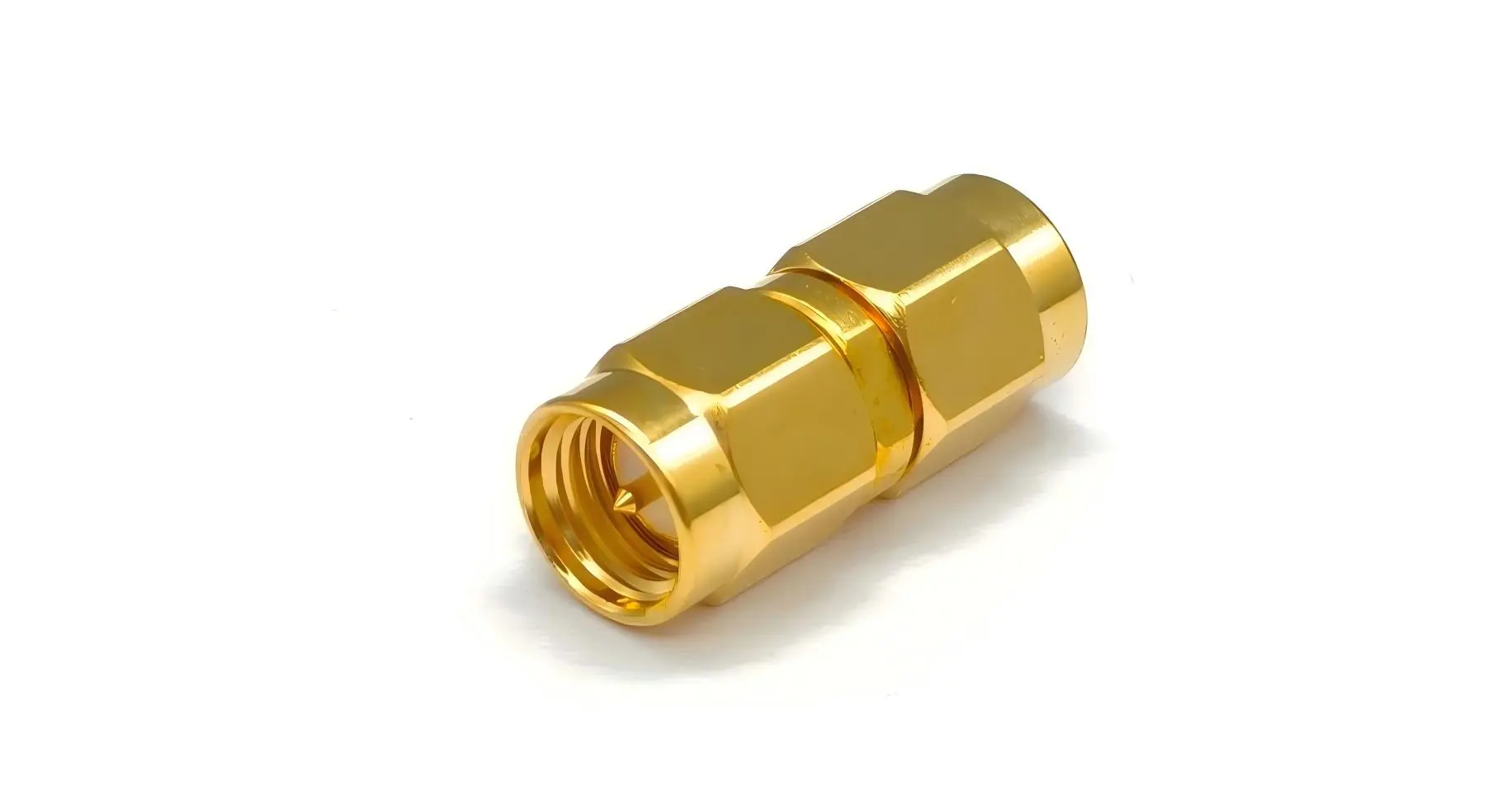
Understanding Male to Male SMA Adapters: Key Specifications and Uses
The design architecture of these adapters directly impacts measurement accuracy in high-frequency applications. Knowing their structural details helps procurement managers justify specifications to finance departments while ensuring compatibility with existing test systems.
RF Coaxial Structure and Impedance Characteristics
Precision coaxial construction in professional-grade adapters keeps the characteristic impedance at 50Ω. For the middle wire, beryllium copper with gold plating is used, which makes it more conductive and resistant to oxidation than normal brass options. The dielectric insulator is made of polytetrafluoroethylene (PTFE), which was chosen because it doesn't lose much signal and stays stable at different temperatures. Brass with gold plating is used for the outer wire. This provides strong electromagnetic protection and prevents rusting in lab settings. This three-layer design makes sure that the electrical performance stays the same even after many mating cycles.
Frequency Range and Performance Parameters
The operating frequency ranges from DC to 18 GHz, which makes it useful for testing radio communications, making sure RF circuits work, and checking microwave components. Across the whole bandwidth, the voltage standing wave ratio (VSWR) stays below 1.25. This keeps signal reflections to a minimum, which keeps measurement results accurate. Insertion loss is still very small, usually less than 0.2 dB at 6 GHz and 0.3 dB at 18 GHz. When testing 4G/5G base stations, WiFi routers, or millimeter-wave samples, these factors are very important because signal integrity is directly linked to data throughput and system dependability.
Mechanical Durability and Mating Cycle Life
Long-term dependability is based on the center pin retention force and coupling nut torque specs. High-quality adapters can be mated more than 500 times without losing their electrical or mechanical fit. The gold-plated outer conductor doesn't wear down easily from making many connections, so the contact pressure stays the same over the life of the product. This durability is very important in R&D labs where test configurations change often, and adapters need to be reconnected every day. Before buying in bulk, engineers should check these specs to make sure that things don't break down too soon and mess up testing schedules.
When and Why to Use a Male to Male SMA Adapter in Your Lab
Real-world testing scenarios reveal specific situations where these adapters become indispensable rather than optional accessories. Understanding these contexts helps technical directors allocate budgets appropriately.
Connecting Test Instruments with Female-Only Ports
Vector network analyzers and spectrum analyzers often have female SMA ports to keep the center receptacle of the instrument from getting damaged. If you want to test a system at the system level, like measuring amplifier gain while keeping an eye on harmonic distortion, you can connect two of these instruments using the adapter. This setup is often seen in semiconductor testing labs where characterizing devices needs to involve signal input and analysis across multiple frequency bands at the same time.
Extending Cable Assemblies Without Re-Termination
Test engineers often have to extend signal paths to make room for different equipment layouts when they are testing prototypes. The adapter instantly connects two female-terminated cables, so you don't have to order custom cable lengths or re-terminate existing assemblies. This method saves time and money while keeping the signal strong. It works especially well when testing new antenna designs or RF front-end modules where the placement affects the radiation patterns.
Resolving Interface Polarity Mismatches in Test Fixtures
RF test fixtures can show odd polarity combinations sometimes because of limitations in PCB structure or the need to place components in a certain way. The male to male SMA adapter fixes these problems without having to redesign the fixture or replace the cables. This freedom is especially helpful for companies that test implantable RF telemetry systems, since changing the test setup could add weeks to the time it takes to submit to regulators.
Calibration and Verification Procedures
Precision adapters are often included in calibration kits so that they can be used as reference measures for regular checks. Technicians need known-good adapters to set measurement baselines when they calibrate network analyzers or do SOLT (Short-Open-Load-Thru) calibration sequences. Low insertion loss and stable VSWR across temperature changes in the adapter make sure that the accuracy of the calibration stays traceable to national standards, which is very important for ISO/IEC 17025 accredited testing laboratories.
How to Choose the Best Male to Male SMA Adapter for Your Lab Needs
Selecting the optimal adapter requires matching technical specifications to operational requirements, a process that procurement managers must navigate carefully to balance performance against budget constraints.
Frequency Range Alignment with Application Demands
When testing wireless communication below 6 GHz, the requirements can be a little less strict, but when researching millimeter waves, they need to be much stricter. For WiFi 6E development, a lab needs adapters with a rating of 7.125 GHz, but for 5G mmWave tests, it needs speeds above 40 GHz. When frequency rates don't match, measurement errors happen. This is especially bad when describing filters or amps where out-of-band rejection is important. Make sure that the manufacturer's data sheet lists actual frequency limits instead of theoretical maximums.
Material Selection: Gold Versus Nickel Plating Trade-Offs
Gold plating is better at conducting electricity and resisting rust. The contact resistance stays the same even after hundreds of mating rounds. It is cheaper to nickel-plate, but it oxidizes over time, which raises insertion loss and lowers VSWR performance. Only gold-plated contacts should be used by labs that do precise readings below -80 dBm sensitivity. Nickel-plated versions can be used in production test settings with higher signal levels. This lowers the cost of adapters by 30–40% for large purchases without affecting their pass/fail accuracy.
Environmental Ratings and Mechanical Robustness
Standard laboratory adapters work fine in climate-controlled rooms, but they need to be made to stricter standards for use in the field or in environmental chambers. Adapters that can handle temperatures ranging from -55°C to +125°C are good for RF testing in cars and for aerospace qualification programs. The brass outer conductor is strong enough for use on a workbench, and the stainless steel design can handle shaking and shock loads in mobile test rigs. Defense contractors should make sure that adapters used to connect radar systems meet MIL-STD-202 standards.
Bulk Purchasing and Customization Benefits
Specialty suppliers usually offer 15–25% bulk savings when you order more than 50 units. ODM makers can make special designs, like coupling nuts that are longer for recessed connections or torque indicators that are built in for technician training programs. These changes make it easier for multiple operators to repeat tests and cut down on mistakes made during assembly. When you give a seller custom requirements, make sure their manufacturing skills match your tolerance needs by sending them engineering drawings and electrical parameters for products such as a male to male SMA adapter.
Purchasing and Procurement Insights: Where and How to Buy Male to Male SMA Adapters
Efficient sourcing strategies balance cost, delivery speed, and supplier reliability—considerations that directly affect laboratory productivity and budget utilization.
Direct Manufacturer Partnerships Versus Distributor Networks
When you buy directly from manufacturers like Shaanxi Chuangyu Electronic Technology, you can usually get better prices on orders of more than 100 units and get help from engineers for custom requirements. Distributors offer faster delivery for small orders and a wider range of products from more brands, but the cost per unit is higher. Relationships with distributors are good for R&D labs whose demand changes all the time, while agreements with manufacturers are better for production test labs whose demand stays steady. Hybrid strategies, which include keeping distributor accounts open in case of emergencies and negotiating yearly deals with manufacturers, are the best way to balance flexibility and cost structure.
Supplier Assessment Criteria Beyond Unit Price
When adapter failures stop production lines or push back experiment plans, shipping speed is very important. Even if the price per unit is 10-15% higher, suppliers who offer same-day shipping on in-stock items keep businesses from having to pay for expensive downtime. Support after the sale, such as expert help and failure analysis, adds value that pure-play online markets can't match. By asking for proof of certification like ISO 9001 quality systems, RoHS compliance, and test results before making an order, you can avoid problems with compliance during regulatory audits. Instead of just comparing unit prices, purchasing managers should look at the total cost of delivery, which should include shipping costs, payment terms, and guarantee support.
Total Cost of Ownership Considerations
When lab use requires a lot of reconfiguring, a $12 adapter that can be mated 200 times is not as good a value as a $20 unit that can be mated 500 times. The real economic comparison can be seen by figuring out the cost per mating cycle. This is especially important for automatic test equipment that goes through dozens of links every day. Warranty terms have a big impact on lifecycle costs. Suppliers who offer free replacement for electrical failures within 12 months lower the risk of losing money due to premature wear and tear. In addition to anecdotal performance reviews, test engineers should keep track of how often adapters fail by supplier. This will help them make better procurement decisions based on facts.
Trusted Brands and Supplier Recommendations for Male to Male SMA Adapters
Selecting suppliers involves evaluating technical capabilities, quality systems, and support infrastructure that extend beyond product specifications alone.
Industry-Leading Manufacturers and Their Strengths
Defense contractors who need to be able to track their purchases will like that Amphenol RF has a lot of products and documentation that back up their DO-160 aerospace qualifications. Thanks to its global distributor networks, TE Connectivity makes its products widely available and guarantees short lead times for common setups. Pasternack specializes in shipping off-the-shelf things the same day, which is helpful for labs that need to meet tight project schedules. Radiall does custom engineering for high-frequency uses above 40 GHz for research schools that are pushing the limits of measurement. Depending on the application's top priorities—fast delivery, easy customization, or certification paperwork—each manufacturer has its own unique advantages.
Quality Certifications and Compliance Standards
ISO 9001 certification makes sure that manufacturing processes are consistent, but it doesn't promise that the electrical performance will be good. Environmental stress testing that meets MIL-STD-348 standards shows that the equipment is suitable for use in military RF applications. RoHS approval proves that the material meets European environmental rules, which are needed to sell it in the EU. Instead of blindly accepting vendor specifications, OEM manufacturers should ask for third-party test reports that prove VSWR, insertion loss, and mating durability claims. Accredited testing according to IEC 61169-15 standards gives quality assurance teams concrete performance data that helps them justify the procurement of reliable male to male SMA adapter solutions.
Partnering with Specialized RF Component Suppliers
Shaanxi Chuangyu Electronic Technology is an example of a specialized supplier that offers benefits beyond those of a general distributor. With almost 20 years of experience making RF components, the company makes precise adapters that can handle frequencies up to 110 GHz, which is higher than what is needed for most lab uses. The Xi'an factory has quality systems that are ISO-certified and offers affordable prices through combined manufacturing. Engineering teams help customers choose the right adapters by giving them technical advice and making sure that the configurations are best for each test scenario. A production capacity of 500,000 RF components per year provides supply safety for high-volume users, and the ability to make custom probes and test fixtures meets specific integration needs. Direct communication through chuangyuwz01@cymicrowave.com makes it possible to get quotes and answers to technical questions quickly, which speeds up the procurement process compared to multi-tier distributor chains.
Conclusion
To choose the right male to male SMA adapters, you have to weigh the electrical performance requirements against practical needs and price limits. These precise parts make it possible for RF labs to connect to each other, fixing interface problems that would have stopped testing processes otherwise. Engineers can choose adapters that meet the needs of an application without buying too many features that aren't needed if they know about coaxial construction, frequency rates, and mechanical sturdiness. Long-term value is higher when purchasing strategies focus on total cost of ownership instead of unit pricing. This is especially true when working with specialized suppliers who offer technical support and quality certifications. Test engineers and procurement managers can improve the accuracy of measurements and the efficiency of operations in both development and production RF settings by using the insights presented in this study to choose the best adapters.
FAQ
What distinguishes a male to male SMA adapter from other SMA configurations?
The male to male SMA adapter has center pins that stick out on both ends so that it can connect two female SMA ports. This is different from types that match males to females or females to females, which are used for different polarity matching needs. The dual-male design solves the common problem in laboratories where equipment only has female connectors, allowing direct connection without having to change cables or make special assemblies.
How does adapter quality affect RF measurement accuracy?
Impedance differences in low-quality adapters cause signal echoes, which lower VSWR and raise insertion loss. These distortions mess up measurement data, which is especially bad when figuring out how filters or amplifiers work, where accuracy down to the fractional dB level is important. Professional adapters keep the 50Ω resistance constant and the VSWR below 1.25. This keeps measurement error within acceptable limits for tested systems that have been measured.
Can adapters be used at frequencies above their rated specifications?
When you operate above the rated frequency limits, performance starts to drop in unpredictable ways. When the specified maximums are reached, VSWR increases in a way that is not linear, while insertion loss rises because of dielectric losses and resonant effects. An adapter that is rated for 18 GHz might work at 20 GHz, but its specs would be lower, which would make measurements less accurate. By choosing adapters with frequency rates 20 to 30 percent higher than what is needed for the application, you can be sure that the specifications won't change over joining cycles.
What maintenance procedures extend the adapter's operational life?
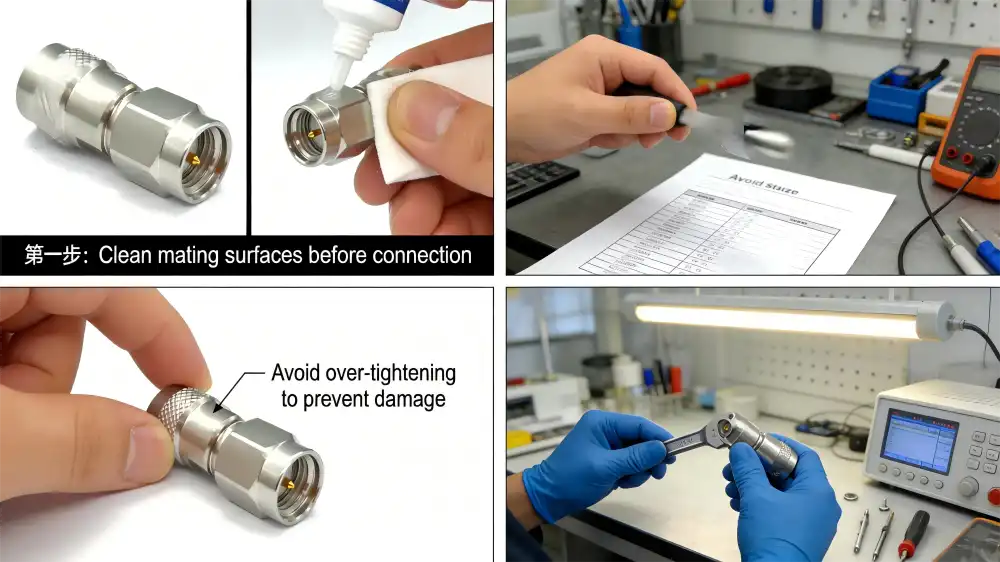
Cleaning often with dry alcohol gets rid of rust and other contaminants that make contact resistance higher. Corrosion can be avoided by storing adapters in climate-controlled spaces that are between -10°C and 40°C and have humidity levels below 60% RH. When mating, using calibrated torque wrenches keeps the surfaces from being overtightened, which can damage them. Before each use, checking the center pins for physical damage stops wear and tear before it changes the measurements. By following these steps, service life is often increased beyond 500 mating rounds.

Partner with Chuangyu for Precision Male to Male SMA Adapter Solutions
Shaanxi Chuangyu Electronic Technology makes RF connectors that are very reliable and are designed to work in harsh lab conditions. We have male to male SMA adapters in stock that have PTFE dielectrics, gold-plated beryllium copper contacts, and VSWR below 1.25 across DC to 18 GHz. We have been making RF components for almost 20 years and can offer precision adapters that work with frequencies up to 110 GHz. Our quality systems are ISO-certified, and we can make more than 500,000 units each year. Email our engineering team at chuangyuwz01@cymicrowave.com to talk about your specific needs. As a well-known company that sells male to male SMA adapters, we offer expert support, unique configurations, and low prices for large orders. This will help your test systems keep the integrity of the signals and measurements.
References
1. Pozar, David M. Microwave Engineering, 4th Edition. Hoboken: John Wiley & Sons, 2012.
2. Agilent Technologies. Specifying Calibration Standards and Kits for Agilent Vector Network Analyzers. Application Note 1287-11, 2010.
3. IEC 61169-15:2013. Radio-frequency connectors - Part 15: Sectional specification for RF coaxial connectors with inner diameter of outer conductor 4.13 mm (0.163 in) with bayonet lock - Characteristic impedance 50 Ω (Type SMA). Geneva: International Electrotechnical Commission, 2013.
4. Whitaker, Jerry C. The RF Transmission Systems Handbook. Boca Raton: CRC Press, 2017.
5. MIL-STD-348B. Military Standard: Radio Frequency Connector Interfaces. Washington: U.S. Department of Defense, 2004.
6. Maury, Michel. Microwave Connector Technology: From the Science of Interconnection to Practical Connector Hardware. Portland: Microwave Journal, 2018.