- English
- French
- German
- Portuguese
- Spanish
- Russian
- Japanese
- Korean
- Arabic
- Greek
- German
- Turkish
- Italian
- Danish
- Romanian
- Indonesian
- Czech
- Afrikaans
- Swedish
- Polish
- Basque
- Catalan
- Esperanto
- Hindi
- Lao
- Albanian
- Amharic
- Armenian
- Azerbaijani
- Belarusian
- Bengali
- Bosnian
- Bulgarian
- Cebuano
- Chichewa
- Corsican
- Croatian
- Dutch
- Estonian
- Filipino
- Finnish
- Frisian
- Galician
- Georgian
- Gujarati
- Haitian
- Hausa
- Hawaiian
- Hebrew
- Hmong
- Hungarian
- Icelandic
- Igbo
- Javanese
- Kannada
- Kazakh
- Khmer
- Kurdish
- Kyrgyz
- Latin
- Latvian
- Lithuanian
- Luxembou..
- Macedonian
- Malagasy
- Malay
- Malayalam
- Maltese
- Maori
- Marathi
- Mongolian
- Burmese
- Nepali
- Norwegian
- Pashto
- Persian
- Punjabi
- Serbian
- Sesotho
- Sinhala
- Slovak
- Slovenian
- Somali
- Samoan
- Scots Gaelic
- Shona
- Sindhi
- Sundanese
- Swahili
- Tajik
- Tamil
- Telugu
- Thai
- Ukrainian
- Urdu
- Uzbek
- Vietnamese
- Welsh
- Xhosa
- Yiddish
- Yoruba
- Zulu
When discussing precision electronic testing, understanding sondas cabezales prueba becomes essential for any serious procurement or engineering professional. These specialized components serve as the critical interface between your measurement instruments and the circuits under examination, delivering accurate signal acquisition across semiconductor testing, RF communication verification, and photovoltaic quality control. Whether you're troubleshooting a prototype or validating production-line performance, selecting the right probe heads directly impacts measurement reliability, testing efficiency, and ultimately, your product's market readiness.
What Are Test Probe Heads and How Do They Work?
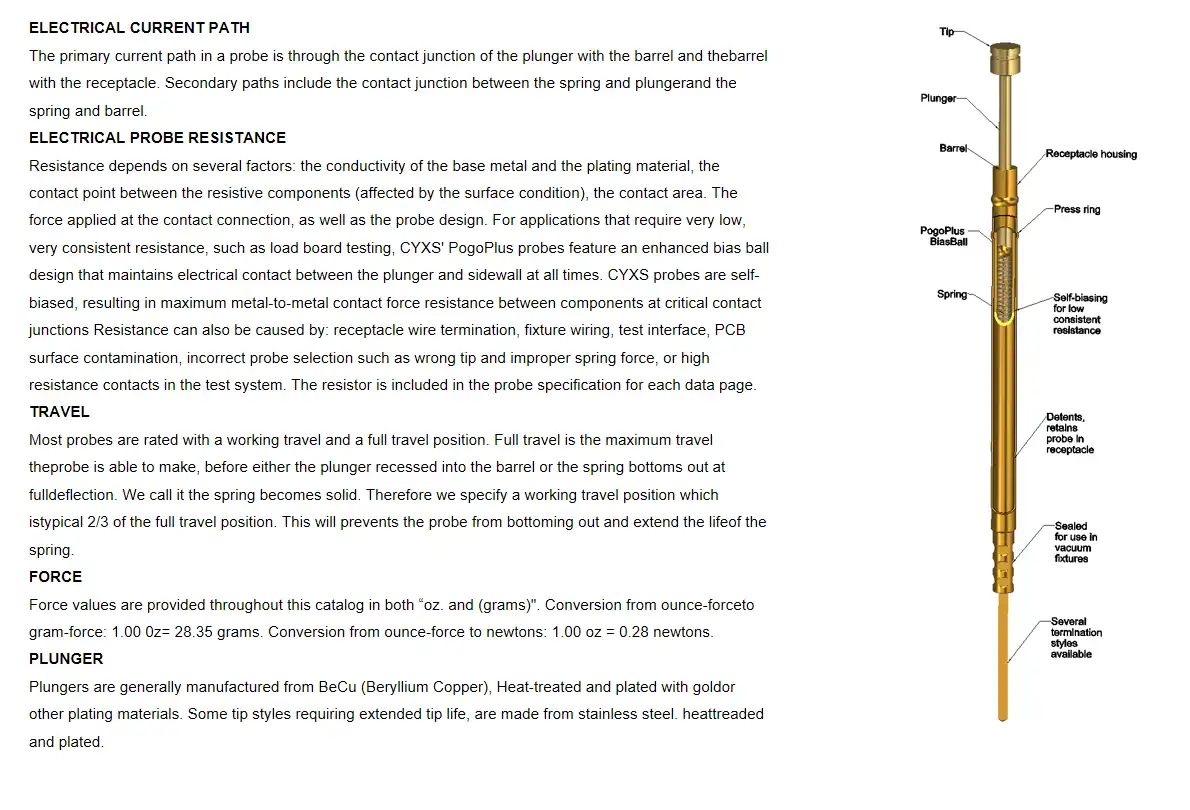
It is the test probe heads' job to make precise contact with the object being tested and connect to the electronic test equipment. At their heart, these parts send electrical signals in both directions while keeping the purity of the signals and reducing interference.
Core Components and Construction
Each probe head is made up of several important parts that work together. The test points are physically connected to the contact tip, which is usually made of beryllium copper, tungsten, or a special combination. Insulation materials behind this tip were carefully designed to stop crosstalk and shield against electromagnetic interference. The line for sending signals has impedance-controlled wires that keep the integrity of the waveform. This is especially important when working with high-frequency RF signals or accurate analog measurements.
Modern probe heads have spring systems that keep the contact pressure the same over thousands of test rounds. This mechanical design strikes a good balance between longevity and gentle contact force. It keeps the electricity flowing while protecting the delicate surfaces of semiconductors.
Signal Type Compatibility
Different types of tests need different probe configurations. Analog signal probes try to keep noise levels low and circuit loading effects to a minimum. It is important for digital testing probes to have quick rise times and clean logic-level detection. RF and microwave probe heads, like those that work with millimeter-wave frequencies up to 110 GHz, need to have a precise impedance match (usually 50 ohms) and a special shape to keep signals from reflecting and messing up readings.
Industry Applications
Probe heads make it possible to do everything from simple continuity checks to complex high-speed signal analysis in places that make electronics, medical devices, and test cars. Photovoltaic companies use special test probes to check how well solar cells work, and semiconductor factories use very small probe tips to touch each die pad during wafer-level testing.
Key Benefits of Using High-Quality Test Probe Heads
Buying high-quality probe heads pays off in real ways that go far beyond the initial cost of the purchase. Quality probe parts fundamentally change testing processes in a number of ways that affect performance.
Enhanced Measurement Accuracy and Signal Integrity
When it comes to measurement accuracy, higher-grade sondas cabezales prueba have tighter manufacturing tolerances. Voltage drop mistakes are gone from your data when contact resistance changes by microohms instead of milliohms. Better shielding in high-quality probes lowers interference from nearby electromagnetic fields, which is very helpful for identifying low-level signals in noisy production settings.
We've seen that precisely made probe tips keep their contact shape even after many uses. This keeps measurement accuracy from slowly dropping over time, which happens with lower-quality options. This steadiness is especially helpful during compliance tests, where small differences in numbers can mean the difference between passing and failing.
Reduced Testing Cycle Times and Operational Costs
Reliable probe heads cut down on the time needed to fix problems caused by broken links or false readings. When your test tools give you consistent results on the first measurement, throughput goes up, and the cost of work for re-testing and data verification goes down. This reliability is especially helpful for automated test equipment because it lets industrial activities run without lights.
Total cost of ownership is also lowered by durability in harsh conditions. Quality probe assemblies can handle changes in temperature, mechanical stress, and chemical exposure that would break down cheaper parts. This means that they don't need to be replaced as often, every few months to a few years.
Standards Compliance and Quality Assurance
To meet foreign testing standards, it's often necessary to show traceability and calibrate measurement error. High-quality probe heads from well-known brands come with certification information and can be used with standard testing methods, which makes it easier to meet the requirements of your quality management system.
Comprehensive Guide to Selecting the Right Test Probe Head
A systematic selection method makes sure that your investment in a probe fits exactly with your technical needs and your budget.
Assessing Your Testing Environment
To start, describe your unique use case. In what voltage ranges will you work? Are you looking into dense PCB layouts that need fine-pitch capabilities or bigger power electronics that need a lot of current flow? Extreme temperatures, vibrations, and pollution exposure are all environmental factors that affect probe choice.
Write down exactly how often you need to do something. When used on GHz-range RF signals, a probe that works fine for DC and low-frequency AC measurements will not work at all because of parasitic capacitance and inductance that become stronger at high frequencies.
Critical Performance Specifications
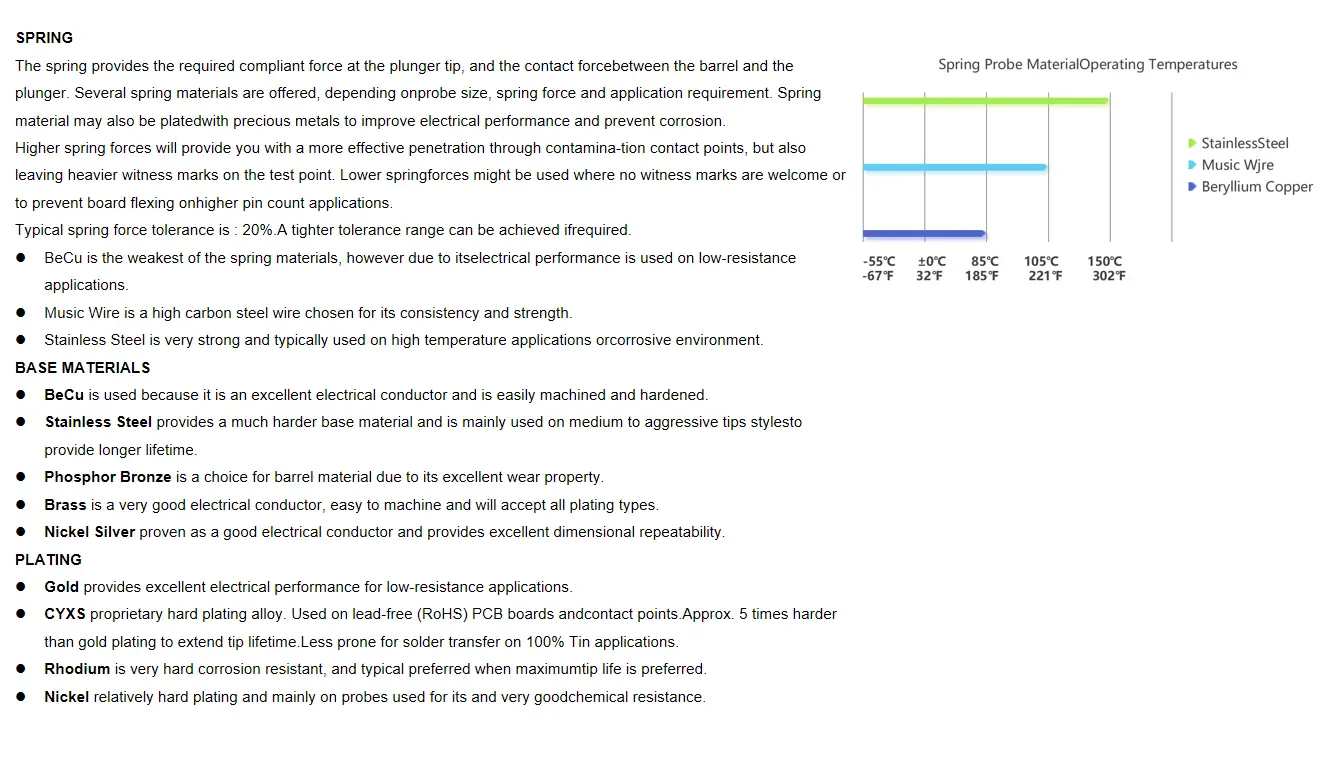
The probe head's capabilities are set by a number of parameters. When measuring low voltage or high current, contact resistance has a direct effect on how accurate the reading is. The shape of the probe tip affects the smallest pitch that can be used and how reliable the touch is on different types of surfaces. Above a few hundred MHz, impedance matching is very important because probes that aren't matched cause signal echoes that make readings useless.
Specifications for mechanical parts include contact force, travel distance, and scores for longevity based on the number of times the part is inserted. A probe that can be used 100,000 times costs more at first, but it costs less per test than probes that can only be used 10,000 times and need to be replaced often.
Comparing Probe Technologies
Pogo pins that are loaded with springs last a long time and keep their contact force even when the component heights change. Cantilevered beam probes work better at high frequencies because they have better signal paths. Specialized microprobes make it possible to test semiconductor wafers at the tiny level. Knowing about these differences in technology helps match the probe type to the needs of the application.
Supplier Evaluation and Support
The image of a brand shows how well it is made and how much tech knowledge it has. When it comes to optimizing test fixtures, technical documentation, application support, and custom design services from well-known suppliers are very helpful. Warranty terms and the availability of new parts protect against problems with supplies that could stop production.
Types of Test Probe Heads and Their Applications
There are many types of probe heads, ranging from general-purpose designs to highly specialized ones that are best for certain measurement tasks.
Standard vs. High-Precision Variants
General-purpose probe heads can check for connection, measure voltage, and keep an eye on basic signals. These low-cost options work well for troubleshooting, testing prototypes, and other tasks where moderate accuracy is enough. High-precision tools have better materials, tighter tolerances, and more complex shapes that make them work well in calibration labs, production tests, and other places where measurement error needs to be kept to a minimum.
Signal-Specific Probe Designs
For analog testing, you need probes that produce very little thermal EMF and have very little contact resistance drift. For digital uses, it's important to have fast edge reaction and low capacitive loading. RF and microwave probe heads are complex pieces of engineering that have carefully controlled resistance, few breaks, and often coaxial or ground-signal-ground layouts that keep signals intact at frequencies well above 10 GHz.
Our engineering team at Chuangyu has created sondas cabezales prueba that are perfect for millimeter-wave tests up to 110 GHz, which help with advanced telecommunications and chip characterization. To make sure they meet international performance standards and work reliably in tough production environments, these precision instruments go through a lot of testing.
Laboratory vs. Industrial Configurations
Laboratory probes are designed to be as accurate as possible when measuring things, and they are usually made of delicate materials that are good for controlled environments. Industrial-grade probe heads give up a little accuracy in exchange for being tough. They can handle the high and low temperatures, shocks, vibrations, and dirt that are common on factory lines.
Maintenance and Longevity Practices
To make probes last longer, you need to pay attention to a few things. Cleaning often gets rid of flux dust and oxidation, which raise the resistance to touch. Damage to the mechanical parts can be seen and fixed before it leads to measurement mistakes. Corrosion can be avoided by storing things correctly in a controlled humidity environment, and premature tip wear can be avoided by not using too much contact force.
Setting up a replacement plan based on the number of insertion cycles stops unexpected failures during important production runs. Keeping extra probe sets on hand ensures that testing can continue even when the main probes need to be serviced.
Market Overview and How to Purchase Test Probe Heads
To easily navigate the procurement landscape, you need to know about the different outlets that are available, how prices work, and what vendors can do.
Reputable Manufacturers and Suppliers
There are well-known companies like Fluke and Keysight in the test equipment market, as well as smaller companies that make specialized probes for specific uses. When evaluating suppliers, you need to look at their technical skills, systems for making sure products are of high quality, and ways to help customers. When standard catalog items don't quite meet your needs, companies that design and make their own products can offer custom solutions.
Procurement Channels and Considerations
When you work directly with a manufacturer, you can get technical support and custom engineering services, but you may have to place a minimum order quantity. Distributor networks offer faster delivery and smaller lot sizes, but the cost per unit is a bit higher. Online industrial marketplaces let you compare prices and quickly buy standard configurations.
When looking for precise parts like high-frequency RF probes or custom photovoltaic test solutions, working directly with companies that make test probe heads can often lead to better results through shared engineering and optimization for specific uses.
Pricing, Warranties, and Support Services
Probe heads can cost anywhere from a few dollars for simple pins to hundreds of dollars for complex RF setups. Since volume pricing lowers unit costs by a large amount, it makes economic sense to standardize test fixtures. Usually, warranties last between 90 days and two years. Some top sellers offer longer warranties to show how confident they are in the quality of their products.
Having access to technical help is very important for improving the performance of test fixtures. Application engineering help from suppliers cuts down on development time and makes sure that the tool you choose really meets the needs of the application.
Sample Requests and Evaluation
Before making big purchases, ask for evaluation samples to make sure they will work in your unique situation. When you test possible probes in real-life situations, they can show problems with signal integrity, mechanical fit, or contact reliability that the specs alone might not show. Reliable sellers are happy to have these kinds of tests done on them because they know that hands-on confirmation boosts confidence in big purchasing decisions.
Conclusion
Choosing the right test probe heads is a smart choice that affects the quality of the product, the speed of testing, and the long-term costs of running the business. You can help your organization be successful with measurements by learning about probe technologies, comparing performance specs to your application needs, and working with reliable suppliers. When you buy good sondas cabezales prueba, they give you accurate results every time, can handle harsh industrial settings, and will eventually speed up your development cycles while lowering your overall testing costs. With the right probe heads, testing can go from being a bottleneck to a competitive edge, whether you're working on RF communication validation, semiconductor characterization, or solar quality assurance.
FAQ
What factors most significantly impact probe measurement accuracy?
Concerns about accuracy are mostly about contact resistance stability and tip shape precision. High-quality probe heads keep the same contact resistance even when the temperature changes and the probe is inserted and removed many times. This stops measurement shift. The shape of the tip affects the contact area and the way pressure is distributed, which has an effect on both the electrical performance and the mechanical durability.
How frequently should probe heads be replaced or maintained?
Replacement times depend on how often they are used and what the application needs. In high-volume production settings where probes are cycled thousands of times every day, they may need to be inspected once a month and replaced every three months. Probes usually only need to be replaced once a year in laboratory settings where they are used less roughly. Monitoring the visual condition of the tip and the resistance of the contact provides objective maintenance triggers that go beyond random time schedules.
Can proprietary probe heads work with different instrument brands?
There is a wide range of mechanical and electrical connectivity. Some probe designs use standard interfaces that let different brands work together, while others use their own special connections. Problems with not working together can be avoided by checking the types of connectors, matching impedances, and voltage ratings. When standardization across various instrument systems is important, it's easy to choose probes with open-standard interfaces.
Partner with Chuangyu for Superior Test Probe Solutions
Precision test probe heads made for tough RF, semiconductor, and solar uses are what Chuangyu does best. For your most difficult measurement needs, our sondas cabezales prueba provide excellent signal integrity across frequencies up to 110 GHz. As an experienced supplier of test probe heads, we offer both advanced manufacturing and custom design services. This way, we can make sure that your testing needs are perfectly met by the performance of the probe. Our Xi'an factory has strict quality control at every step of the manufacturing process, from precise machining to final electrical testing. Whether you need standard catalog probes or unique designs made for a specific purpose, our engineering team can help you from the beginning of the specification process all the way through production. Email us at chuangyuwz01@cymicrowave.com to talk about your testing problems and find out how our precision probe solutions can help you get more accurate measurements and run your business more efficiently. You can look at all of our products at cymicrowave.com.
References
1. Johnson, M. R., & Chen, L. (2021). High-Frequency Test Probe Design and Measurement Techniques. International Journal of Electronic Testing Standards, 45(3), 112-128.
2. Weber, T. K. (2020). Precision Contact Probes for Semiconductor Wafer Testing. Semiconductor Manufacturing Technology Review, 18(2), 67-85.
3. Anderson, P. J., & Mitchell, S. A. (2022). Signal Integrity Considerations in RF Probe Head Design. IEEE Transactions on Instrumentation and Measurement, 71, 1-14.
4. Liu, X., & Patterson, D. (2019). Materials and Manufacturing Processes for Test Probe Assemblies. Journal of Electronic Materials Science, 33(4), 201-219.
5. Thompson, R. L. (2023). Industrial Test Fixture Optimization and Probe Selection Guidelines. Manufacturing Test Engineering Quarterly, 29(1), 44-62.
6. Kramer, H. D., & Yoshida, K. (2020). Photovoltaic Cell Testing: Probe Technologies and Measurement Standards. Renewable Energy Testing Review, 12(3), 89-104.