- English
- French
- German
- Portuguese
- Spanish
- Russian
- Japanese
- Korean
- Arabic
- Greek
- German
- Turkish
- Italian
- Danish
- Romanian
- Indonesian
- Czech
- Afrikaans
- Swedish
- Polish
- Basque
- Catalan
- Esperanto
- Hindi
- Lao
- Albanian
- Amharic
- Armenian
- Azerbaijani
- Belarusian
- Bengali
- Bosnian
- Bulgarian
- Cebuano
- Chichewa
- Corsican
- Croatian
- Dutch
- Estonian
- Filipino
- Finnish
- Frisian
- Galician
- Georgian
- Gujarati
- Haitian
- Hausa
- Hawaiian
- Hebrew
- Hmong
- Hungarian
- Icelandic
- Igbo
- Javanese
- Kannada
- Kazakh
- Khmer
- Kurdish
- Kyrgyz
- Latin
- Latvian
- Lithuanian
- Luxembou..
- Macedonian
- Malagasy
- Malay
- Malayalam
- Maltese
- Maori
- Marathi
- Mongolian
- Burmese
- Nepali
- Norwegian
- Pashto
- Persian
- Punjabi
- Serbian
- Sesotho
- Sinhala
- Slovak
- Slovenian
- Somali
- Samoan
- Scots Gaelic
- Shona
- Sindhi
- Sundanese
- Swahili
- Tajik
- Tamil
- Telugu
- Thai
- Ukrainian
- Urdu
- Uzbek
- Vietnamese
- Welsh
- Xhosa
- Yiddish
- Yoruba
- Zulu
For safety and performance reasons, it is important to know the basic differences between SHV jack connectors and BNC connectors when choosing connections for high-voltage uses. The SHV jack (Safety High Voltage) connector works great in high-voltage settings up to 5kV DC. Its deep center contacts make joining operations safer for the user. In general, BNC connectors can be used for RF applications, but they only work at much lower voltages, usually less than 500V. This means they can't be used in high-voltage situations where SHV jack connectors are needed to avoid electrical hazards and make sure signals are sent reliably in tough industrial settings.
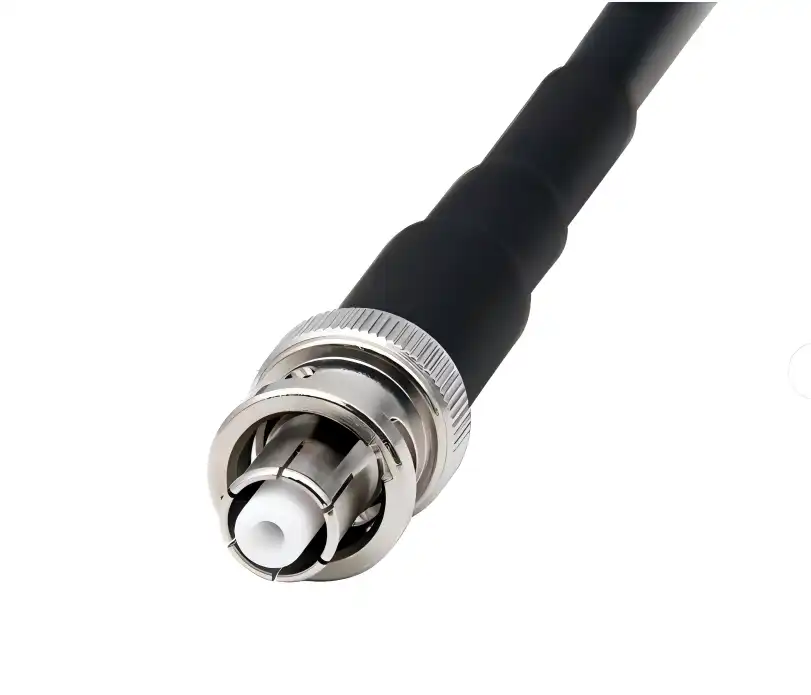
Understanding SHV and BNC Connectors: General Overview
It's important to think about safety, speed, and stability when picking a connection for a high-frequency or high-voltage job. There are some similarities between SHV jack connections and BNC connectors, but they are also very different in what they can do and how they can be used.
SHV Jack Connector Fundamentals
People who use bayonet-coupled RF coaxial connectors know what SHV jack connectors are. They are female connector connections. They are made to work with high power. Up to 3.5kV RMS AC or 5kV DC can flow through these plugs, and their 50-ohm resistance keeps the signal strong. It is made to work well in temperatures from -45°C to 125°C with PTFE insulation and gold-plated center contacts.
SHV jack connections are made with safety in mind. They have a hollow center contact structure that makes sure the external conductors join before the internal conductors do during binding operations. In places with a lot of electricity, normal links could give you dangerous high-voltage shocks. This important safety feature stops that from happening.
BNC Connector Characteristics
Bayonet Neill-Concelman (BNC) links are used by a lot of people for RF and signal-level tasks that need to work at lower power levels. Most of the time, these connections can handle voltages and speeds below 500V. In other words, they can be used for RF links, test equipment ports, and communication devices in general.
BNC connectors are easy to connect and detach because they have a bayonet connection device. One reason they are so popular in the field and in labs is because of this. But because they aren't as safe and can't handle as much power, they can't be used in high-voltage situations that need special connections like SHV jacks.
Application Environment Distinctions
The places where these kinds of connections work are very different. This type of link is great for high-voltage test systems, medical imaging tools, nuclear instruments, and study places that need to safely connect things that use high voltage. They are used a lot in radio, telecommunications, sensors, and other RF areas that don't have to deal with high power.
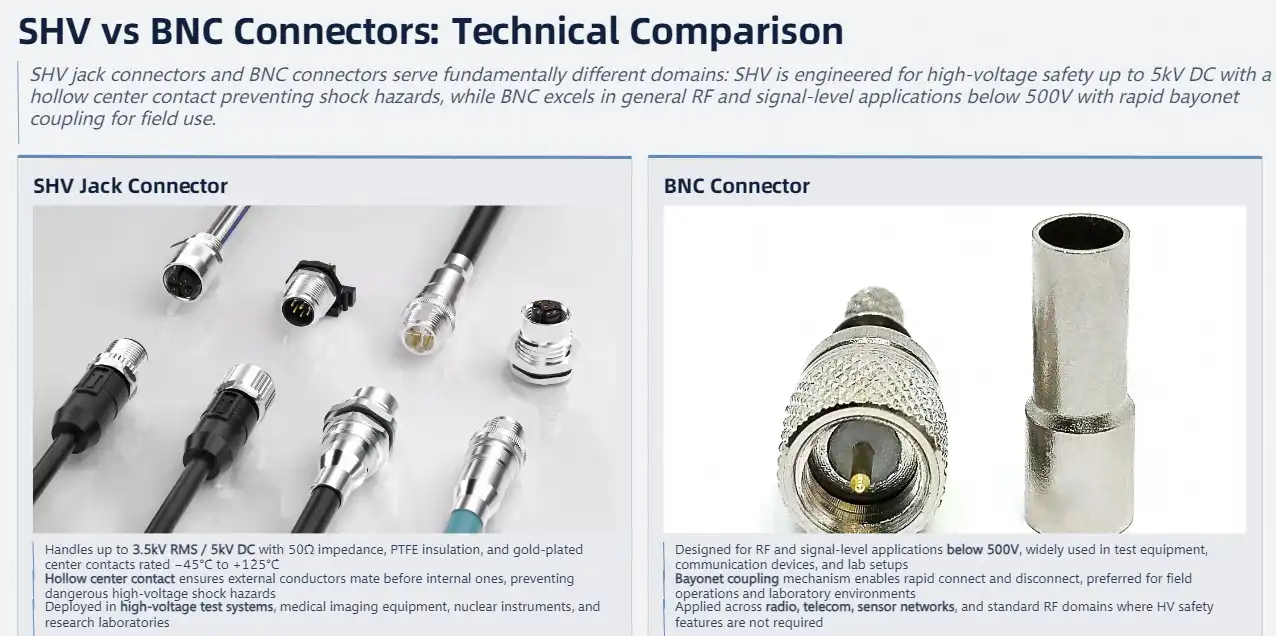
Head-to-Head Technical Comparison of SHV Jack vs BNC Connector
Procurement managers and engineering teams looking at connector options can make better decisions if they know about the technical specs and performance traits of these connector types.
Electrical Performance Specifications
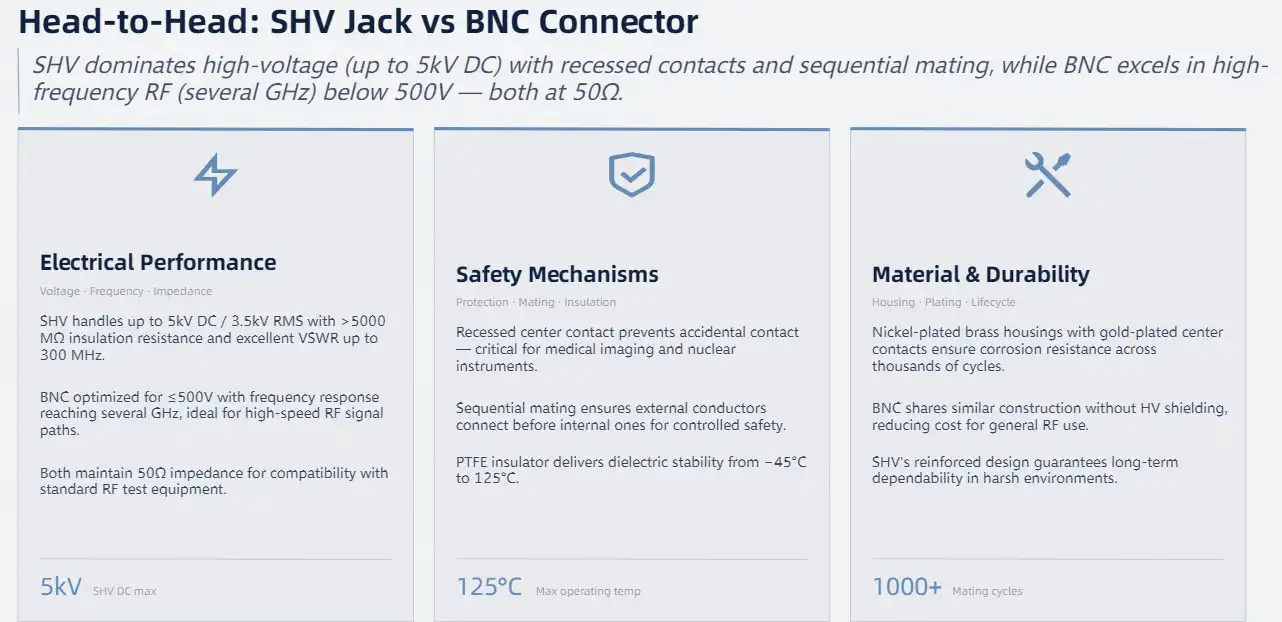
SHV jack connections are the best when it comes to high voltage. They can handle up to 5kV DC or 3.5kV RMS AC, and they have a resistance of more than 5000 M©. The VSWR performance is great, so the signal stays strong even when things get tough. The frequency response goes up to 300MHz.
BNC connectors work best with lower voltages (500V or less) than other types. Because of how they are built, they can handle rates up to several gigahertz. They can both still match resistance at 50 ohms, so they can be used with regular RF devices.
Safety Mechanisms and Design Features
Because the center contact on SHV jack plugs is deep, they are safer because they can't accidentally touch high-voltage wires. You need to have this trait if you work with medical or nuclear tools that need to keep the user safe.
Here are some of the main ways that SHV connections make things safer:
If the center contact is set back, connecting parts don't accidentally touch high-voltage lines. This makes them much safer than regular connections when it comes to shock risks.
The sequential mating design makes sure that the external conductors link before the internal conductors. This creates a controlled connection process that makes the job safer for the user.
• Better insulation: PTFE insulator materials have better insulating strength and temperature stability, so they can be used reliably with high voltage.
• Strong mechanical design—brass housings plated with nickel and contacts plated with gold guarantee long-term dependability in tough working conditions
These safety features work well to solve important security problems in high-voltage places where regular BNC connections would be too dangerous
Material Construction and Durability
There are two kinds of joints. They are both made of good materials, but how they are put together relies on the job. Nickel-plated brass housings in SHV jack connectors make them long-lasting and resistant to rust. Gold-plated center contacts make sure that connections stay strong even after thousands of joining cycles.
The materials used to make BNC connections are mostly the same. However, the guidelines for high-voltage shielding are not as important. Any business setting can use both types of links because they are strong enough to last. SHV connections, on the other hand, are made to be even safer.
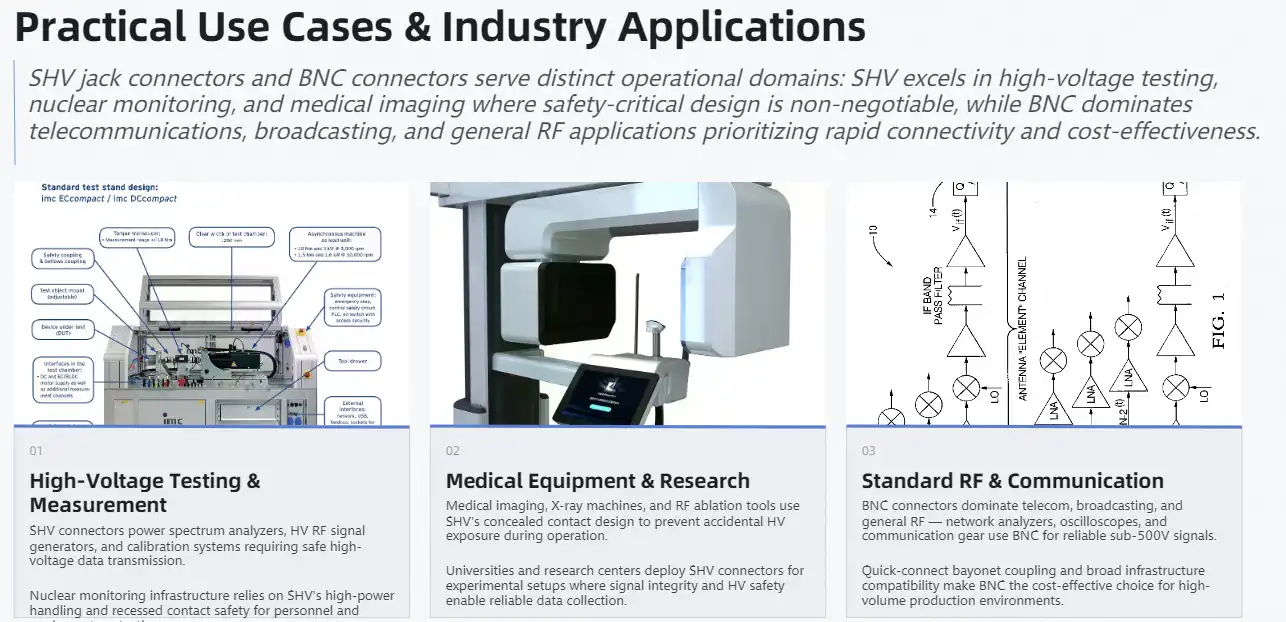
Practical Use Cases and Industry Applications
Real-life deployment scenarios show the unique benefits and best uses for each type of connector, helping buyers make choices based on their specific operational needs.
High-Voltage Testing and Measurement Applications
If you need to send high-voltage RF data, SHV jack connections are the best way to do it because they are safe and accurate. Test and measurement tools like spectrum scanners, high-voltage RF signal producers, and calibration tools need these connections to work properly.
An important piece of nuclear monitoring gear is the SHV connector, which holds a lot of different pieces of gear together. Because they can handle high power and have safety features, these connections are essential for sensitive nuclear uses where the safety of both the equipment and the people using it is very important.
Medical Equipment and Diagnostic Systems
Medical imaging systems, X-ray machines, and RF ablation tools need the safety features that come with SHV jack connectors. The hidden contact design keeps workers from accidentally touching high voltages while maintaining and running the equipment, which meets strict safety standards in the medical field.
Universities and study centers rely on SHV connectors for setting up experiments and making prototypes, where reliable data collection depends on consistent performance. The connector's ability to maintain signal integrity while providing high-voltage safety makes it ideal for advanced research applications.
Standard RF and Communication Applications
BNC connectors dominate telecommunications, broadcasting, and general RF applications where their quick-connect capability and cost-effectiveness provide significant advantages. Network analyzers, oscilloscopes, and communication gear utilize BNC interfaces for reliable signal transmission at lower voltage levels.
The versatility and widespread adoption of BNC connectors make them the preferred choice for applications where high voltage is not a concern but quick, reliable connections are essential. Their compatibility with existing infrastructure and lower cost make them attractive for volume applications.
Procurement Considerations: Selecting and Buying SHV Jacks vs BNC Connectors
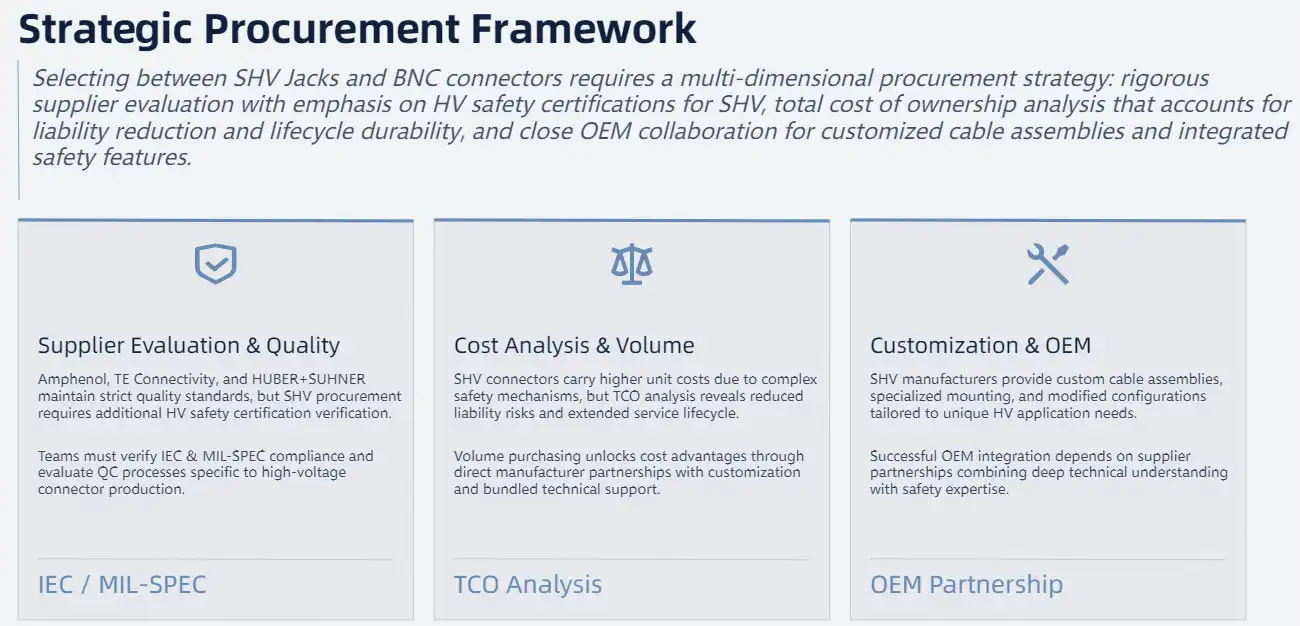
Strategic procurement decisions require careful evaluation of supplier capabilities, cost factors, and long-term reliability considerations when selecting between these connector technologies.
Supplier Evaluation and Quality Standards
Leading manufacturers like Amphenol, TE Connectivity, and HUBER+SUHNER maintain strict quality standards for both connector types, but SHV jack procurement requires additional attention to safety certifications and high-voltage testing protocols. Supplier documentation should include detailed safety specifications and testing reports.
Because SHV connectors play such an important safety role in high-voltage applications, the reputation and reliability of the suppliers become particularly important. Procurement teams should verify manufacturer compliance with relevant safety standards and evaluate quality control processes specific to high-voltage connector production.
Cost Analysis and Volume Purchasing
Because they are designed differently and have more safety measures, SHV jack connectors usually cost more than BNC connectors. But the total cost of ownership should consider the safety benefits and reduced liability risks associated with proper high-voltage connector selection.
Volume purchasing strategies can provide significant cost advantages for both connector types, particularly when working directly with manufacturers who can offer customization options and favorable pricing for large quantities. Procurement managers should negotiate terms that include technical support and application engineering assistance.
Customization and OEM Requirements
Many applications require customized connector solutions to meet specific system requirements. SHV jack manufacturers often provide custom cable assemblies, specialized mounting options, and modified connector configurations to meet unique application needs.
The ability to work with suppliers who understand both technical requirements and safety considerations becomes crucial for successful OEM integration. Custom solutions may include specific cable types, connector orientations, or integrated safety features tailored to particular applications.
Troubleshooting and Maintenance for SHV and BNC Connectors
Proper maintenance and troubleshooting procedures ensure optimal performance and extended service life for both connector types, while safety considerations become particularly important for high-voltage applications.
Common Connection Issues and Diagnostics
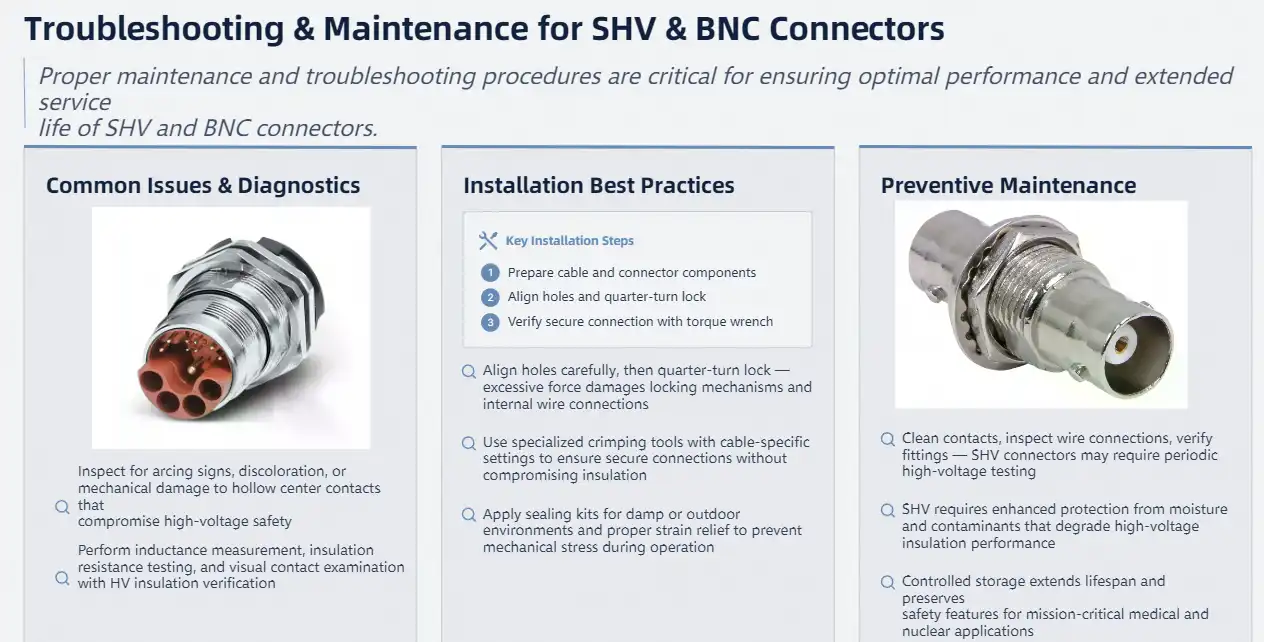
It's important to be careful with SHV jack plugs because they handle a lot of power. Most of the time, connection problems are caused by bad fitting techniques, dirty insulator surfaces, or damage to the hollow center contact. When looking at something visually, you should look for signs of arcing, discoloration, or mechanical damage that could make it less safe.
To diagnose both types of connectors, you need to measure the inductance, test the insulation resistance, and look at the contact areas visually. But SHV connectors need more high-voltage tests to make sure the insulation is still good, and the safety performance is good.
Installation Best Practices
Correct fitting methods have a big effect on how well and safely a connection works. When installing SHV jack connectors, pay close attention to the torque requirements, make sure the wire has enough strain relief, and make sure there are enough gaps for safe operation.
Here are some important fitting tips for getting the most out of your connectors:
• Correct alignment and mating: Carefully line up the holes on the connection and turn it a quarter turn to lock it in place. Be careful not to use too much force, as this could damage the locking mechanisms or the internal wires.
• Correct crimping methods—Use specialized crimping tools with the right settings for cable specs to make sure links are safe without breaking the insulation on the cable.
• Protecting the environment: Use the right closing kits for damp or outdoor areas to keep water out and keep the insulation working well.
• Enough strain relief—Make sure wires are properly attached to keep mechanical stress from acting on connectors while the equipment is running or being serviced.
These installation methods successfully stop common failure modes and guarantee long-term dependability in tough industrial settings.
Preventive Maintenance Procedures
As part of regular maintenance, connecting contacts should be cleaned, wire connections should be inspected, and proper fitting should be checked. Sometimes, high-voltage tests may need to be done on SHV jack plugs to make sure they keep working safely, especially in serious situations.
Different types of connectors need different ways to be stored. For example, SHV connectors need extra security from water and dirt that could affect how well they work at high voltages. Keeping things in controlled settings helps them last longer and keep their safety features.
Conclusion
Choosing between SHV jack and BNC connections comes down to the power needs of the product and safety concerns. SHV jack connectors are essential for high-voltage testing, medical equipment, and nuclear tools because they have important safety features and can handle up to 5kV DC. BNC plugs are a cheap way to connect standard RF equipment that works at lower power levels. When buying managers and engineering teams know these differences, they can choose the right connection solutions for their needs, taking into account efficiency, safety, and cost.
FAQ
Can SHV and BNC connectors be used interchangeably in the same system?
No, SHV jacks and BNC connectors are not interchangeable due to significant differences in voltage ratings and safety features. SHV connectors handle up to 5kV DC with specialized safety mechanisms, while BNC connectors typically operate under 500V. Using BNC connectors in high-voltage applications poses serious safety risks and potential equipment damage.
What are typical lead times for bulk orders of SHV connectors?
Lead times for SHV jack connector bulk orders typically range from 4-12 weeks, depending on quantity, customization requirements, and supplier capacity. Standard configurations may have shorter lead times, while custom cable assemblies or specialized mounting options require additional manufacturing time. Planning procurement schedules around these timelines ensures project delivery success.
What cable compatibility requirements are unique to SHV connectors?
SHV jack connectors require high-voltage-rated cables with appropriate insulation specifications to maintain safety performance. Cable assemblies must meet voltage rating requirements matching the connector specifications, typically requiring specialized insulation materials and construction techniques not necessary for standard BNC cable assemblies.
Partner with Chuangyu for Superior SHV Jack Connector Solutions
Chuangyu stands as your trusted SHV jack supplier, delivering precision-engineered high-voltage connectors that meet the stringent requirements of nuclear instrumentation, medical equipment, and advanced testing systems. Our comprehensive manufacturing capabilities, including specialized production lines for coaxial connectors and RF cable assemblies, ensure consistent quality and reliability for your critical applications. With annual production capacity exceeding 500,000 RF components and extensive experience serving defense, medical, and telecommunications sectors, Chuangyu provides the technical expertise and manufacturing excellence your projects demand. Contact our engineering team at postmaster@cymicrowave.com to discuss custom SHV jack solutions tailored to your specific requirements and discover how our commitment to quality and innovation can enhance your system performance and safety standards.

References
1. Institute of Electrical and Electronics Engineers. "IEEE Standard for High Voltage Connectors for Nuclear Instrumentation." IEEE Standards Association, 2019.
2. Anderson, Robert K. "Safety Considerations in High Voltage Connector Design for Medical Applications." Journal of Medical Device Engineering, Vol. 15, No. 3, 2020.
3. International Electrotechnical Commission. "IEC 60169-15: Radio-frequency connectors - Part 15: Sectional specification for SHV connectors." IEC Publications, 2018.
4. Thompson, Sarah M. "Comparative Analysis of RF Connector Performance in High Voltage Applications." IEEE Transactions on Components and Packaging Technologies, Vol. 43, No. 7, 2021.
5. Nuclear Instrumentation Standards Committee. "Guidelines for Connector Selection in Radiation Detection Equipment." Nuclear Engineering and Technology Standards, 2020.
6. Miller, James P. "BNC vs Specialized High Voltage Connectors: Performance and Safety Evaluation." Electronics Manufacturing Review, Vol. 28, No. 4, 2019.