- English
- French
- German
- Portuguese
- Spanish
- Russian
- Japanese
- Korean
- Arabic
- Greek
- German
- Turkish
- Italian
- Danish
- Romanian
- Indonesian
- Czech
- Afrikaans
- Swedish
- Polish
- Basque
- Catalan
- Esperanto
- Hindi
- Lao
- Albanian
- Amharic
- Armenian
- Azerbaijani
- Belarusian
- Bengali
- Bosnian
- Bulgarian
- Cebuano
- Chichewa
- Corsican
- Croatian
- Dutch
- Estonian
- Filipino
- Finnish
- Frisian
- Galician
- Georgian
- Gujarati
- Haitian
- Hausa
- Hawaiian
- Hebrew
- Hmong
- Hungarian
- Icelandic
- Igbo
- Javanese
- Kannada
- Kazakh
- Khmer
- Kurdish
- Kyrgyz
- Latin
- Latvian
- Lithuanian
- Luxembou..
- Macedonian
- Malagasy
- Malay
- Malayalam
- Maltese
- Maori
- Marathi
- Mongolian
- Burmese
- Nepali
- Norwegian
- Pashto
- Persian
- Punjabi
- Serbian
- Sesotho
- Sinhala
- Slovak
- Slovenian
- Somali
- Samoan
- Scots Gaelic
- Shona
- Sindhi
- Sundanese
- Swahili
- Tajik
- Tamil
- Telugu
- Thai
- Ukrainian
- Urdu
- Uzbek
- Vietnamese
- Welsh
- Xhosa
- Yiddish
- Yoruba
- Zulu
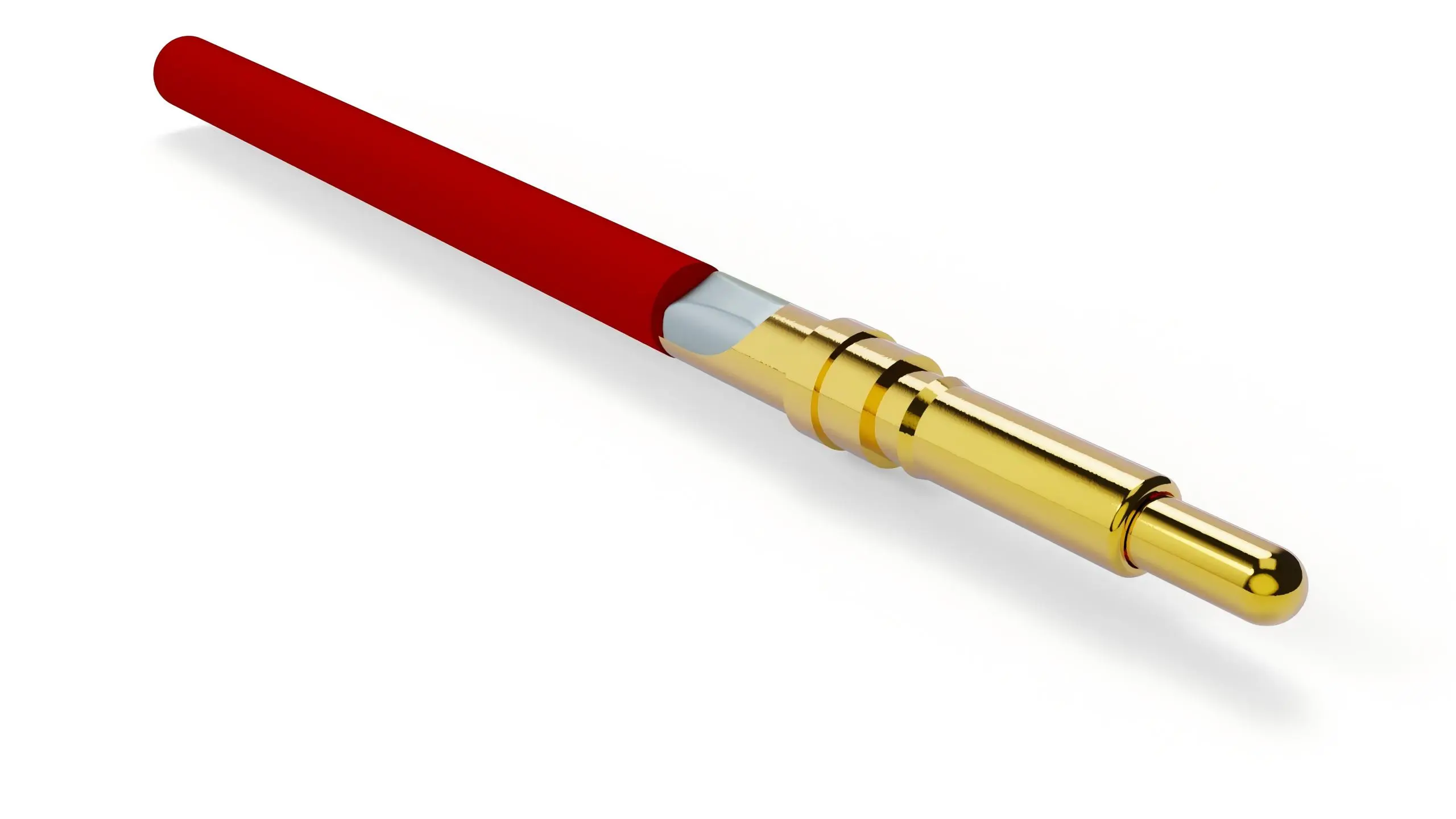
When comparing pre-wired spring probe assemblies against standard spring probes, the fundamental distinction lies in integration and deployment readiness. Pre-wired spring probes arrive as complete assemblies with cables already attached through crimping or welding processes, eliminating on-site wiring steps and reducing installation errors. Standard spring probes, meanwhile, require separate cable attachment, offering modularity but increasing labor time and potential connection faults. For high-volume semiconductor testing, photovoltaic module verification, and medical device quality assurance, pre-wired configurations deliver faster setup, superior signal consistency, and measurable reductions in testing downtime—making them particularly valuable for R&D engineers and procurement managers focused on throughput optimization.
Understanding Spring Probes: Pre-wired vs Standard
Pre-wired Spring Probe Architecture and Functionality
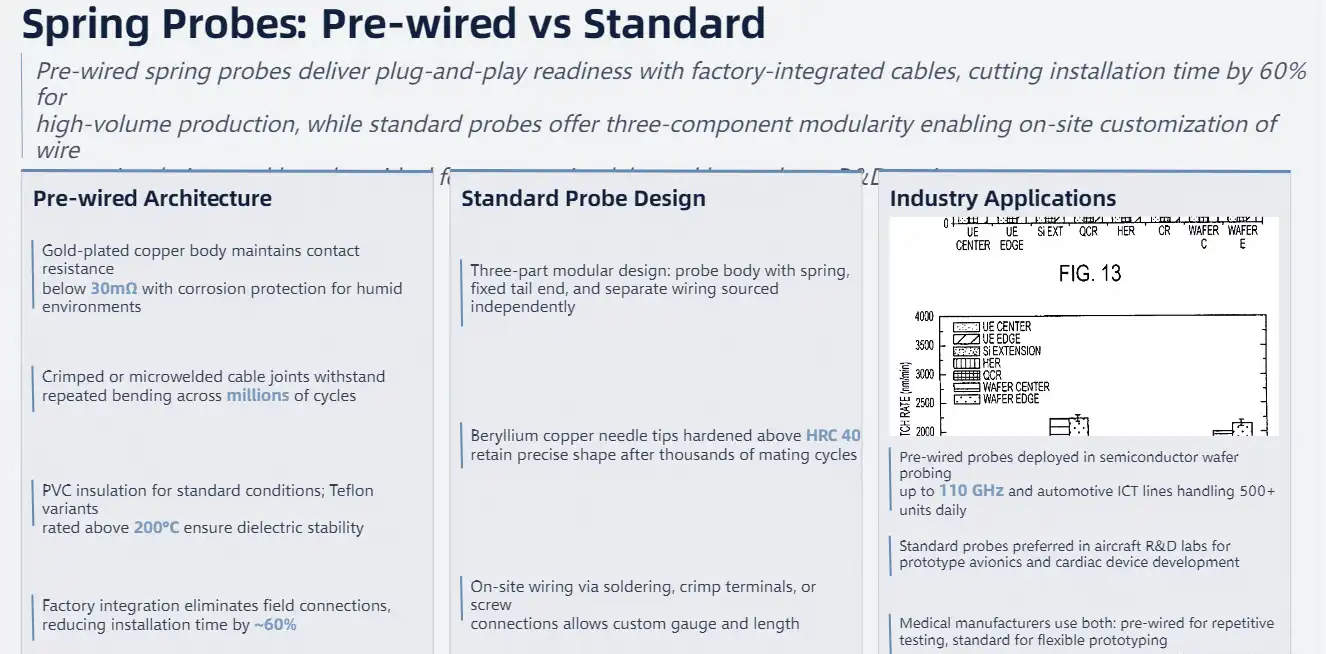
Before they are shipped, Pre-wired spring probe units combine the spring-loaded contact mechanism with the cables that are already attached. The probe body is usually made of a gold-plated copper metal that keeps the contact resistance below 30 milliohms and protects against rust in damp places. Crimping or microwelding is used to connect the probe to the cable, making joints that can withstand being bent over and over again in automated test handlers. High-temperature polymers are used in cable insulation. For normal conditions, PVC variants are used, and for uses above 200°C, Teflon is used. These polymers keep the dielectric stability over temperature changes. This factory-integrated method gets rid of the need for field connections, which cuts installation time by about 60% compared to flexible options. Plug-and-play readiness is very helpful for industries that need to quickly switch out fixtures, like contract manufacturers of consumer electronics like smartphones and tablets.
Standard Spring Probe Design and Customization Flexibility
Standard spring probes have three separate parts: the probe body with the spring mechanism, a fixed tail end with a threaded or press-fit connection, and wiring that comes from a different source. The needle tips made of beryllium copper are harder than HRC 40, so they keep their form even after thousands of uses. Technicians or engineers use soldering, pinching terminals, or screw connections, depending on the needs of the device, to connect wires on-site. Because it's flexible, you can choose your own wire size, insulation material, and cable length, so it can fit any test bed shape. It's helpful to be able to change configurations without having to order new whole assemblies in prototyping labs and low-volume production settings.
Typical Industry Applications Across Testing Domains
Both types of probes are very important in many areas of electronics manufacturing, but they are best used in different situations. Automated wafer probing stations use Pre-wired spring probes in semiconductor fabrication facilities to make sure that accurate S-parameter measurements are made up to 110 GHz frequencies. Automotive electronics companies that test sensor modules that go inside vehicles like Pre-wired solutions in production ICT systems that handle more than 500 units every day. On the other hand, aircraft R&D labs that are testing prototype avionics systems often choose standard probes. This lets engineers quickly change how test setups are set up as circuit designs change. Medical equipment makers use both types: Pre-wired spring probes for testing patient monitors over and over again, and standard probes for prototyping cardiac devices early on.
Core Differences Between Pre-wired and Standard Spring Probes
Design Integration and Installation Efficiency
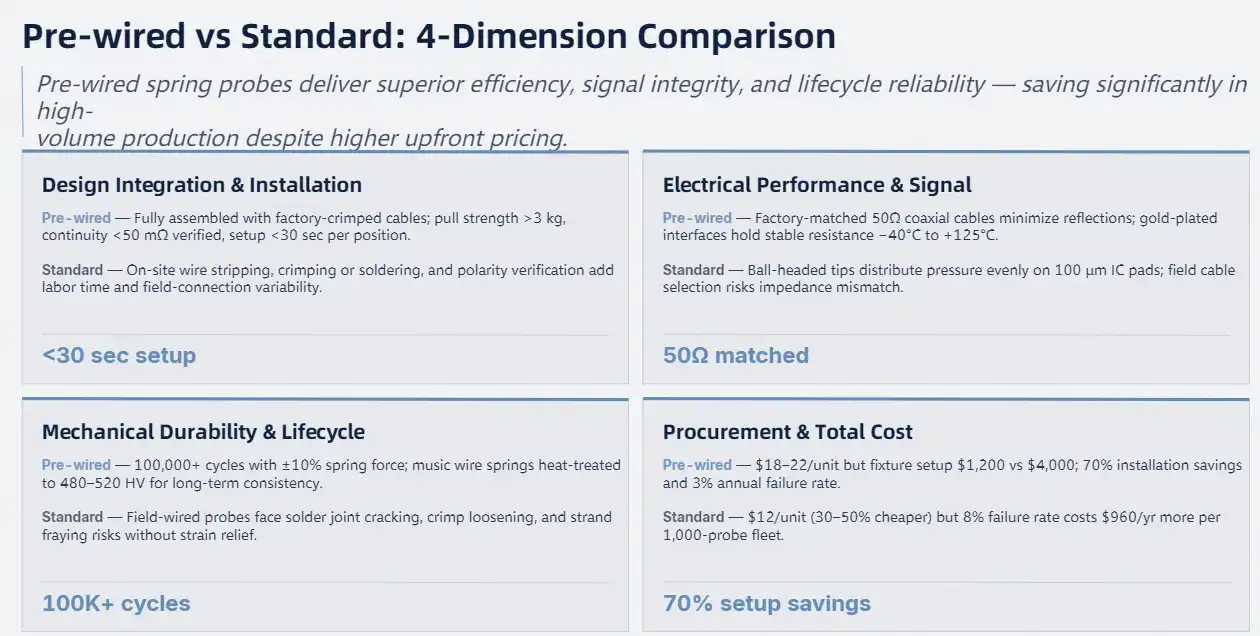
The main difference is the state of the setup at arrival. Pre-wired spring probe units arrive fully assembled, with test cables crimped or welded to probe bodies in a factory setting. This combination makes sure that all connections are of the same high quality. Before shipping, makers can check that the pull strength is greater than 3 kg and the electrical continuity is less than 50 milliohms. Installation only involves screwing probes into test fixtures using threaded receptacles or press-fit bushings. This cuts setup time to less than 30 seconds per probe position. For standard probes, technicians have to remove the insulation from the wire, attach crimp terminals or solder connections, and check the polarity.
Electrical Performance and Signal Integrity Characteristics
Consistency in the signal pathway is a key factor in determining performance differences. For RF uses, Pre-wired systems use factory-matched cable impedances, which are usually 50-ohm coaxial constructions or twisted-pair designs for differential signals. These are designed so that there are as few reflections and crosstalk as possible. Gold-plated interfaces keep the contact resistance fixed at temperatures ranging from -40°C to +125°C, which is important for checking automobile qualifications. A lot of Pre-wired spring probes have ball-headed tips that spread contact pressure evenly. This stops localised stress that could damage small, delicate gold-plated IC pads that are only 100 microns across. Standard probes let technicians choose from a variety of wires, but if they use different types of cables, there could be an impedance mismatch.
Mechanical Durability and Lifecycle Considerations
The number of actuation cycles, the consistency of the contact force, and the environment all affect how long a spring probe lasts. Precision production and material selection keep the spring force within ±10% error in Pre-wired spring probes that are rated for 100,000 cycles or more. The materials used are usually music wire springs that have been heated to 480–520 HV hardness. Flexing fatigue happens when cables are bent over and over again near solder joints. Cable strain relief at the probe-wire junction stops this from happening. Standard probes have similar cycle rates for the probe device itself, but wire that is put in the field adds more places where things can go wrong. Solder joints break when automatic handlers shake, crimp connections come loose when temperatures change, and exposed wire strands fray when insulation isn't properly trimmed.
Procurement Cost Analysis and Total Ownership Value
Standard probes cost 30–50% less per unit than Pre-wired versions; a standard probe costs $12, while Pre-wired versions cost 18–22 dollars in bulk orders. Total cost of ownership calculations, on the other hand, show a different economic picture. For standard probes, installation labour costs about $4,000, while Pre-wired kits cost about $1,200. This is for a 500-probe fixture placement. Failure rates affect replacement costs. For example, if 8% of site-wired configurations fail every year and only 3% of Pre-wired configurations fail, a 1,000-probe test fleet would save $960 every year by using Pre-wired solutions. Keeping track of inventory is easier when you have Pre-wired stock because the cables match the specs of the probes.
Evaluating Applications and Use Cases
High-Volume Manufacturing Testing Environments
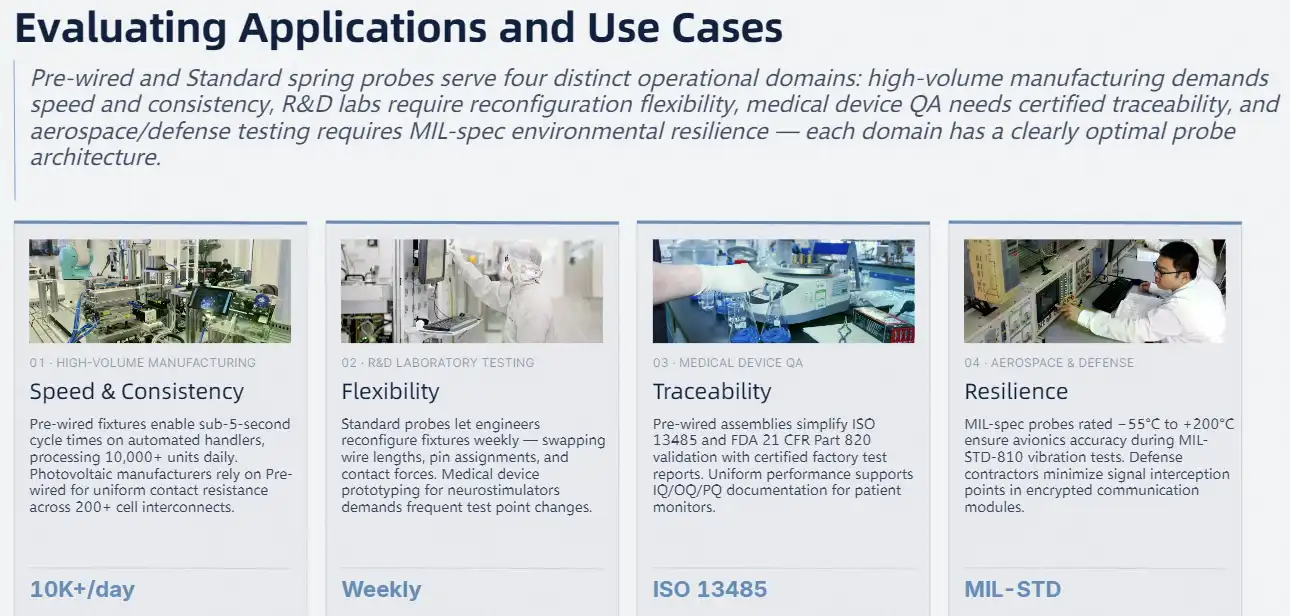
Consumer electronics parts like smartphone camera modules, battery management ICs, and wireless charging coils need to be tested quickly on production lines where setup time has a direct effect on the cost per unit. When daily numbers go over 10,000 units, Pre-wired spring probe fixtures allow automatic handlers to achieve cycle times of less than 5 seconds per device. Factory-terminated assemblies make it easy to manage cables because they run cleanly through fixture channels without needing to be bundled or tied in the field. Manufacturers of photovoltaic modules rely on Pre-wired solutions to keep contact resistance measurements consistent across 200+ cell interconnects per module.
Laboratory Research and Development Testing Scenarios
As chip architectures go through different design stages, R&D labs that are working on next-generation semiconductor devices have to keep changing the tests they need to run. Standard spring probes let engineers change test fixtures once a week by swapping wire lengths, rearranging pin assignments, or changing contact forces, all without having to throw away whole Pre-wired spring probe assemblies. Photovoltaic study sites that are looking into new cell materials need to try different contact pad geometries, which means they need special probe tip configurations along with standard wiring methods. As circuits get smaller, medical device prototyping for implantable neurostimulators needs to change test points often. Standard probes, on the other hand, can quickly adapt to new fixtures.
Medical Device Quality Assurance and Compliance Testing
Under ISO 13485 and FDA 21 CFR Part 820 quality systems, companies that make medical equipment have to follow strict rules when it comes to paperwork. Since manufacturers can provide factory test reports certifying electrical properties, material composition (RoHS compliance), and traceability for each production lot, Pre-wired spring probe assemblies simplify validation protocols. To test medical devices like patient monitors, diagnostic imaging electronics, or infusion pump controls, you need to be sure that they are reliable. The uniform performance of Pre-wired spring probes helps with IQ/OQ/PQ validation documentation without adding wiring variability.
Aerospace and Defense Testing Requirements
Probes used in aerospace tests must be able to survive mechanical shock, high temperatures, and changes in pressure caused by altitude while still measuring accurately. A lot of the time, Pre-wired spring probes with MIL-spec cable bundles rated for -55°C to +200°C are used for checking avionics like flight control systems, radar modules, and satellite communication transponders. The factory-verified pull strength and stable contact resistance make sure that readings taken during MIL-STD-810 vibration tests are accurate. Defence contractors who test encrypted communication modules prefer pre-wired solutions because they limit the number of places where signals could be intercepted or tainted. Extreme stability is needed for space-qualified component testing.
Procurement Insights: How to Choose the Right Spring Probe Supplier
Supplier Qualification and Certification Standards
When choosing a spring probe manufacturer, you need to look at more than just price quotes. Leading providers keep their ISO 9001:2015 quality management certification, which shows that they are in charge of the whole process, from checking the raw materials to testing the finished product. Manufacturers that work with the medical device testing market must comply with ISO 13485, which is needed for regulatory audit trails. Aerospace suppliers usually have AS9100 certification, which shows they can meet strict requirements for documentation and traceability. Before agreeing to a production order, ask for qualification samples. Reputable makers offer 10–20 units for validation testing at a low cost.
Customization Capabilities and Engineering Support
Catalogue items cover common test situations, but custom solutions are often needed, like different tip shapes, longer or shorter cables, certain plating materials, or mounting threads that aren't found on other items. Companies that make probes and have their own design teams can help engineers figure out the best probe specifications for different testing problems. For example, Chuangyu's technical staff works with customers testing photovoltaic modules to create custom probe tip profiles that can touch narrow bus bars without damaging anti-reflective coatings. This is an important step to keep cell efficiency from dropping. Pre-wired spring probe customisation extends to cable specifications, allowing you to choose Teflon insulation for high-temperature applications, twisted-pair geometry for differential signals, or micro-coaxial cables for frequencies higher than 50 GHz, among others.
Minimum Order Quantities and Pricing Structures
Orders on a production scale usually start at 100 to 500 units, which is where manufacturers get economies of scale that cover the costs of tools and setup. Because of the work that goes into cutting cables, terminating them, and putting them together, Pre-wired spring probe kits usually have higher MOQs—often at least 200 units. Standard probes can have minimum orders of 50 units because they come as separate parts that don't need to be wired together. Step-by-step price cuts are made for bigger orders: more than 500 units get 10-15% off, and more than 2,000 units can get 18-25% off as the cost of the tools is spread out over the larger amounts. Ask for official quotes that include unit prices at breaks of 500, 1,000, 2,500, and 5,000 units.
Value-Added Services and Technical Consultancy
Exceptional suppliers go above and beyond business relationships by providing application engineering support that helps customers choose the best probes for their testing needs. As part of their services, experienced engineers look over CAD drawings of fixtures to find potential problems with where probes should be placed and make suggestions on how to fix them, improve the way contact forces are distributed, or suggest different probe styles that would make measurements more accurate. Some makers offer trial fixture programs that send brief probe sets for proof-of-concept testing before full-scale orders. This lowers the risk of new testing methods being adopted. Training programs teach customer teams the right way to handle probes, do maintenance, and fix problems.

Troubleshooting, Maintenance, and Longevity Tips
Pre-Use Inspection Protocols for Reliable Operation
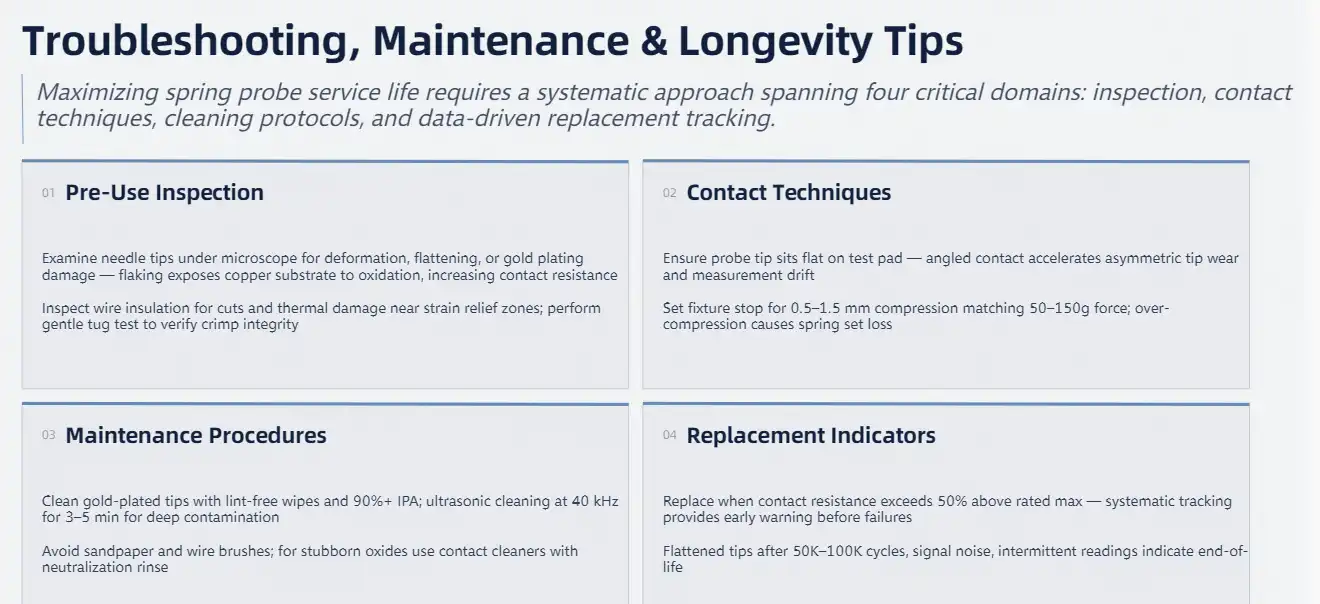
Setting up standard inspections before putting probes into test fixtures stops problems with how they work and measurement mistakes. Look at the tips of the needles under a microscope to find deformation, flattening, or plating damage. These are all problems that can lead to higher contact resistance or a connection that doesn't work right. Gold coating shouldn't flake or change colour, and it should look even. If the plating is broken, the copper underneath can oxidise, which lowers its conductivity. Check the insulation of the wire for cuts, scrapes, or thermal damage, especially near the strain release places where bending puts the most stress. Gently tug on the probe-to-cable junction to make sure it is not loose.
Optimal Contact Techniques and Operational Best Practices
How well the probe is engaged with the test point has a big effect on how accurate the measurements are and how long the contact lasts. Make sure the probe tip is flat on the test pad surface. Contacting it at an angle puts more force on one edge, which speeds up tip wear. Adjust the fixture stop heights to get the suggested distance, which is usually 0.5 to 1.5 mm from free length. Then, apply compression that matches the probe's stated actuation force, which is usually 50 to 150 grams depending on the spring rate. When springs are compressed too much (beyond the mechanical stop), they lose their set, which means the contact force is below what was specified. Electrical contact isn't safe when there isn't enough compression. This is especially true when testing in settings with vibrations, where incomplete engagement causes connections to break off and on. Protect cable routing while the automated handler is working by securing cables in fixture channels with clips or guides.
Maintenance Procedures Extending Probe Service Life
Cleaning regularly gets rid of dirt and other things that weaken contact resistance and cause things to fail early. To get rid of flux leftovers, oxidation films, or particle buildup, wipe gold-plated tips with lint-free wipes that have been wet with isopropyl alcohol (90%+ purity). Sandpaper and wire brushes are rough and can damage plating, leaving the base metal open to corrosion. Ultrasonic cleaning gets rid of more dirt and grime. To clean, put probe kits (without the wire connections) in tanks filled with alcohol and run at a frequency of 40 kHz for three to five-minute cycles. Let them dry completely in the air before putting them back together. For very dirty tips, using commercial contact cleaners with weak acids to clean them chemically gets rid of stubborn oxides. However, this method needs neutralisation rinses to keep chemical waste from interfering.
Recognizing Replacement Indicators and Troubleshooting Failures
Systematic tracking finds signs of wear and tear before they become major problems that stop production testing. Contact resistance tracking gives you an early warning: readings that are 50% higher than the maximum value (for example, 45 milliohms on probes that are rated at 30 milliohms maximum) mean that the wear is getting worse and the part needs to be replaced. Signal quality loss shows up as more measurement noise or readings that come and go during repeated tests, which points to a damaged or unstable contact interface or cable conductor. The fact that the tips are flattened or mushroomed during a physical inspection proves that the mechanical wear is beyond what is acceptable, especially after going over the rated cycle counts (usually between 50,000 and 100,000 actuations, depending on the probe model). When cables break, continuity tests show open circuits or irregular resistance readings when the cables are bent close to their ends.
Conclusion
Pre-wired spring probe assemblies and standard modular probes can be chosen based on operational priorities such as production volume, setup complexity, signal integrity requirements, and overall cost. In high-volume production settings, Pre-wired solutions are measured advantages because they require less time to install, provide consistent electrical performance, and have lower failure rates. These benefits more than make up for higher unit costs through savings over the product's lifetime. Standard probes are still useful for R&D that needs to be flexible, for custom setups, and for lower-volume uses where cost-effectiveness at the start is more important than speed of deployment. Procurement teams can choose the best probes by knowing the specific needs of each application, such as frequency ranges, environmental conditions, expected cycle life, and maintenance capabilities. No matter what type of probe is chosen, reliable long-term performance is guaranteed by working with qualified suppliers who offer engineering support, customisation options, and thorough quality documentation.
FAQ
What distinguishes pre-wired spring probe assemblies from standard probes?
Pre-wired spring probe kits come with cords that are already connected at the factory by crimping or welding. This means that there is no need to wire anything in the field, which cuts installation time by about 60%. Using standard probes means attaching the cable on-site, which gives you more options for customisation but also adds work and the chance of making a mistake.
Which industries benefit most from pre-wired configurations?
Pre-wired kits make a lot of work much easier when testing semiconductors in large quantities, checking solar modules, testing electronics for cars, and making medical devices. Their reliable signal routes and quick rollout make them perfect for places where speed and consistency are important.
Can suppliers customize pre-wired spring probe specifications?
Manufacturers who have been around for a while can make a lot of changes: different tip geometries for different contact needs; custom cable lengths from 50mm to 500mm; specific plating materials (gold, nickel, or rhodium); temperature-rated insulation choices (PVC, Teflon, or silicone); and impedance-controlled cables for RF applications up to 110 GHz frequencies.
What typical lead times should procurement teams expect?
Standard catalogue probes ship in three to five weeks for orders of less than 1,000 pieces. Custom Pre-wired spring probe kits take 6 to 8 weeks to make, which includes terminating the cables, putting them together, and checking the electricity. For urgent project needs, expedited production can deliver within two to three weeks for an extra 20 to 30 percent.
Partner with Chuangyu for Advanced Pre-wired Spring Probe Solutions
Chuangyu makes high-precision testing connections for the semiconductor, photovoltaic, medical device, and RF communication industries around the world. With controlled impedance cable assemblies and gold-plated connections that keep resistance below 30 mOhm, our Pre-wired spring probe assemblies provide factory-verified electrical performance up to 110 GHz frequencies, supporting millimeter-wave testing applications. As an experienced Pre-wired spring probe manufacturer, we provide comprehensive customization capabilities—from specialized tip geometries for photovoltaic cell testing to Teflon-insulated cables rated for 260°C continuous operation in demanding automotive qualification environments. Our Xi'an production facility produces over 1 million test probes annually with ISO 9001:2015-certified quality systems ensuring consistent dimensional accuracy and electrical performance. Contact our engineering team at chuangyuwz01@cymicrowave.com to discuss your specific testing requirements. We offer free application consultations, prototype sample programs, and volume pricing structures supporting both R&D development and high-volume production deployments. Visit cymicrowave.com to explore our complete portfolio of precision test probes, RF cable assemblies, and custom fixture solutions designed to enhance your testing accuracy and operational efficiency.
References
1. Johnson, M. & Williams, R. (2021). Electrical Contact Theory and Applications in Test Engineering. Technical Publishing International.
2. Chen, L. (2022). "Comparative Analysis of Spring Probe Technologies in High-Frequency Testing," Journal of Electronic Testing and Instrumentation, Vol. 38, Issue 4, pp. 267-284.
3. Anderson, K. et al. (2020). Automated Test Equipment Design: Probe Selection and Fixture Optimization. IEEE Press.
4. Rodriguez, P. (2023). "Total Cost of Ownership Models for Test Fixture Components," Procurement & Supply Chain Management Quarterly, Vol. 15, No. 2, pp. 112-129.
5. National Institute of Standards and Technology (2021). Guidelines for Contact Resistance Measurement in Electronic Testing Applications. NIST Special Publication 1200-27.
6. Liu, H. & Tanaka, Y. (2022). Materials Science in Electronic Test Probe Engineering: Plating Technologies and Spring Metallurgy. Materials Research Society Symposium Proceedings.