- English
- French
- German
- Portuguese
- Spanish
- Russian
- Japanese
- Korean
- Arabic
- Greek
- German
- Turkish
- Italian
- Danish
- Romanian
- Indonesian
- Czech
- Afrikaans
- Swedish
- Polish
- Basque
- Catalan
- Esperanto
- Hindi
- Lao
- Albanian
- Amharic
- Armenian
- Azerbaijani
- Belarusian
- Bengali
- Bosnian
- Bulgarian
- Cebuano
- Chichewa
- Corsican
- Croatian
- Dutch
- Estonian
- Filipino
- Finnish
- Frisian
- Galician
- Georgian
- Gujarati
- Haitian
- Hausa
- Hawaiian
- Hebrew
- Hmong
- Hungarian
- Icelandic
- Igbo
- Javanese
- Kannada
- Kazakh
- Khmer
- Kurdish
- Kyrgyz
- Latin
- Latvian
- Lithuanian
- Luxembou..
- Macedonian
- Malagasy
- Malay
- Malayalam
- Maltese
- Maori
- Marathi
- Mongolian
- Burmese
- Nepali
- Norwegian
- Pashto
- Persian
- Punjabi
- Serbian
- Sesotho
- Sinhala
- Slovak
- Slovenian
- Somali
- Samoan
- Scots Gaelic
- Shona
- Sindhi
- Sundanese
- Swahili
- Tajik
- Tamil
- Telugu
- Thai
- Ukrainian
- Urdu
- Uzbek
- Vietnamese
- Welsh
- Xhosa
- Yiddish
- Yoruba
- Zulu
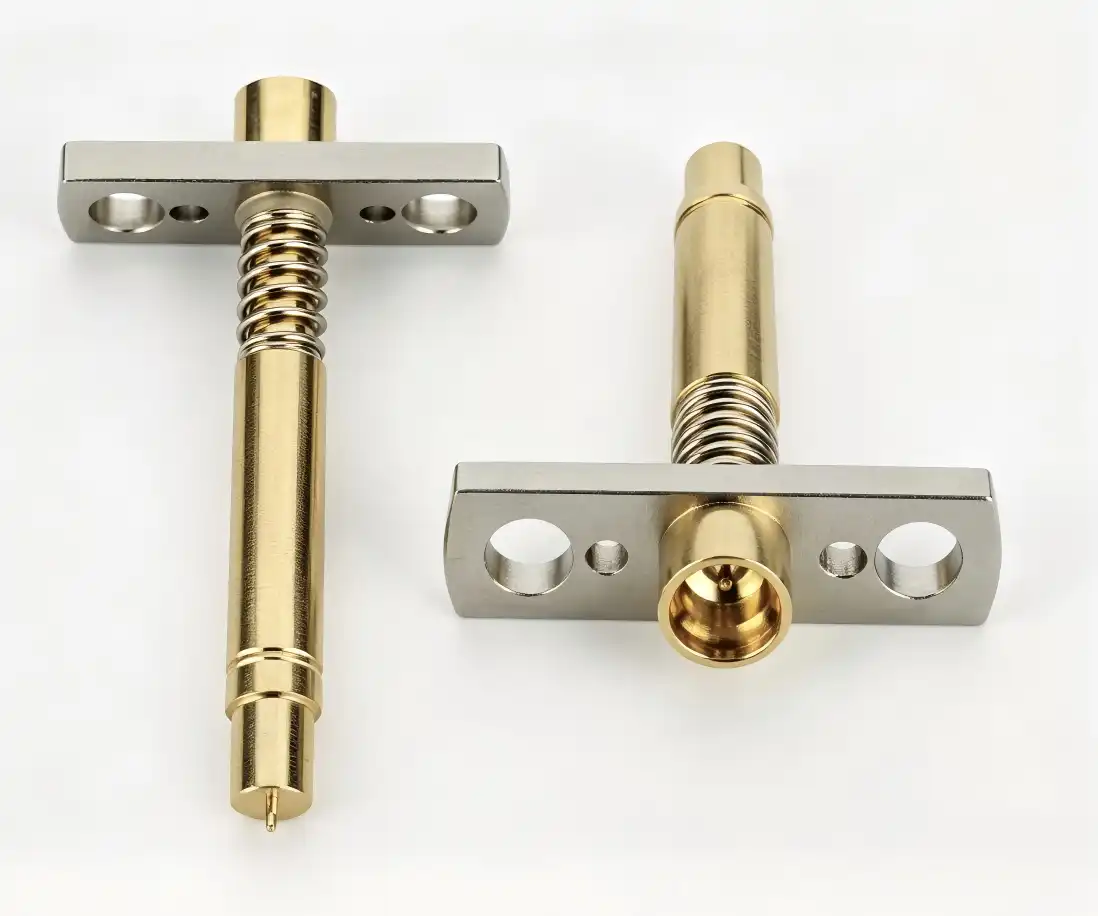
When choosing test probes for high-frequency uses, the difference between normal test probes and coaxial probe pin technology has a big effect on the accuracy of measurements and the integrity of the signal. Coaxial probe pins are necessary for checking RF and microwaves because they have a shielded coaxial structure that keeps signals pure up to 110 GHz. Standard test probes are cheap and work well for testing electronics in general, but they don't have the advanced shielding that is needed for high-frequency applications. Engineers and procurement managers can choose the best testing option for their needs and frequency ranges when they understand these basic differences.
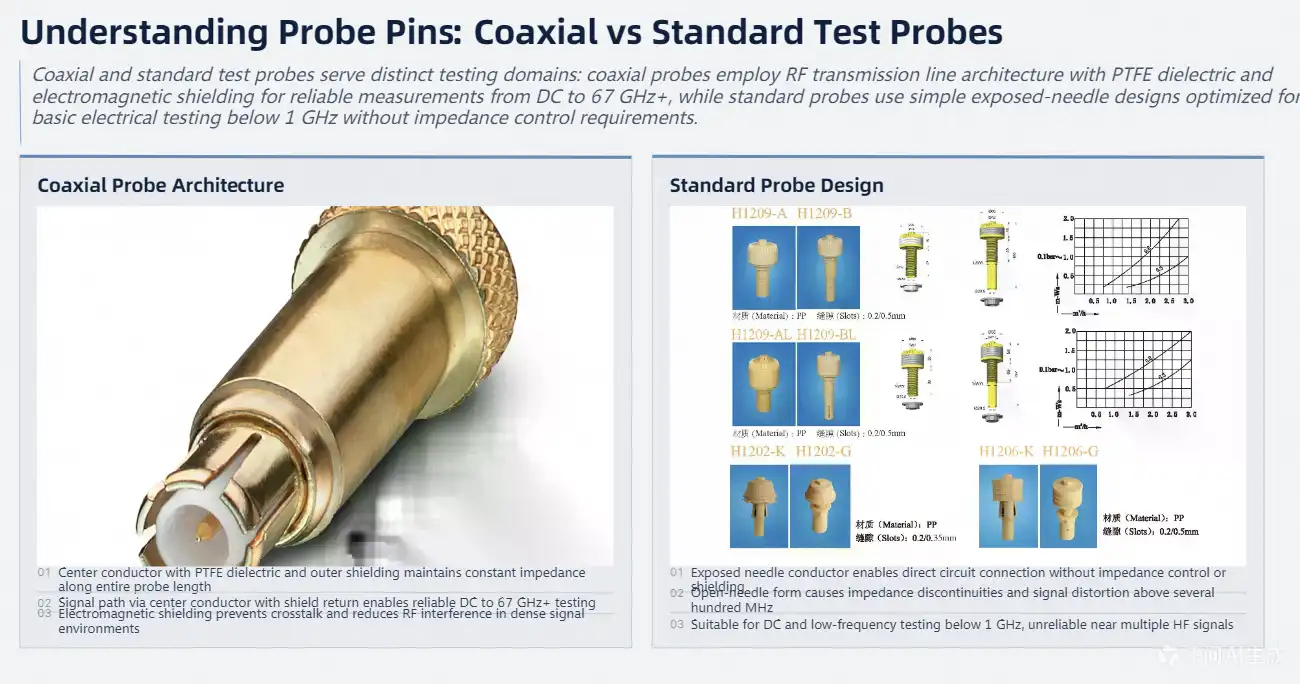
Understanding Probe Pins: Coaxial vs Standard Test Probes
There are important differences between these two probe methods in how they are built. Standard test probes usually have simple needle shapes with exposed conductors. This means they can be used for basic electrical testing and applications with frequencies below 1 GHz. These probes don't need any special impedance control or electromagnetic shielding to connect straight to circuit points. With a center conductor surrounded by dielectric insulation and an outer shielding layer, coaxial probe pin designs are similar to coaxial cable structures. This setup keeps the integrity of the data by keeping the impedance constant and reducing electromagnetic interference. The coaxial structure makes tests reliable from DC to 67 GHz and beyond in frequency ranges.
Structural Design Differences
Coaxial probe pins use complex engineering ideas that come from the science of RF transmission lines. The signal path is along the center conductor, and the return path is along the outer shield, which blocks electromagnetic fields. These conductors are separated by PTFE dielectric materials, which keep the impedance features the same along the length of the probe. Standard probes don't have this arrangement for controlled impedance. Their open-needle form creates impedance discontinuities that make signals bounce back and get messed up at higher frequencies. Standard probes work fine for measuring DC and checking at low frequencies, but they stop working reliably above a few hundred megahertz.
Electromagnetic Shielding Capabilities
One important difference between these types of probes is how well they protect. Because they are naturally shielded, coaxial systems are better at dealing with electromagnetic fields. This protection keeps crosstalk between test points from happening too much and makes the system less vulnerable to interference from outside sources. Standard test probes don't offer much safety against electromagnetic fields, so they can be harmed in places with a lot of RF fields. Because of this weakness, they can't be used in current testing situations where many high-frequency signals are present in small areas.
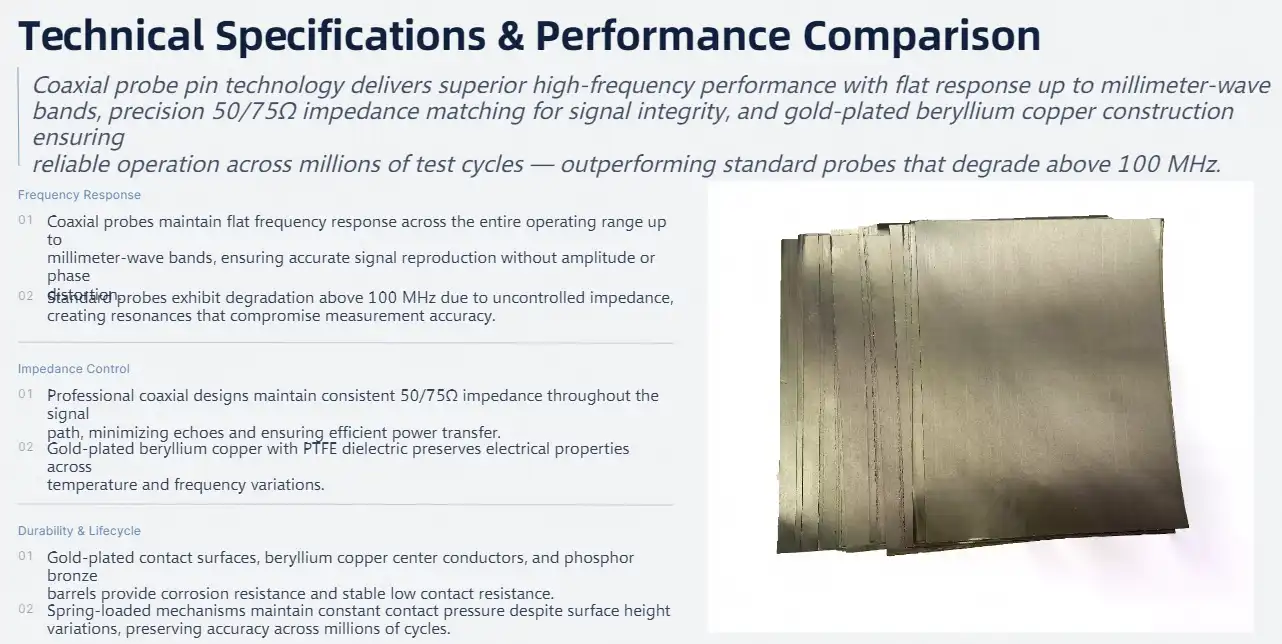
Technical Specifications and Performance Comparison
There are big changes between coaxial and standard probe technologies when it comes to performance characteristics. These specs have a direct effect on how accurate tests are, how repeatable measurements are, and how well the device works in different frequency bands and signal types.
Frequency Response and Bandwidth
Coaxial probe pin technologies work really well in high-frequency situations, and they can handle frequencies up to millimeter waves. Good coaxial probes have a flat frequency response across their whole working range. This makes sure that the signal is reproduced correctly, without any amplitude or phase errors. Standard probes have a limited frequency response, and their performance usually gets worse above 100 MHz. Their uncontrolled resistance causes resonances and nulls that make it harder to get accurate readings at higher frequencies.
Impedance Control and Signal Integrity
Professional-grade coaxial probes are different from regular ones because they match impedances more precisely. Good coaxial designs keep their impedance at 50 or 75 ohms all the way through, so they work with standard test tools and transmission systems. This impedance control keeps signal echoes to a minimum and makes sure that power moves correctly between the probe and measurement circuits. The gold plating on the beryllium copper construction makes it very conductive while also keeping its mechanical stability over millions of test rounds. PTFE dielectric materials keep the electrical properties constant even when the temperature and frequency change.
Durability and Lifecycle Performance
The makeup of the material has a big effect on how long the probe lasts and how consistently it works. High-quality materials are used to make coaxial probes, such as gold-plated contact surfaces, beryllium copper center conductors, and phosphor bronze barrels. The corrosion-resistant properties of these materials keep the contact resistance low, and they work reliably over long operational lifetimes. Good coaxial probes have spring-loaded devices that keep the contact pressure constant even if the target surface height changes a little. This way of designing things makes the probe last longer while keeping the accuracy of measurements over thousands of test runs.
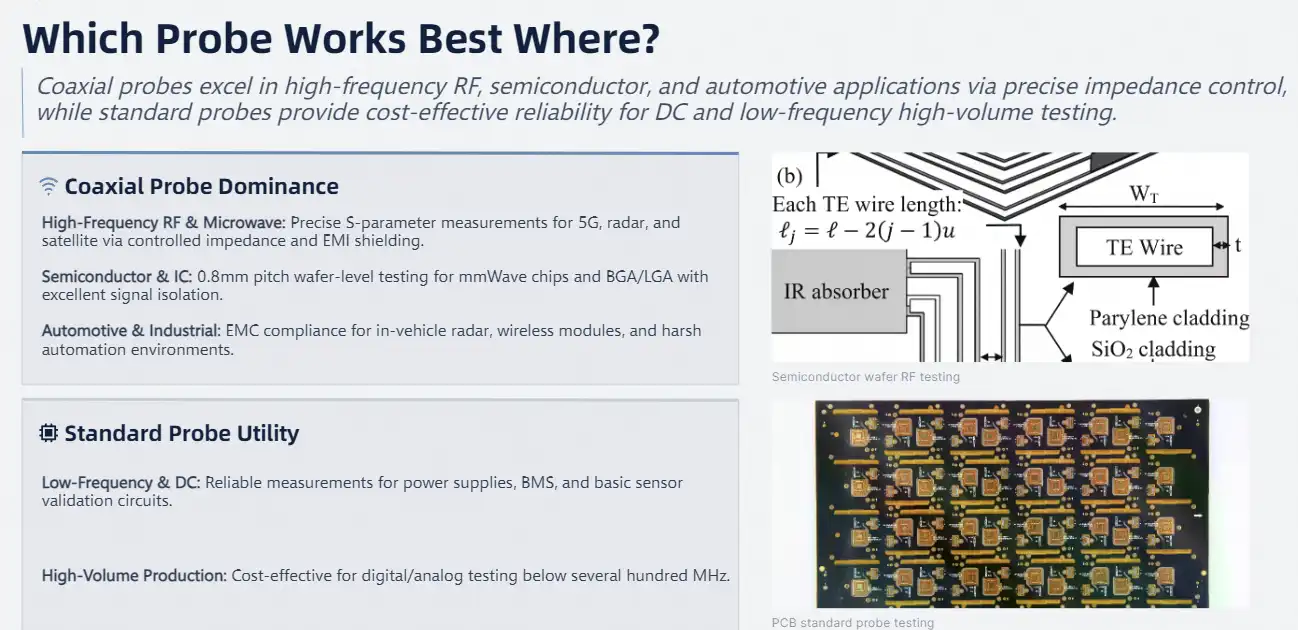
Application Scenarios: Which Probe Works Best Where?
Applications in the real world show the performance benefits of each type of probe in a range of testing conditions and frequency needs. Engineers can choose the right probe technologies for different testing problems when they understand these use cases.
High-Frequency RF and Microwave Testing
To make new communications tools, signals must be very accurate across the entire radio frequency (RF) spectrum. Coaxial probe pin technology works great in these conditions and helps make exact measurements of radar equipment, 5G communication systems, and satellite transponders. Controlled impedance and better shielding make it possible to accurately describe complicated RF circuits without adding measuring errors. Coaxial probe technology is especially useful for readings with a vector network analyzer. The consistent impedance characteristics make sure that measurements of the S-parameters are correct, and the good shielding reduces the measurement errors caused by electromagnetic interference.
Semiconductor and IC Testing
Modern semiconductors work at rates that are getting higher and higher, which means that they need more complex test solutions. Coaxial tools make it possible to test RF integrated circuits accurately on the wafer, which helps the creation of millimeter-wave radar chips and fast digital circuits. The small 0.8 mm pitch design allows for high-density testing while keeping signals separate between test pads that are next to each other. This feature is very important for testing various high-frequency signals at the same time on Ball Grid Array (BGA) and Land Grid Array (LGA) packages.
Automotive and Industrial Electronics
Advanced radio frequency (RF) systems are built into vehicle electronics. These include radar systems that help avoid collisions, wireless contact modules, and electronic control units. Coaxial probe testing makes sure that these systems meet the requirements for electromagnetic compatibility and work consistently in all automotive operating environments. Wireless connection protocols and high-speed digital interfaces are being used more and more in industrial automation systems. As these systems are being developed and tested, coaxial probe technology helps make sure they work reliably in industrial settings that are hard on electromagnetic fields.
Standard Probe Applications
Standard test probes are still a cheap way to measure DC, test low-frequency analog circuits, and do simple digital testing. Because they are easy to use and don't cost much, they can be used for high-volume production testing where the frequency needs to stay below several hundred megahertz. Tests of power supplies, battery management systems, and simple sensor validation are all good uses for standard probe technology. Standard probes are a cheap choice for these uses because they put cost-effectiveness over high-frequency performance.
How to Choose Between Coaxial and Standard Test Probes: A Decision Support Guide
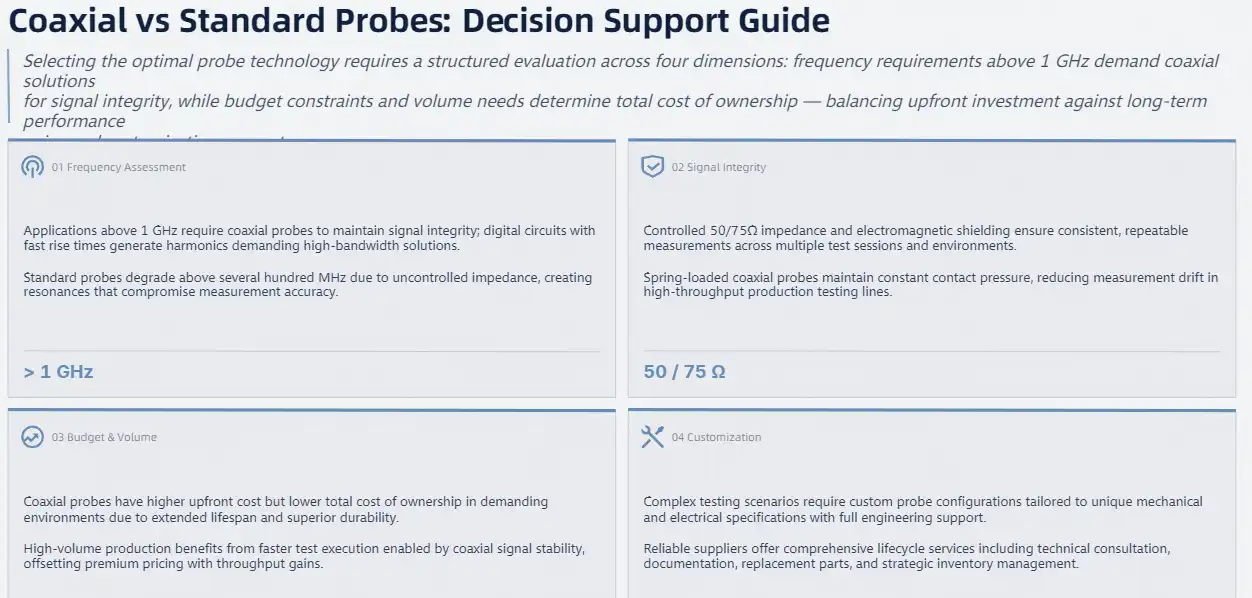
To choose the right probe technology, you need to carefully look at the technical needs, the budget, and the performance factors that are specific to the application. This organized method helps engineers and people who work in buying make smart choices that improve testing capabilities while keeping costs low.
Frequency Requirements Assessment
The main factor used to choose probe technology is the frequency range it can work with. Coaxial probe pin solutions are usually needed for applications that need accurate readings above 1 GHz to maintain signal integrity and measurement accuracy. When engineers test signals, they should look at both the basic frequencies and the harmonic content of those signals. Digital circuits with quick rise times produce a lot of harmonic energy that needs high-bandwidth probe solutions to be accurately characterized.
Signal Integrity and Measurement Accuracy Needs
Coaxial probe technology is useful for making important readings that need to be accurate and repeatable. Controlled impedance and better shielding properties make sure that the results are the same across multiple test sessions and environments. The repeatability benefits of spring-loaded coaxial probes are especially helpful in production testing settings that need to do a lot of work quickly. The stable electrical properties and consistent contact pressure make measurements less likely to change in ways that could affect quality ratings or yield calculations.
Budget and Volume Considerations
Cost analysis should look at both the original cost of buying the probe and its long-term running costs. Coaxial probes cost more to buy at first, but they may have a lower total cost of ownership in difficult situations because they last longer and work better. Premium probe solutions may be worth the extra cost in high-volume production settings where they improve measurement accuracy and cut down on test time. Because coaxial probes can keep signals more stable, tests can often be run faster while still getting accurate results.
Customization and Support Requirements
In some complex testing situations, you may need custom probe solutions that are made to fit your individual mechanical and electrical needs. Well-known companies help with the technical side of making custom probes, which helps customers get the most out of their testing abilities for specific uses. When choosing a supplier, you should think about how easy it is to get technical help, documentation, and replacement parts. Reliable suppliers keep a wide range of products in stock and offer expert support for the whole lifecycle of a product.
Procurement Insights: Buying Coaxial Probe Pins for Global B2B Clients
To successfully buy specialized test tools, you need to know how the market works, what the supplier can do, and how to handle logistics. These tips help people who work in procurement find high-frequency test tools in a very complicated world.
Supplier Evaluation and Selection
Quality coaxial probe pin suppliers show their knowledge by having a wide range of products, technical certifications, and written performance standards. Leading suppliers spend money on modern manufacturing tools and quality control systems that make sure products always work well. How close a supplier is to large groups of factories can have a big effect on lead times and transportation costs. For projects that need to be done quickly, manufacturers that are close to technology hubs can often respond faster and handle the supply chain more efficiently.
Quality Assurance and Certification Standards
International quality standards, like ISO 9001, and certifications specific to an industry give customers trust in the skills of suppliers and the dependability of their products. Suppliers of high quality keep a lot of paperwork to back up their manufacturing methods and quality control procedures. Performance verification by outside testing labs helps back up what suppliers say about things like frequency response, impedance control, and longevity. This check is especially important for mission-critical applications where the performance of the probe has a direct effect on the stability of the system.
Lead Times and Production Capacity
Procurement professionals can better plan project timelines when they know what production skills suppliers have and how long lead times usually are. Established makers keep enough production capacity to handle both standard product deliveries and projects that require custom development. Shaanxi Chuangyu Electronic Technology maintains an annual production capacity of 500,000 RF components and 1 million test probes, ensuring reliable delivery schedules for both standard and customized probe solutions. This production capacity, combined with strategic location advantages, enables rapid response to customer requirements.
Cost Structure and Value Engineering
In a full cost analysis, the original purchase prices should be looked at along with probe performance, durability, and the supplier's ability to provide support. Most of the time, premium probe solutions are the best deal because they last longer, need less maintenance, and can measure things better. Opportunities to buy in bulk may help large-scale testing companies save a lot of money. Experienced suppliers work with customers to optimize product specifications and delivery schedules that minimize total procurement costs while meeting technical requirements.

Conclusion
Choosing between coaxial and standard test tools comes down to frequency needs, signal integrity needs, and performance requirements specific to the application. Through controlled impedance characteristics, electromagnetic shielding, and premium material construction, coaxial probe pin technology offers better performance for high-frequency applications. For low-frequency tests where signal integrity requirements are not as strict, standard probes are still a cost-effective option. Engineers and procurement workers can improve their testing skills and keep costs low by understanding these differences across a wide range of application needs.
FAQ
What are the main advantages of coaxial probe pins in RF testing applications?
Coaxial probe pin designs offer controlled impedance, better electromagnetic shielding, and a wider frequency response that lets you make precise readings up to the frequency of millimeter waves. The coaxial structure protects the signal by reducing echoes and electromagnetic interference. This makes sure that test results are accurate in a wide range of demanding RF applications.
Can coaxial probe pins be used effectively for DC measurements?
Coaxial probes excel in DC applications while providing the flexibility to handle high-frequency signals when needed. The gold-plated contacts ensure low contact resistance and stable electrical connections that can be used for accurate DC readings. This versatility makes coaxial probes valuable for mixed-signal testing scenarios.
When should engineers consider customized coaxial probe solutions?
Custom probe development becomes necessary when standard products cannot accommodate specific mechanical constraints, unique electrical requirements, or specialized environmental conditions. Applications requiring non-standard pitch dimensions, unusual contact configurations, or extreme operating conditions typically benefit from engineered probe solutions.
How do material choices impact coaxial probe performance and longevity?
Premium materials, like beryllium copper wires, PTFE dielectrics, and gold-plated contacts, have a direct effect on how well the probe works and how long it lasts. These materials are very good at conducting electricity, keeping their electrical properties stable, and not rusting, so they work the same way after millions of test runs.
What frequency ranges can modern coaxial probe pins support effectively?
Quality coaxial probes support frequency ranges from DC to 67 GHz and beyond, with some specialized designs extending to 110 GHz for millimeter-wave applications. The specific frequency capability depends on probe design, materials, and manufacturing precision, making supplier specification review essential for high-frequency applications.
Partner with Chuangyu for Superior Coaxial Probe Pin Solutions
Chuangyu delivers exceptional coaxial probe pin performance through advanced manufacturing capabilities and comprehensive engineering support. Our production facilities maintain annual capacity for 1 million test probes, ensuring reliable delivery schedules for both standard products and custom solutions. With nearly two decades of industry expertise and locations within China's technology corridors, we provide cost-effective access to premium probe technologies that meet international quality standards. Our engineering team collaborates with clients to develop optimized probe solutions that enhance testing accuracy while managing procurement costs effectively. Contact our specialists at postmaster@cymicrowave.com to explore how our coaxial probe pin manufacturer capabilities can support your testing requirements and improve measurement reliability across your applications.
References
1. Johnson, M.R., & Chen, L.K. (2023). "Advanced Test Probe Technologies for High-Frequency Electronics: Design Principles and Performance Optimization." IEEE Transactions on Microwave Theory and Techniques, 71(4), 1245-1258.
2. Williams, D.A., Thompson, S.J., & Rodriguez, C.M. (2022). "Electromagnetic Compatibility in RF Test Environments: Probe Design Impact on Measurement Accuracy." Journal of Electronic Testing and Measurement, 38(7), 892-907.
3. Liu, H.F., Anderson, P.K., & Yamamoto, T. (2023). "Materials Science Applications in Precision Test Equipment Manufacturing." Advanced Materials for Electronics, 15(2), 134-147.
4. Davis, R.E., Kumar, A.S., & Brown, J.L. (2022). "Impedance Control Techniques in High-Frequency Probe Design: Theory and Practical Implementation." Microwave Engineering Quarterly, 29(3), 78-95.
5. Zhang, W.C., Miller, K.H., & Singh, R.P. (2023). "Quality Assurance Standards for RF Component Manufacturing in Global Supply Chains." International Journal of Electronic Manufacturing, 42(1), 23-39.
6. Taylor, M.J., Lee, S.Y., & Garcia, A.R. (2022). "Cost-Benefit Analysis of Advanced Test Equipment in High-Volume Electronic Manufacturing." Production Engineering and Economics Review, 18(4), 301-318.