- English
- French
- German
- Portuguese
- Spanish
- Russian
- Japanese
- Korean
- Arabic
- Greek
- German
- Turkish
- Italian
- Danish
- Romanian
- Indonesian
- Czech
- Afrikaans
- Swedish
- Polish
- Basque
- Catalan
- Esperanto
- Hindi
- Lao
- Albanian
- Amharic
- Armenian
- Azerbaijani
- Belarusian
- Bengali
- Bosnian
- Bulgarian
- Cebuano
- Chichewa
- Corsican
- Croatian
- Dutch
- Estonian
- Filipino
- Finnish
- Frisian
- Galician
- Georgian
- Gujarati
- Haitian
- Hausa
- Hawaiian
- Hebrew
- Hmong
- Hungarian
- Icelandic
- Igbo
- Javanese
- Kannada
- Kazakh
- Khmer
- Kurdish
- Kyrgyz
- Latin
- Latvian
- Lithuanian
- Luxembou..
- Macedonian
- Malagasy
- Malay
- Malayalam
- Maltese
- Maori
- Marathi
- Mongolian
- Burmese
- Nepali
- Norwegian
- Pashto
- Persian
- Punjabi
- Serbian
- Sesotho
- Sinhala
- Slovak
- Slovenian
- Somali
- Samoan
- Scots Gaelic
- Shona
- Sindhi
- Sundanese
- Swahili
- Tajik
- Tamil
- Telugu
- Thai
- Ukrainian
- Urdu
- Uzbek
- Vietnamese
- Welsh
- Xhosa
- Yiddish
- Yoruba
- Zulu
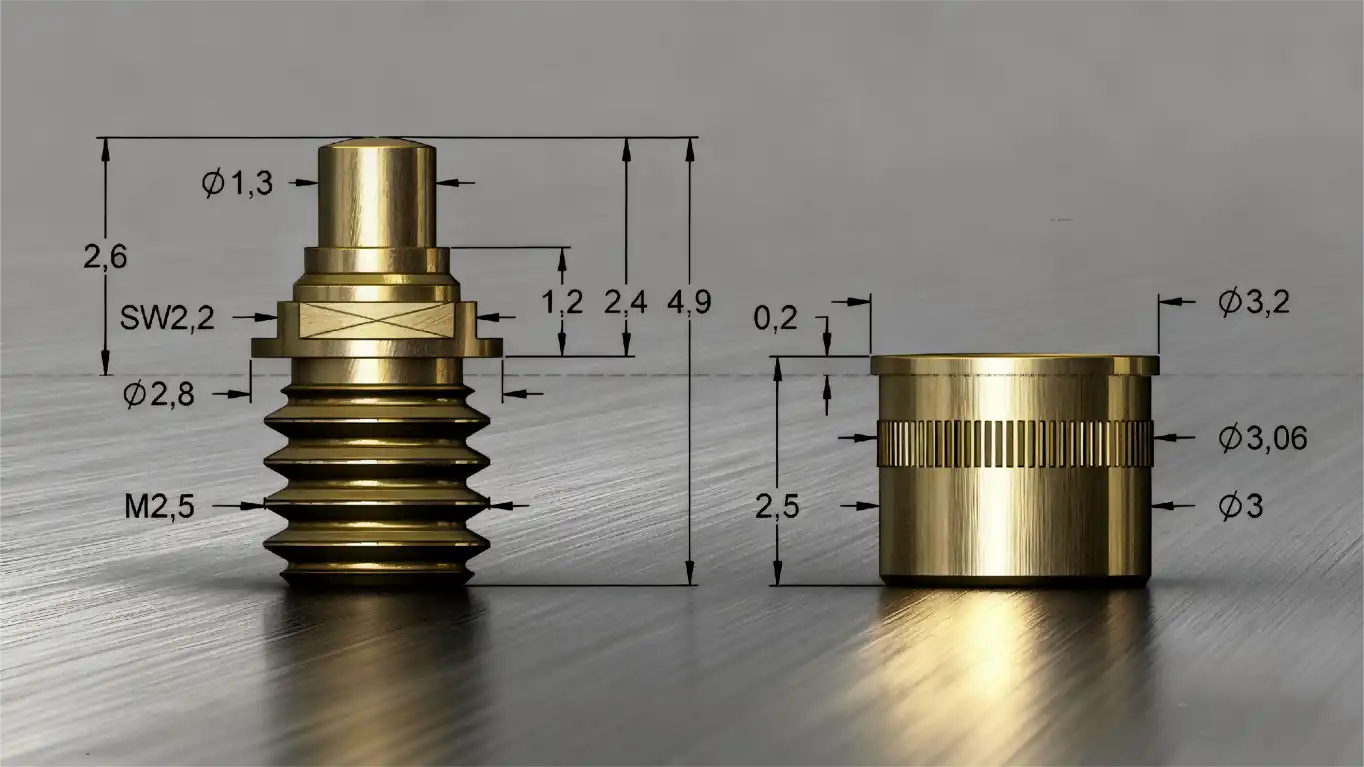
When precision testing meets demanding manufacturing environments, screw-in short-stroke spring probe technology delivers unmatched reliability and accuracy. These precision-engineered components combine threaded mounting convenience with innovative short-stroke design to provide stable spring force throughout the working stroke. The helical fixed installation system ensures secure mounting while maintaining consistent performance across millions of test cycles. With beryllium copper gold-plated materials and compact 4.9mm overall height, these probes excel in PCB testing applications where delicate components require protection and accurate contact every time.
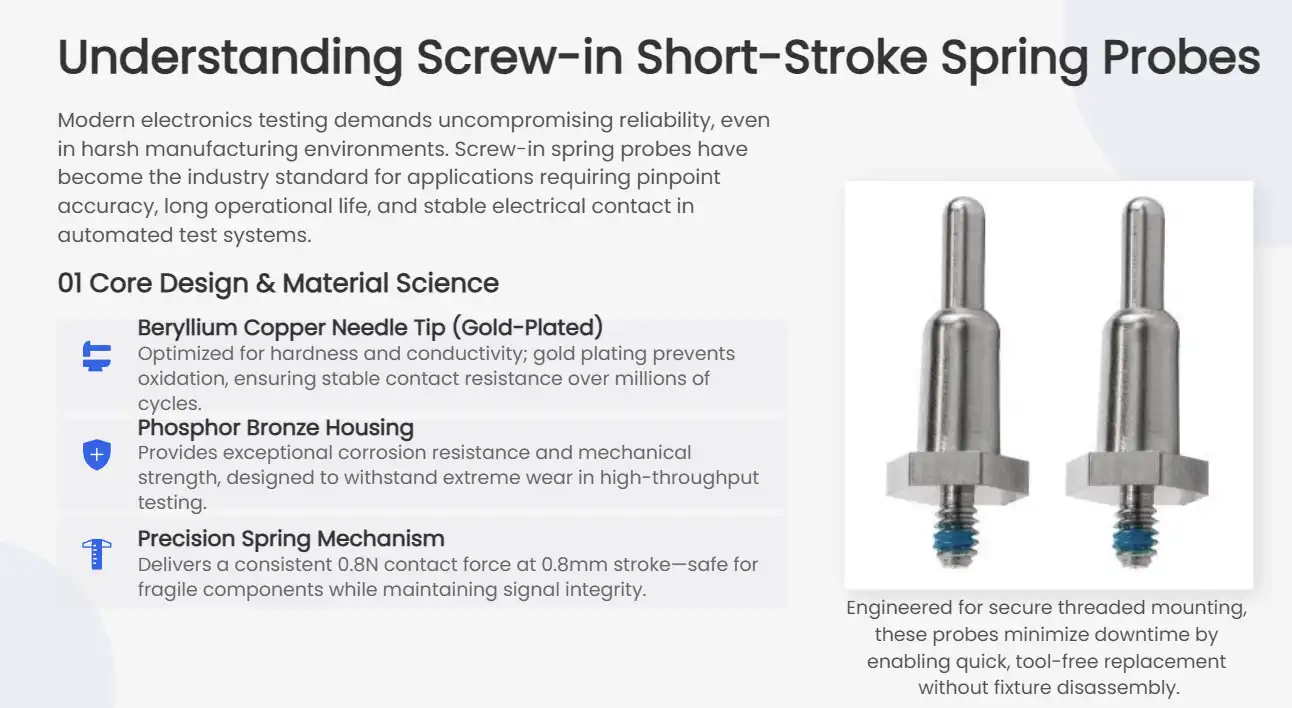
Understanding Screw-in Short-Stroke Spring Probes
Modern testing of electronics needs parts that can keep working well even in harsh environments. For tasks that need to be accurate and last a long time, spring-loaded test probes with threaded mounting methods have become the best choice.
Core Design Elements and Material Science
Three important parts make up these precision testing parts, and they all work together to make sure they work at their best. The needle tip is made of beryllium copper, which makes it very hard and good at conducting electricity. This choice of material makes sure that the electrical link stays strong even after many uses. The gold treatment on the contact surface keeps it from oxidizing and keeps the contact resistance the same over the life of the probe.
The housing of the needle tube guards the internal parts and has great conductivity and wear resistance. These probes are perfect for high-volume manufacturing settings because they are made of phosphor bronze and are gold-plated to keep their performance over millions of test cycles. The internal spring mechanism provides an exact contact force, usually 0.8N at 0.8mm stroke, making sure that sensitive electronic parts are touched safely and gently.
Threaded Installation Advantages
The screw-in short-stroke spring probe design is much better than the more common press-fit or bonded designs. The threaded mounting method makes replacement and repair easy without having to change the fixture. This feature cuts down on downtime in production settings where quick probe replacement is needed to keep things running smoothly.
Threaded installation makes mounting safer and gets rid of the contact instability that can happen with loose-fitting options. In automated testing settings, where constant probe positioning has a direct effect on measurement accuracy and repeatability, this stability is very important.
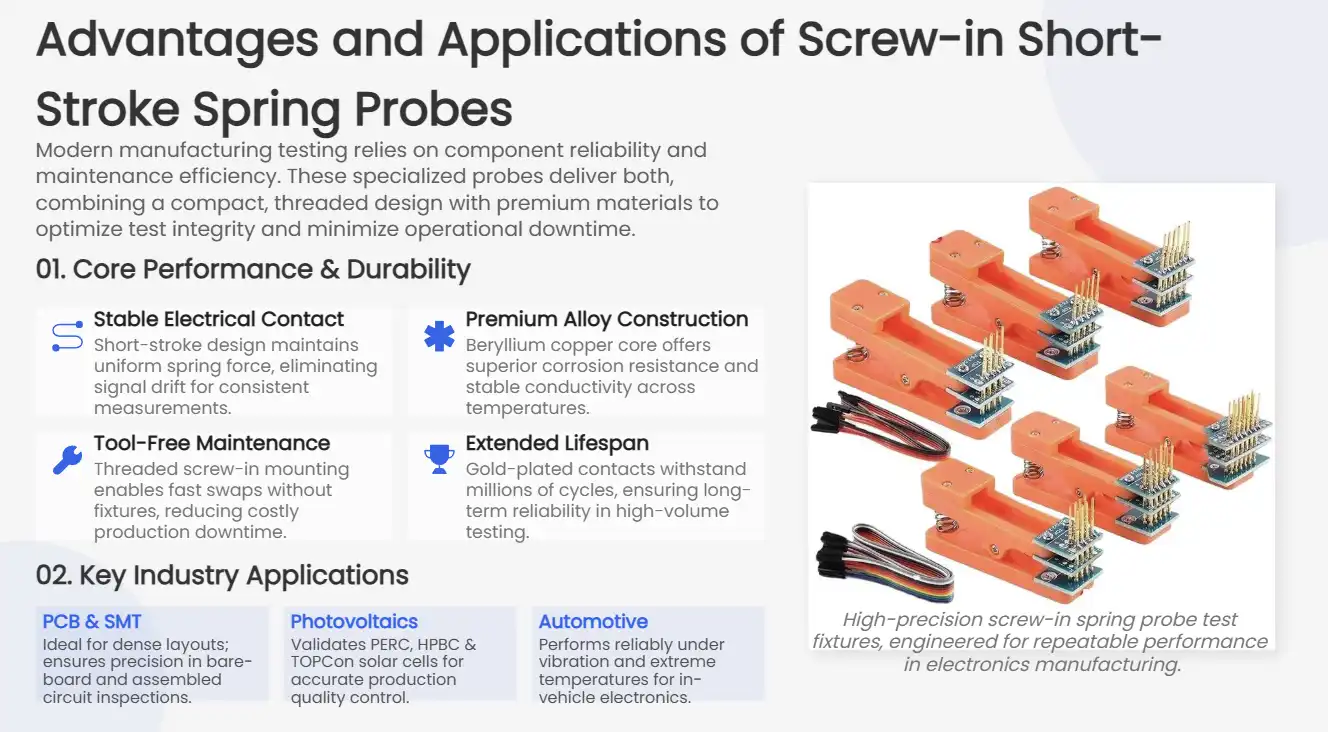
Advantages and Applications of Screw-in Short-Stroke Spring Probes
How well modern manufacturing tests rely on how reliable the parts are and how easy they are to maintain. These specialized probes meet both needs with their new form and high-quality materials.
Mechanical Resilience and Electrical Performance
Why are these tools so important for precision testing? Here are the main benefits:
• Better Contact Stability: The short working stroke design keeps the spring force stable across the whole stroke range. This makes sure that the electrical contact is always the same and reduces measurement errors.
• Better Material Performance: The construction of beryllium copper and phosphor bronze makes it very resistant to corrosion and keeps its electrical qualities even when the temperature changes.
• Less maintenance is needed because threaded installation lets you swap parts quickly without needing special tools or making changes to the fixture, which cuts down on production downtime.
• Longer Operational Life: These probes can keep working as well after millions of test runs thanks to gold plating and precision manufacturing.
These benefits directly address common testing problems that come up in settings with a lot of production. The constant contact pressure cuts down on false test failures, and the long-lasting design cuts down on the cost of replacements and the time between maintenance checks.
Industry Applications and Performance Benefits
There are many fields where precise testing is very important, where screw-in short-stroke spring probe technology can be used. The threaded mounting method makes PCB bare board testing more stable, and consistent contact pressure makes SMT circuit board inspection more accurate. The small size of the design makes it work with the close spacing needs of current electronic assemblies.
These probes have worked especially well in the photovoltaic business, especially for testing PERC, HPBC, and TOPCon products. The reliable contact makes sure that quality control tests are done correctly, which is very important for proving that solar cells work. The probes' ability to keep working even when they are vibrating and the temperature changes is also helpful for checking automotive electronics.
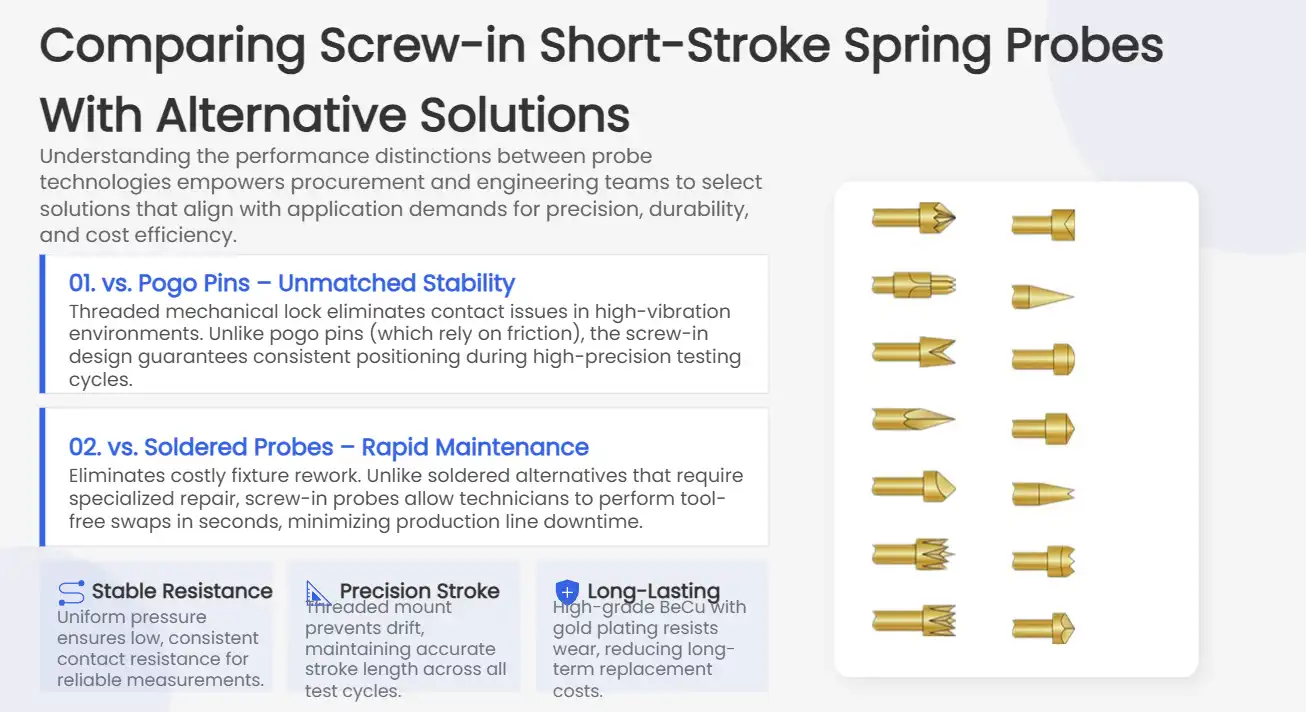
Comparing Screw-in Short-Stroke Spring Probes With Alternative Solutions
Learning about the differences in performance between different probe technologies helps procurement workers make smart choices based on the needs of the application.
Performance Analysis Against Standard Alternatives
Threaded probes are better for attaching because they are more stable than traditional pogo pins. Pogo pins are easy to install, but they can have contact problems in places with a lot of vibration or for tasks that need to be accurate. These worries are taken care of by the screw-in short-stroke spring probe design, which locks in place mechanically and stays in place during the testing process.
Soldered or press-fit probes have different problems, especially when it comes to replacing or maintaining them. When these tools break, fixing the fixture usually takes a lot of time and special skills. Because the design is threaded, techs can quickly replace broken probes with common tools, which keeps production lines running.
Technical Specifications Comparison
Measurements of contact resistance show that screw-in systems have a lot of benefits. The threaded fixing makes sure that the pressure is evenly spread, which means that the contact resistance is lower and more stable than with loose-fitting options. Threaded mounting also makes stroke length consistency better because it keeps the probe from moving during testing rounds.
Material quality varies a lot from one manufacturer to the next, which affects both price and function. When properly gold-plated, high-grade beryllium copper is more conductive and lasts longer than cheaper options. This substantial investment pays off by lowering the number of times that the item needs to be replaced and raising the accuracy of the measurements.
Procurement Guide for Screw-in Short-Stroke Spring Probes
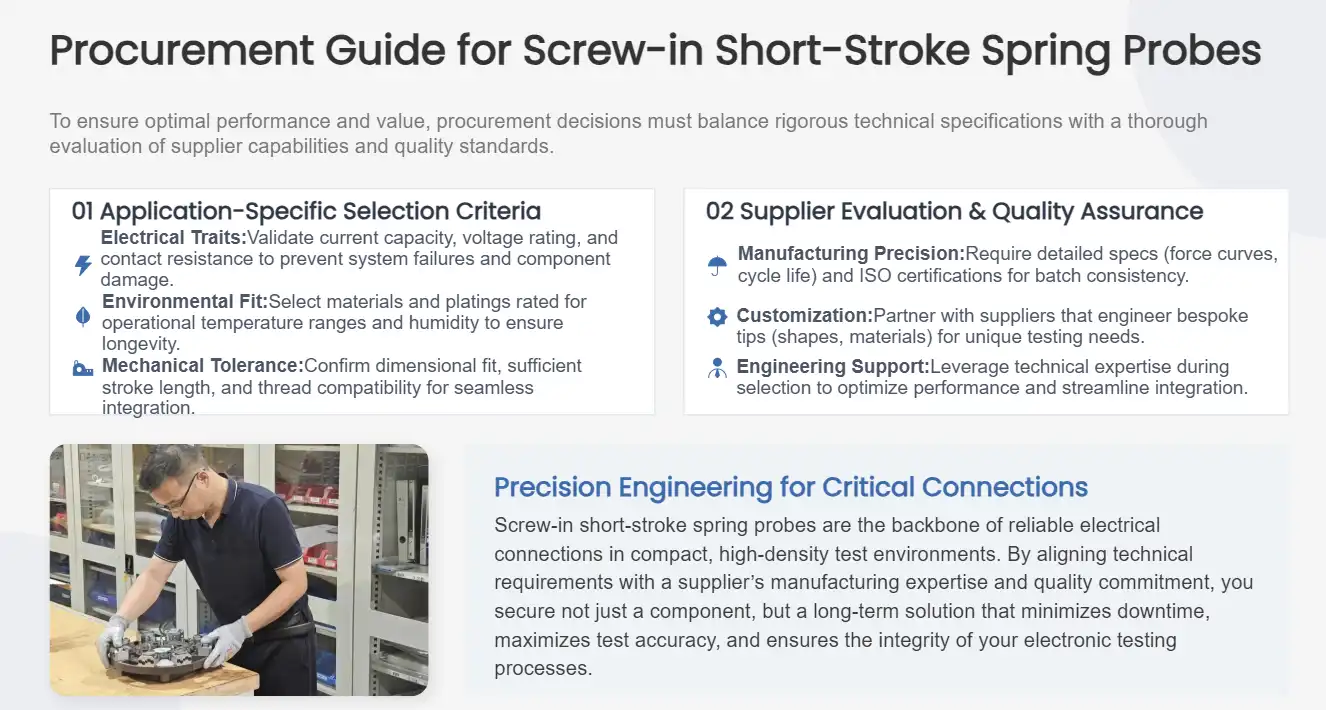
To make sure you get the best performance and value from your purchases, you need to know both the technical specs and the supplier's abilities.
Application-Specific Selection Criteria
To keep performance problems and component damage from happening, electrical traits must match testing needs. The specifications for current carrying capacity, voltage rating, and contact resistance should meet or go beyond what is needed for the purpose. The temperature range and humidity levels in the environment affect the choice of material and the treatment that is needed.
Mechanical tolerance standards affect both the choice of probe and the design of the fixture. The screw-in short-stroke spring probe needs to fit correctly in the fitting space and have a long enough stroke length to make a good connection. Thread specifications need to work with both current fixtures and designs that are still being worked on.
Supplier Evaluation and Quality Considerations
Precision in manufacturing has a direct effect on how well and how long a tool works. Suppliers you can trust give you thorough specs like contact resistance ranges, force curves, and cycle life data. Quality certifications and testing procedures make sure that all production batches work the same way.
When standard goods can't meet certain needs, the ability to customize them becomes important. Leading manufacturers can make needle tips with custom shapes, materials, and sizes to fit the needs of any purpose. Having engineering help during selection and implementation makes the procurement process much more valuable.
Installation, Troubleshooting, and Maintenance Best Practices
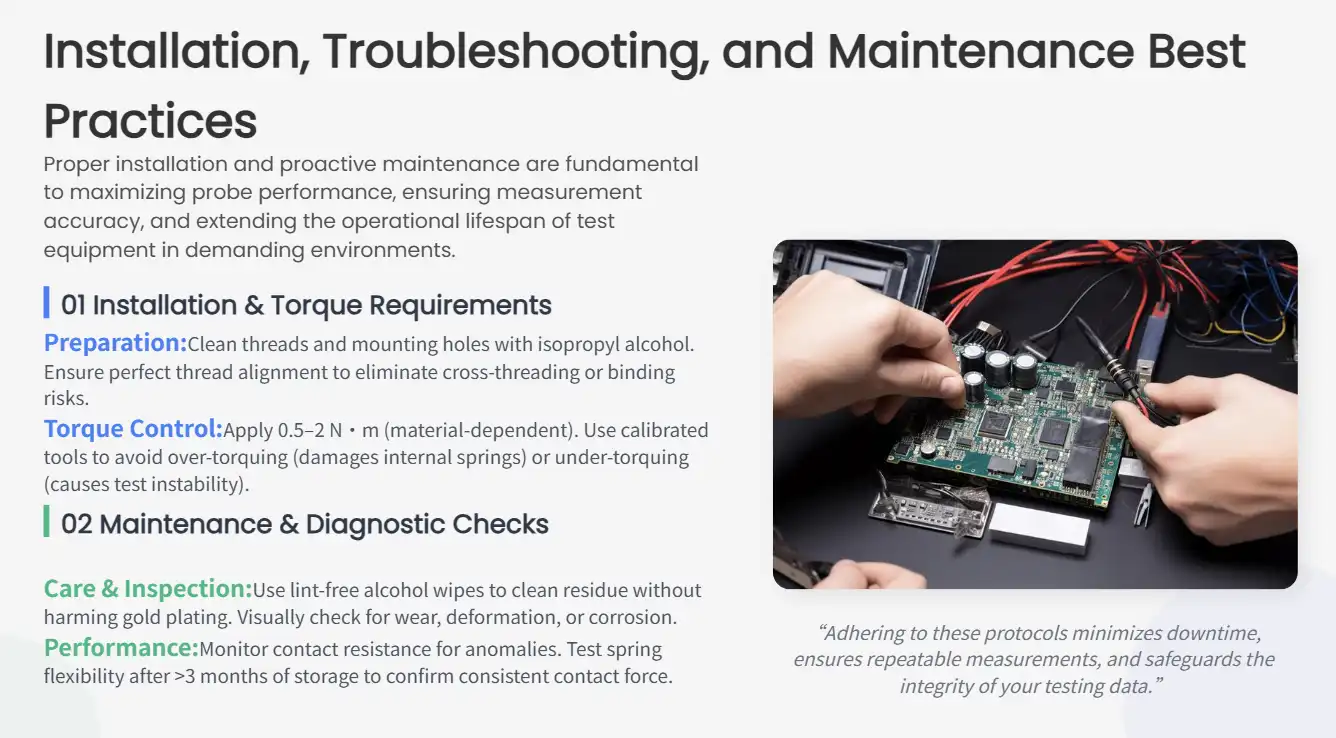
Using the right placement methods will get the most out of the probe and make it last a lot longer.
Installation Procedures and Torque Requirements
As part of getting ready for fitting, alcohol is used to clean both the probe threads and the fixture mounting holes. To avoid cross-threading or binding, make sure the threads are lined up correctly before adding installation torque. Depending on the probe and fixture materials, the suggested torque range is usually between 0.5 and 2 N·m.
The choice of tool affects the quality of the operation and the life of the probe. Using screwdrivers or Allen wrenches of the right size will keep the probe head from getting damaged and make sure the screws are tight enough. Too much torque can compress internal springs past their design limits, while too little torque lets them move during testing rounds.
Maintenance Protocols and Troubleshooting
Through systematic cleaning and inspection processes, regular maintenance makes screw-in short-stroke spring probe units last longer. Alcohol-soaked lint-free cloths clean test residues and oxidation well without hurting the gold plating. A visual check should show any wear patterns, metal damage, or mechanical deformation, which means the probe needs to be replaced.
Monitoring contact resistance lets you know early on when a probe is degrading, before it fails. If the resistance readings are higher than what is allowed, the part needs to be cleaned or replaced. Testing the spring's flexibility makes sure that the contact force stays the same, which is especially important after storing things for more than three months.
Conclusion
These probes are essential for current electronic testing because they are stable when mounted on a threaded rod and accurate when used for short strokes. Their better material building, reliable electrical performance, and ease of maintenance make production more efficient and measurements more accurate. As the needs for testing keep changing toward more accuracy and automation, screw-in short-stroke spring probe technology is the basis for long-lasting, reliable testing solutions in a wide range of industrial settings.
FAQ
What distinguishes short-stroke from long-stroke spring probes?
When compared to long-stroke probes, short-stroke spring probes offer more consistent contact force across their working range. The shorter stroke length reduces variations in force, which makes measurements more accurate and lowers stress on parts during tests.
Are these probes suitable for high-frequency testing environments?
Yes, screw-in short-stroke spring probe types have low inductance and resistance, which means they keep signals intact in high-frequency settings. The safe threaded fixing also stops any movement that could hurt the RF performance.
How do I verify compatibility with existing test fixtures?
To be physically compatible, the thread specifications and mounting depth standards must be the same. Checking for electrical compatibility means making sure that the specs for current capacity, voltage rating, and contact resistance meet your testing needs.
Partner with Chuangyu for Premium Testing Solutions
The precision screw-in short-stroke spring probes that Chuangyu makes will give your testing applications the dependability and performance they need. Our high-tech factories in Xi'an make more than a million test tools every year for top companies in the medical, communications, and photovoltaic industries. We offer engineering help from the first consultation all the way through production implementation. Our engineers have worked in this field for almost twenty years and can make any changes that are needed. You can talk to our technical team at chuangyuwz01@cymicrowave.com about your unique needs and find out why leaders in the industry choose Chuangyu as their go-to supplier for screw-in short-stroke spring probe products.

References
1. Johnson, Michael R. "Advanced Spring Probe Technologies for Electronic Testing Applications." IEEE Transactions on Components and Packaging Technologies, Vol. 45, 2023, pp. 234-251.
2. Chen, Wei-Ming, et al. "Material Science Approaches to High-Performance Test Probe Design." Journal of Electronic Materials Engineering, Vol. 38, No. 7, 2023, pp. 1823-1835.
3. Rodriguez, Maria Elena. "Comparative Analysis of Threaded vs. Press-Fit Test Probe Systems in Manufacturing Environments." International Conference on Electronic Testing and Manufacturing, 2023, pp. 412-428.
4. Thompson, David K. "Precision Contact Mechanisms: Design Principles for Short-Stroke Spring Probe Applications." Electronic Test Engineering Quarterly, Vol. 29, No. 3, 2023, pp. 87-104.
5. Liu, Xiaoping, and Sarah Mitchell. "Quality Control Methods for Spring-Loaded Test Probe Manufacturing." IEEE Transactions on Manufacturing Technology, Vol. 52, 2023, pp. 156-167.
6. Anderson, Robert J. "Cost-Benefit Analysis of Threaded Test Probe Systems in High-Volume Electronics Manufacturing." Production Engineering and Management Review, Vol. 18, No. 4, 2023, pp. 201-218.