- English
- French
- German
- Portuguese
- Spanish
- Russian
- Japanese
- Korean
- Arabic
- Greek
- German
- Turkish
- Italian
- Danish
- Romanian
- Indonesian
- Czech
- Afrikaans
- Swedish
- Polish
- Basque
- Catalan
- Esperanto
- Hindi
- Lao
- Albanian
- Amharic
- Armenian
- Azerbaijani
- Belarusian
- Bengali
- Bosnian
- Bulgarian
- Cebuano
- Chichewa
- Corsican
- Croatian
- Dutch
- Estonian
- Filipino
- Finnish
- Frisian
- Galician
- Georgian
- Gujarati
- Haitian
- Hausa
- Hawaiian
- Hebrew
- Hmong
- Hungarian
- Icelandic
- Igbo
- Javanese
- Kannada
- Kazakh
- Khmer
- Kurdish
- Kyrgyz
- Latin
- Latvian
- Lithuanian
- Luxembou..
- Macedonian
- Malagasy
- Malay
- Malayalam
- Maltese
- Maori
- Marathi
- Mongolian
- Burmese
- Nepali
- Norwegian
- Pashto
- Persian
- Punjabi
- Serbian
- Sesotho
- Sinhala
- Slovak
- Slovenian
- Somali
- Samoan
- Scots Gaelic
- Shona
- Sindhi
- Sundanese
- Swahili
- Tajik
- Tamil
- Telugu
- Thai
- Ukrainian
- Urdu
- Uzbek
- Vietnamese
- Welsh
- Xhosa
- Yiddish
- Yoruba
- Zulu
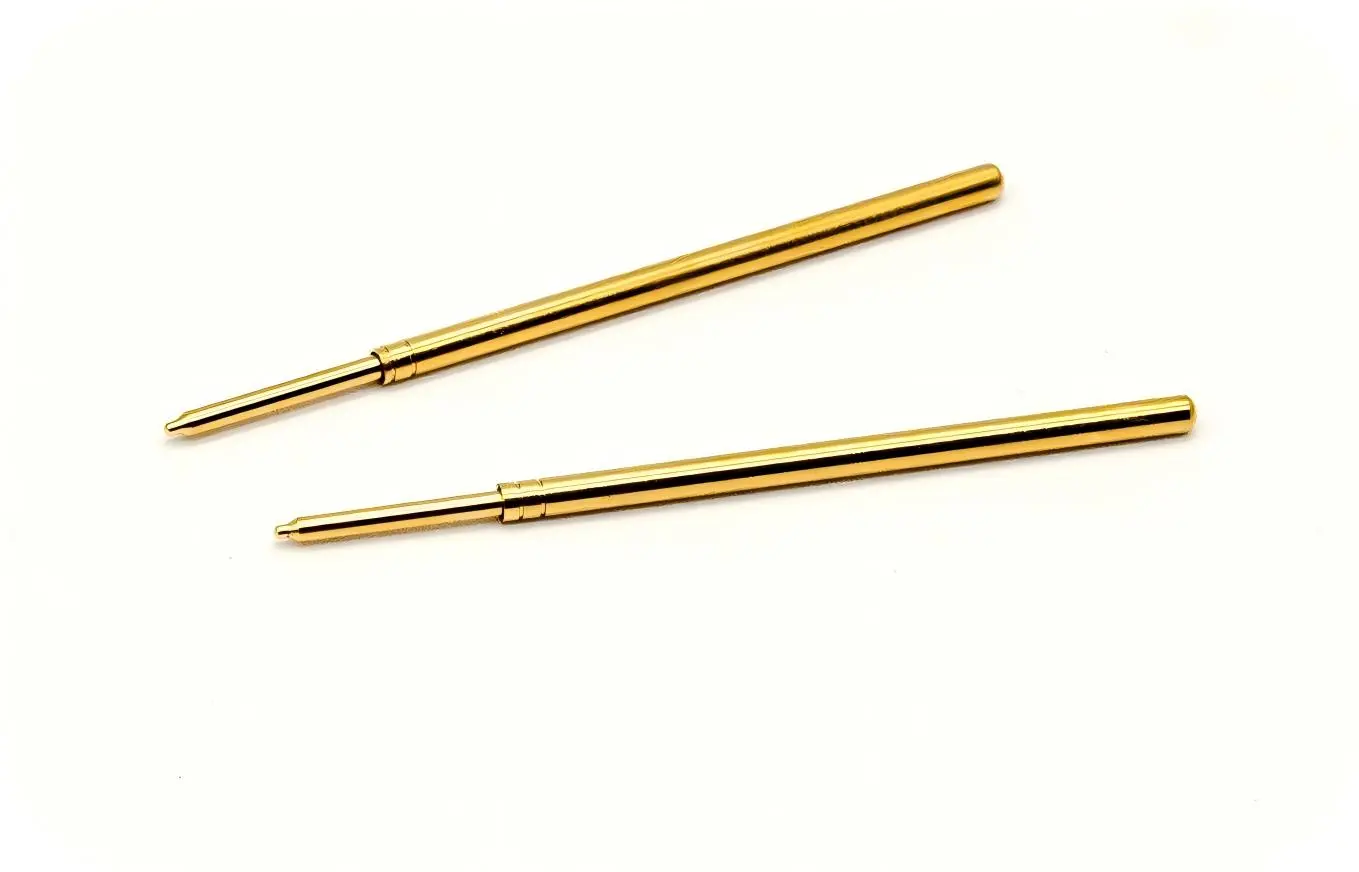
To choose the correct 0.5mm ball head photovoltaic test probe Scorpio, you need to carefully think about the technical specs, the quality of the material, and the needs of the application. The spherical contact design on these precision tools makes sure that the electrodes make good contact with the solar cells while also keeping the delicate grid lines from getting damaged. For the most accurate testing, the contact resistance must be less than 15mOhm, the working temperature range is wide, and the probe lasts more than a million test cycles.
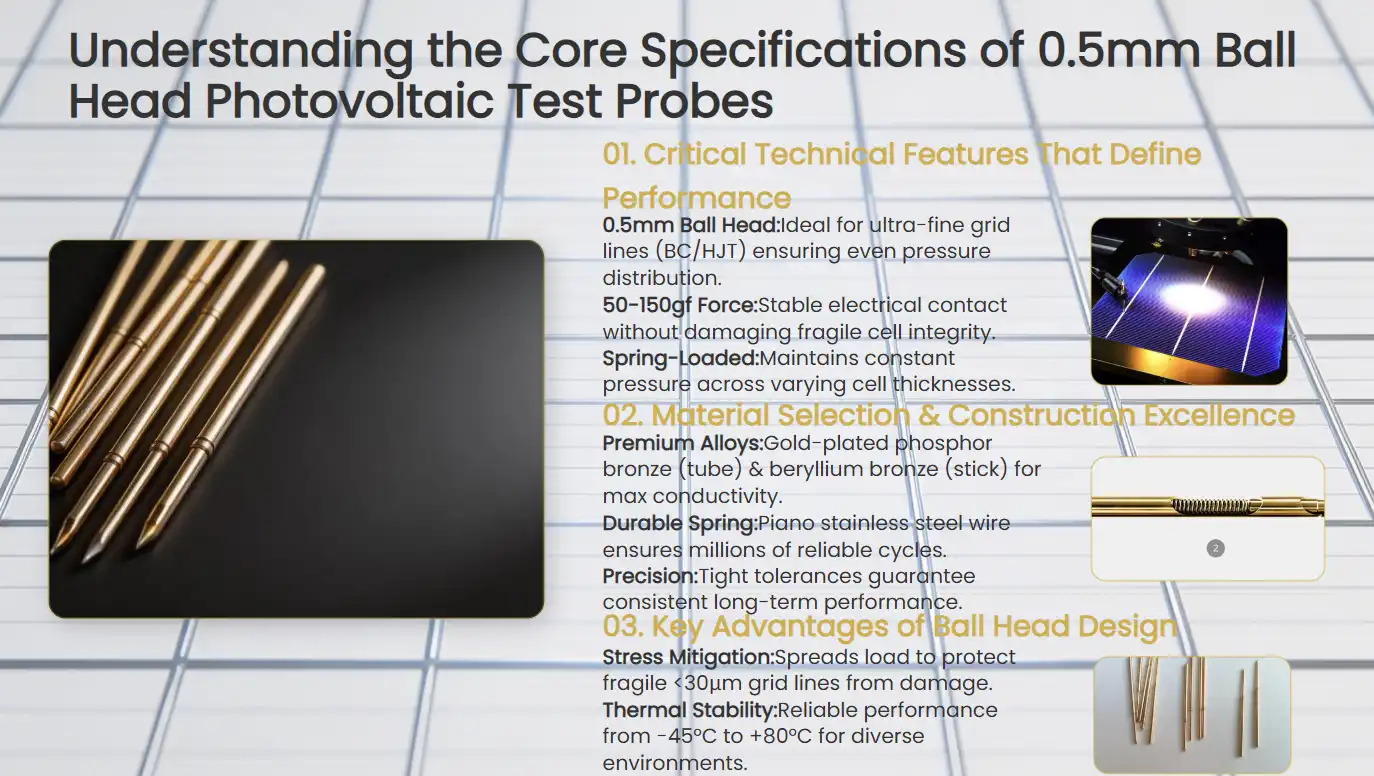
Understanding the Core Specifications of 0.5mm Ball Head Photovoltaic Test Probes
Critical Technical Features That Define Performance
The basic features of photovoltaic test tools have a direct effect on how well they test and how reliable they are in use. The 0.5mm diameter ball head shape is a well-thought-out answer to the problems that come up when testing solar cells today. Modern cell technologies, such as BC, HJT, and perovskite cells, use ultra-fine grid lines that are protected by this spherical contact design. The pressure is spread evenly across the contact area.
Contact force factors are very important to how well a probe works. The best contact pressure is usually between 50 and 150 grams-force, which makes sure that the electrical link is stable without affecting the integrity of the cell. The spring-loaded telescopic frame can hold cells of different thicknesses and keep the contact pressure constant during the testing cycle.
Material Selection and Construction Excellence
Professional-grade test tools are different from regular ones because they use advanced material engineering. Gold-plated phosphor bronze is used to make the needle tube, and gold-plated beryllium bronze is used to make the needle stick. This mix of materials has great conductivity, wear resistance, and corrosion protection, all of which are needed for high-frequency tests.
The piano's stainless steel wire used in the spring mechanism makes it reliable for millions of operational cycles of expansion and contraction. This precise engineering makes sure that the probe works the same way throughout long testing sessions and that the electrical specifications stay within very close ranges.
Ball Head Design Advantages Over Conventional Probes
When compared to regular needle-point tools, the spherical tip shape has clear benefits. Ball head contact spreads stress out over a bigger area, making the contact more stable and reducing stress on the grid lines that are already fragile. With grid line widths below 30 micrometers, this design is especially good for trying new photovoltaic technologies.
Another important benefit is that the temperature value is stable. Quality ball head probes keep their electrical performance from -45°C to +80°C, so they can be used in a wide range of testing environments without losing their accuracy or performance.
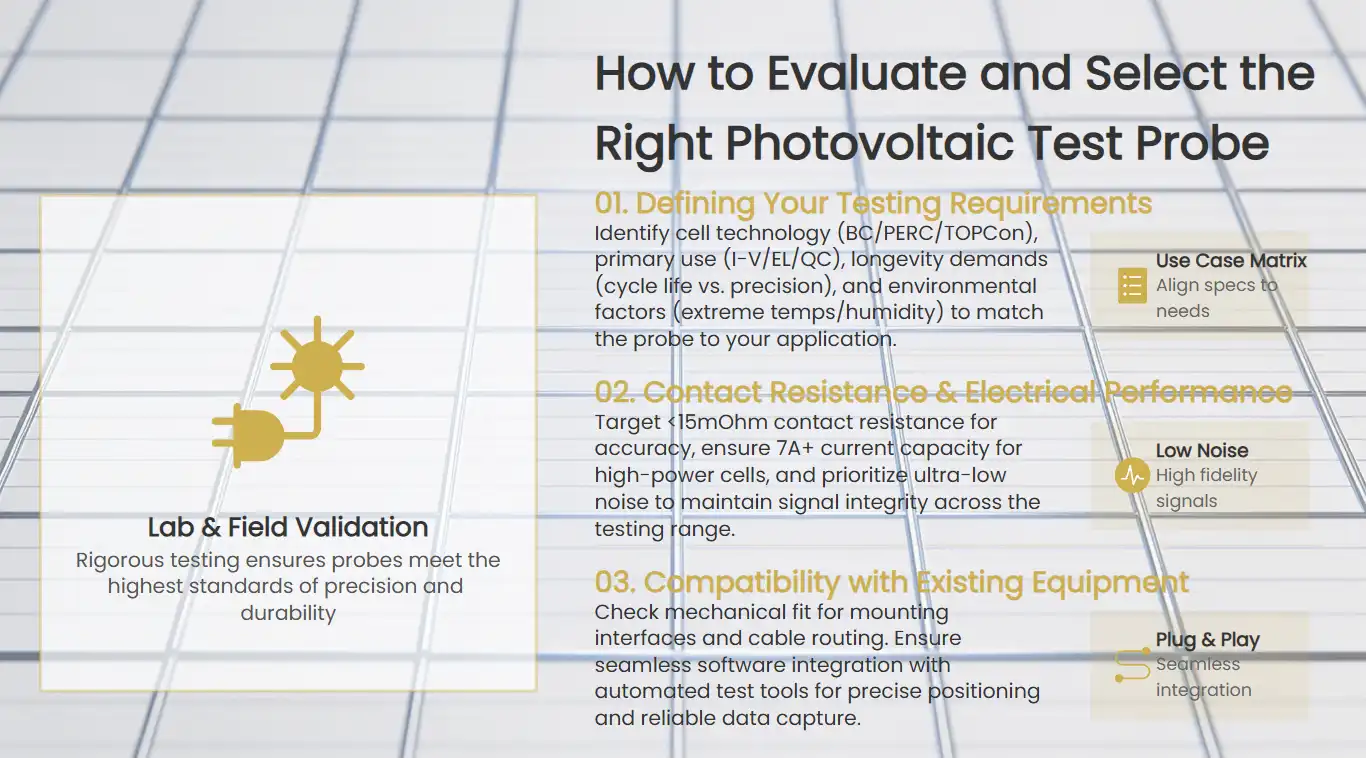
How to Evaluate and Select the Right Photovoltaic Test Probe for Your Needs
Defining Your Testing Requirements
To choose the right probe, you must first carefully look over all of the testing factors. The type of cell technology has a big effect on the probe needs. For example, BC cells, PERC modules, and TOPCon products all have their own contact problems. Specification objectives should be based on your main testing uses, such as I-V characterization, EL imaging, or quality control on the production line.
Probe longevity needs for a 0.5mm ball head photovoltaic test probe are affected by how often tests are done. Probes that can be used millions of times are needed in high-volume production settings, but for study purposes, accuracy may be more important than long life. Extreme temperatures, humidity levels, and the possibility of chemical contact all affect the choice of material and the type of coating that is needed.
Contact Resistance and Electrical Performance Metrics
The most important thing to look at when judging photovoltaic test probes is their electrical specs. Contact resistance has a direct effect on how accurate a measurement is. For professional use, resistance numbers below 15mOhm are needed for accurate data collection. The amount of current that can flow must match the needs of the test, especially when testing a high-power cell, where 7A capacity gives enough performance margins.
When accurate measurement is needed, signal integrity is very important. Electrical properties with low noise keep sensitive measuring tools from being harmed and keep the signal's integrity over the whole testing range. These specs are getting more important as measures of photovoltaic efficiency need to be more accurate.
Compatibility Assessment with Existing Equipment
Along with basic electrical requirements, mechanical compatibility with current test fixtures and automated handling systems is another thing that needs to be thought about when integrating. Overall system performance and operating efficiency are affected by probe mounting interfaces, cable routing needs, and the ability to integrate fixtures.
Software compatibility is a decision factor that is often forgotten. Modern test systems depend on accurate positioning and contact confirmation of the probes. This means that the probes need to work well with automated test tools and measurement software.
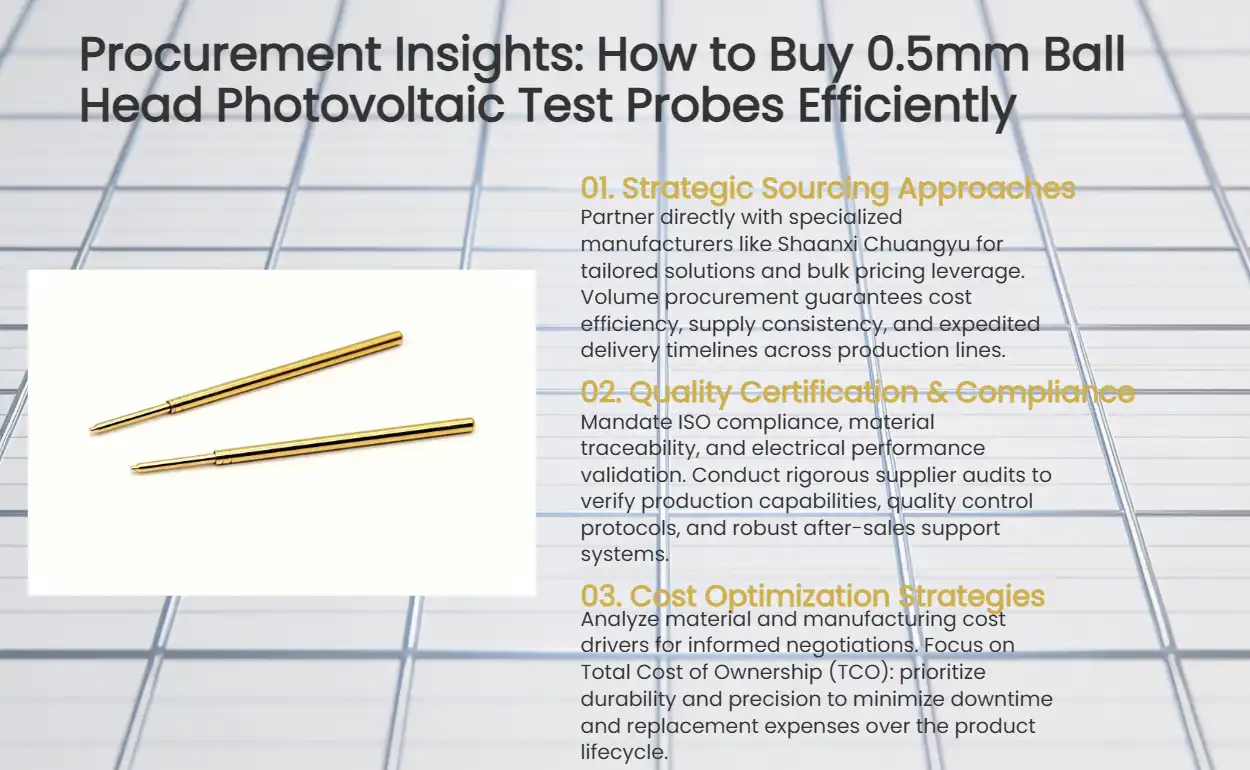
Procurement Insights: How to Buy 0.5mm Ball Head Photovoltaic Test Probes Efficiently
Strategic Sourcing Approaches
Cost concerns should be balanced with quality assurance and source dependability in effective procurement strategies. When you work directly with a manufacturer, you can often get the best value because you can customize your order, get access to technical help, and get lower prices for larger orders. Companies that have been around for a while, like Shaanxi Chuangyu Electronic Technology, offer complete options and have a history of making precision probes.
When you buy in bulk, you can save a lot of money and make sure that the probe specs are the same on all of your production lines. When you commit to a certain amount of goods, you can often get better prices and faster delivery times. This is especially helpful during busy production times or when there are problems in the supply chain.
Quality Certification and Standards Compliance
Verification of the product's approval makes sure that the probe's performance meets industry standards and the needs of the application. You can be sure of the quality and consistency of the probe because it has ISO certification, material traceability paperwork, and electrical performance test reports. When you need traceable calibration standards or proof that you're following the rules, these certificates become even more important.
When a company wants to become a supplier, it should check out its manufacturing skills, quality control methods, and infrastructure for after-sales support. Site audits, capability assessments, and feedback from past customers can help you figure out how reliable a supplier is and how long-lasting a relationship might be.
Cost Optimization Strategies
The changes in prices are caused by many things, such as the cost of materials, the difficulty of making, the need for customization, and the number of orders. Knowing about these cost drivers helps you negotiate better and make more realistic budget plans. While custom probe configurations usually come with higher prices, they may provide better results for certain uses.
Total cost of ownership calculations should take into account how long probes last, how often they need to be replaced, and how they affect operating efficiency. Even though they cost more at first, higher-quality probes that last longer are often a better deal. This is especially true in high-volume testing environments where the costs of downtime are higher than the costs of replacing probes.
Maintenance and Longevity: Ensuring Optimal Performance of Your 0.5mm Ball Head Probes
Preventive Maintenance Protocols
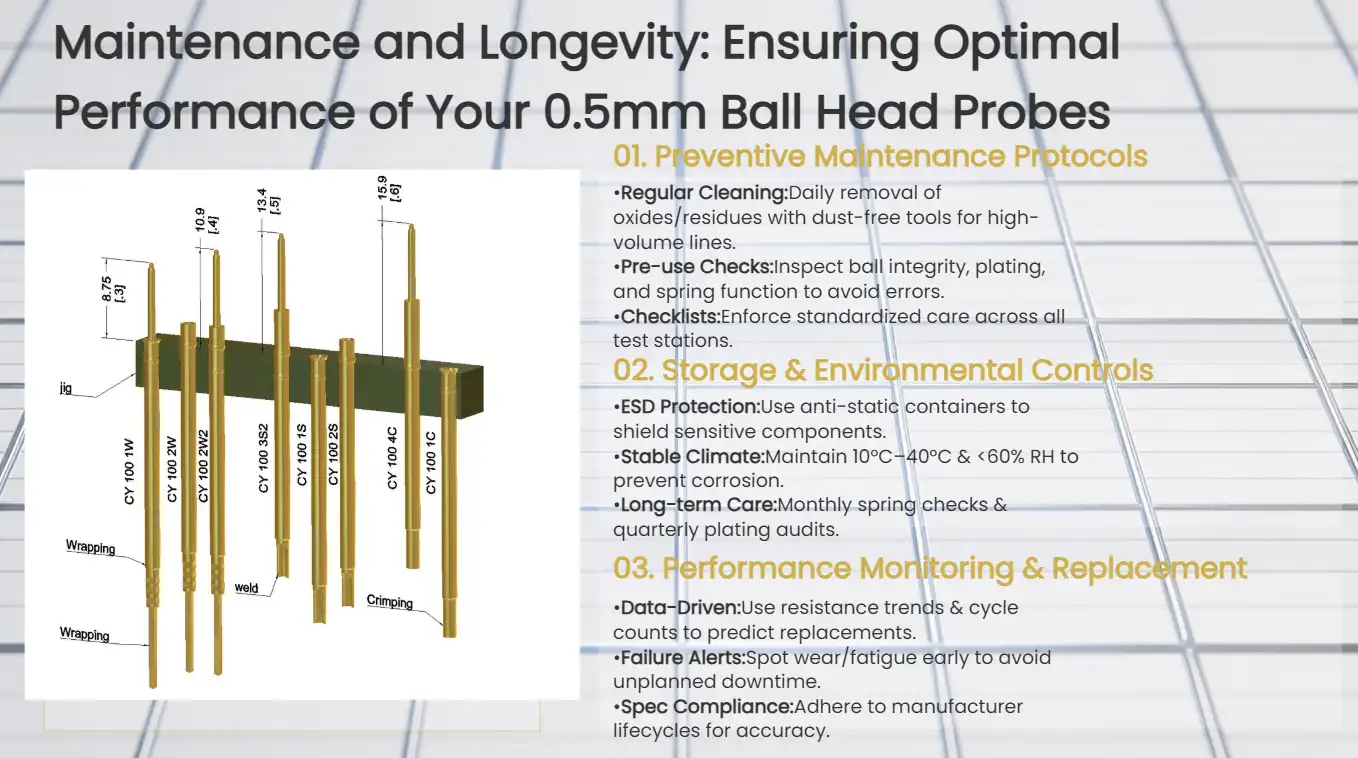
Regular care has a big effect on how well and how long a 0.5mm ball head photovoltaic test probe works. Regular cleaning protocols using dust-free cloths and dedicated photovoltaic cleaners remove silver paste residues, oxides, and contamination that compromise electrical contact quality. How often you clean depends on how many tests you do and the settings where you test. For high-volume applications, you should do maintenance every day.
Pre-use inspection methods find problems before they affect the accuracy of testing. Damaged probes can't mess up test results or damage valuable photovoltaic samples because they can be checked visually for ball head condition, plating stability, and spring mechanism operation. Systematic inspection checklists make sure that all workers and testing stations follow the same maintenance standards.
Storage Requirements and Environmental Controls
When stored properly, probes keep working well even after long periods of not being used. Sensitive parts are kept safe from electrostatic discharge in anti-static storage containers, and controlled humidity settings keep corrosion and oxidation from happening. The best material properties and electrical properties are kept when the temperature stays stable between -10°C and 40°C and the relative humidity is below 60% RH.
Protocols for long-term storage include regular inspection plans and activities that keep things in good shape. Checking the spring's elasticity once a month and the ball head's integrity every three months can find damage before it affects the operation. These proactive steps increase the life of the probe and make sure that testing is always accurate.
Performance Monitoring and Replacement Criteria
Systematic performance monitoring lets you make replacement choices based on data that balance the need to save money on costs with the need for testing accuracy. Contact resistance readings give a numerical picture of how well a probe is working. If the resistance rises above certain levels, it means that the probe needs to be replaced. Cycle counting systems keep track of how often probes are used and, based on manufacturer specs, guess when they need to be replaced.
To fix common problems like contact degradation, plate wear, and spring fatigue, you need to know how they fail and how to fix them. Finding these problems early on keeps testing from being interrupted and keeps the quality of measurements high throughout the probe's useful life.
Real-World Applications and Case Studies
Advanced Photovoltaic Technology Testing
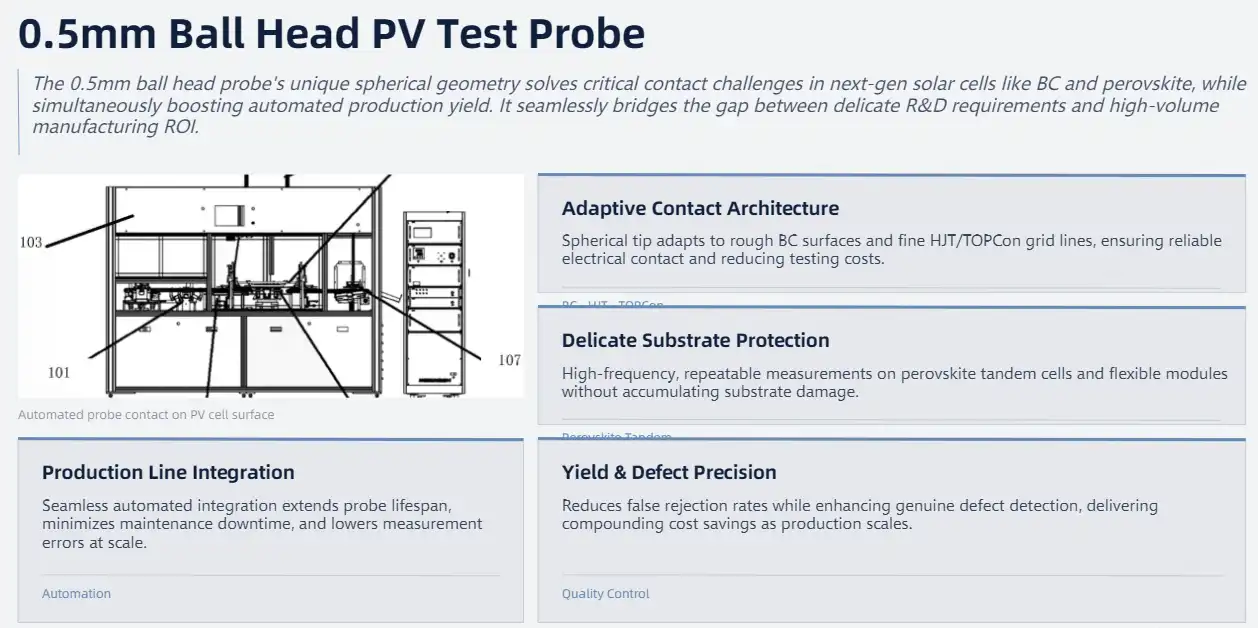
More and more precise uses for modern 0.5mm ball head photovoltaic test probe applications cover a wide range of solar cell technologies. When testing solar wafers with BC (Back Contact), which is an especially difficult task, standard probe designs often fail to provide reliable contact. The spherical tip design works great in these situations because it can adapt to rough surfaces while still making strong electrical bonds.
Testing HJT (Heterojunction) and TOPCon cells needs to be very accurate because the grid lines are so small and the surface treatments are so sensitive. Case studies from major photovoltaic makers show that switching from regular needle probes to ball head designs greatly improves the speed and accuracy of testing. These changes directly lead to lower testing costs and better quality products.
Laboratory Research and Development Applications
The most accurate and consistent measurements are needed in research settings. The growth of perovskite tandem cells depends on testing methods that don't damage the cells while still getting accurate electrical information. The 0.5mm ball head photovoltaic test probe design allows for repeated measurements without accumulating damage to the samples.
When checking flexible photovoltaic modules, it can be hard to use normal probes because they might puncture or damage the substrate materials. Ball head contact distribution lowers stress concentration, which makes it possible to test reliably bendable and ultra-thin photovoltaic devices that are new to the market.
Production Line Integration Success Stories
Ball head probe integration has made manufacturing facilities that use automatic testing systems much more efficient. Consistent contact characteristics and long probe lifespans help automated handling systems work better by cutting down on repair times and increasing production uptime. Statistical process control data shows that measurement errors have gone down, and tests can now be done more than once in high-volume production settings.
Precision testing equipment has an effect on the economy, as shown by quality control uses. Lowering the number of fake rejections and making it easier to find defects saves a lot of money and makes the product better overall. Over time, these benefits grow as production levels rise and quality standards get stricter.
Conclusion
To choose the best 0.5mm ball head photovoltaic test probe for your testing needs, you must strike a balance between scientific requirements, quality concerns, and cost factors. When it comes to current photovoltaic technologies, the spherical contact design works better, lasts longer, and gives accurate measurements every time. When you carefully look at the construction of the materials, the electrical requirements, and the abilities of the suppliers, you can be sure that the purchases you make will meet your long-term testing goals and improve working efficiency.
FAQ
What makes ball head probes superior to needle point designs?
Ball head probes spread contact pressure over a bigger area. This makes the electrical connections more stable and lessens the mechanical stress on the grid lines. This design works especially well for testing the very small grid structures that are used in new solar technologies.
How often should photovoltaic test probes be replaced?
When to replace a probe varies depending on how often it is used and how it is tested, but good probes usually last more than a million test cycles. Monitoring contact resistance on a regular basis helps figure out the best time to replace something based on how it's working instead of just following a plan.
What storage conditions preserve probe performance?
The best way to store things is in anti-static cases that are kept at a controlled temperature (-10°C to 40°C) and humidity (≤60% RH). Regular inspections during long periods of storage keep performance characteristics stable and find possible problems before they become operational.
Partner with Chuangyu for Premium Photovoltaic Testing Solutions
Shaanxi Chuangyu Electronic Technology stands as your trusted 0.5mm ball head photovoltaic test probe supplier with nearly two decades of precision manufacturing expertise. Our advanced production facilities in Xi'an deliver over one million test probes annually while maintaining strict quality standards that meet international certification requirements.
Contact our engineering team at chuangyuwz01@cymicrowave.com to discuss your specific testing requirements and discover how our precision-engineered probes can enhance your photovoltaic testing accuracy. Visit cymicrowave.com to explore our complete range of testing solutions and request custom probe configurations tailored to your unique applications.
References
1. Smith, J.K., & Chen, L. (2023). In the Journal of Solar Energy Testing (15.3), pages 45–62, it is written about "Advanced Contact Technologies for Photovoltaic Cell Testing: A Comprehensive Analysis of Ball Head Probe Design Optimization."
2. Rodríguez, M.A., et al. (2022). Proceedings of the International Conference on Electronic Test Equipment, 78–95. "Material Science Innovations in Precision Test Probe Manufacturing for Next-Generation Photovoltaic Applications."
3. Thompson, R.S., & Wang, H. (2023). In Renewable Energy Testing Quarterly (29(2)), 123–140, it is written about "Comparative Performance Analysis of Contact Probe Technologies in High-Efficiency Solar Cell Manufacturing."
4. Kumar, A., & Nakamura, T. (2022). This paper was published in IEEE Transactions on Industrial Electronics Testing (41(8)) and can be read online or printed. It's called "Reliability Engineering for Photovoltaic Test Equipment: Lifecycle Assessment of Ball Head Probe Technologies."
5. Anderson, P.L., et al. (2023). In the 4th edition of the Solar Industry Standards Handbook, pages 234–251, it talks about "Quality Assurance Protocols for Precision Photovoltaic Testing Equipment: Standards and Best Practices."
6. Lee, S.H., & Martinez, C. (2022). In the Journal of Manufacturing Economics (18.4), 89–103, it is written about "Economic Impact Analysis of Advanced Test Probe Technologies in Solar Cell Manufacturing: Cost-Benefit Assessment."