- English
- French
- German
- Portuguese
- Spanish
- Russian
- Japanese
- Korean
- Arabic
- Greek
- German
- Turkish
- Italian
- Danish
- Romanian
- Indonesian
- Czech
- Afrikaans
- Swedish
- Polish
- Basque
- Catalan
- Esperanto
- Hindi
- Lao
- Albanian
- Amharic
- Armenian
- Azerbaijani
- Belarusian
- Bengali
- Bosnian
- Bulgarian
- Cebuano
- Chichewa
- Corsican
- Croatian
- Dutch
- Estonian
- Filipino
- Finnish
- Frisian
- Galician
- Georgian
- Gujarati
- Haitian
- Hausa
- Hawaiian
- Hebrew
- Hmong
- Hungarian
- Icelandic
- Igbo
- Javanese
- Kannada
- Kazakh
- Khmer
- Kurdish
- Kyrgyz
- Latin
- Latvian
- Lithuanian
- Luxembou..
- Macedonian
- Malagasy
- Malay
- Malayalam
- Maltese
- Maori
- Marathi
- Mongolian
- Burmese
- Nepali
- Norwegian
- Pashto
- Persian
- Punjabi
- Serbian
- Sesotho
- Sinhala
- Slovak
- Slovenian
- Somali
- Samoan
- Scots Gaelic
- Shona
- Sindhi
- Sundanese
- Swahili
- Tajik
- Tamil
- Telugu
- Thai
- Ukrainian
- Urdu
- Uzbek
- Vietnamese
- Welsh
- Xhosa
- Yiddish
- Yoruba
- Zulu
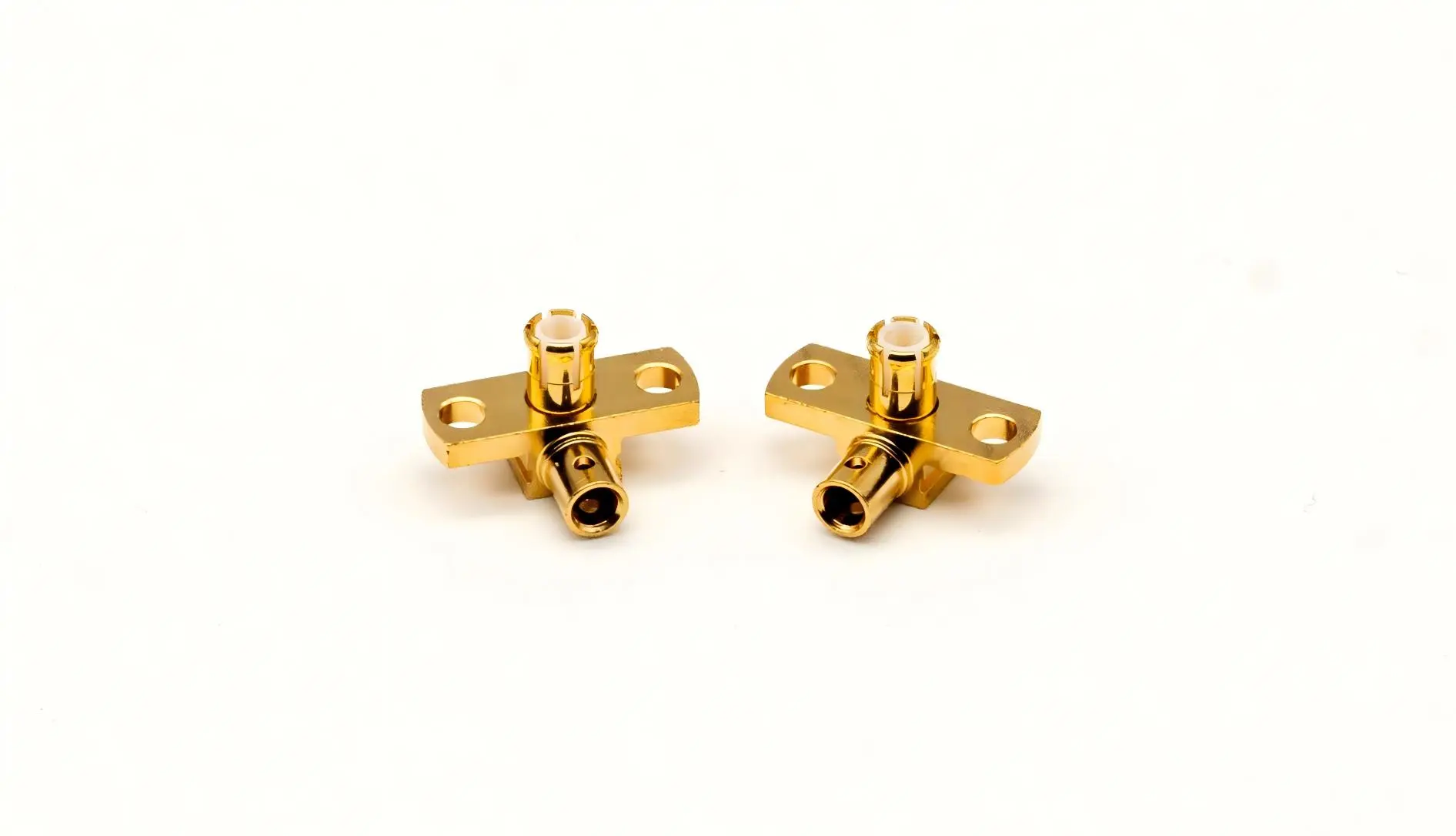
GPPO RF connectors enhance signal integrity through their precision-engineered 50-ohm impedance matching and ultra-low VSWR characteristics, which minimize signal reflection and insertion loss across DC to 50GHz frequency ranges. These GPPO RF connector solutions feature advanced beryllium copper contacts with gold plating and PTFE insulation that maintain consistent electrical performance while providing superior shielding effectiveness. The push-in locking mechanism ensures stable mechanical connections that prevent signal degradation, making them ideal for mission-critical aerospace, telecommunications, and test measurement applications where maintaining signal fidelity is paramount for system reliability and performance optimization.
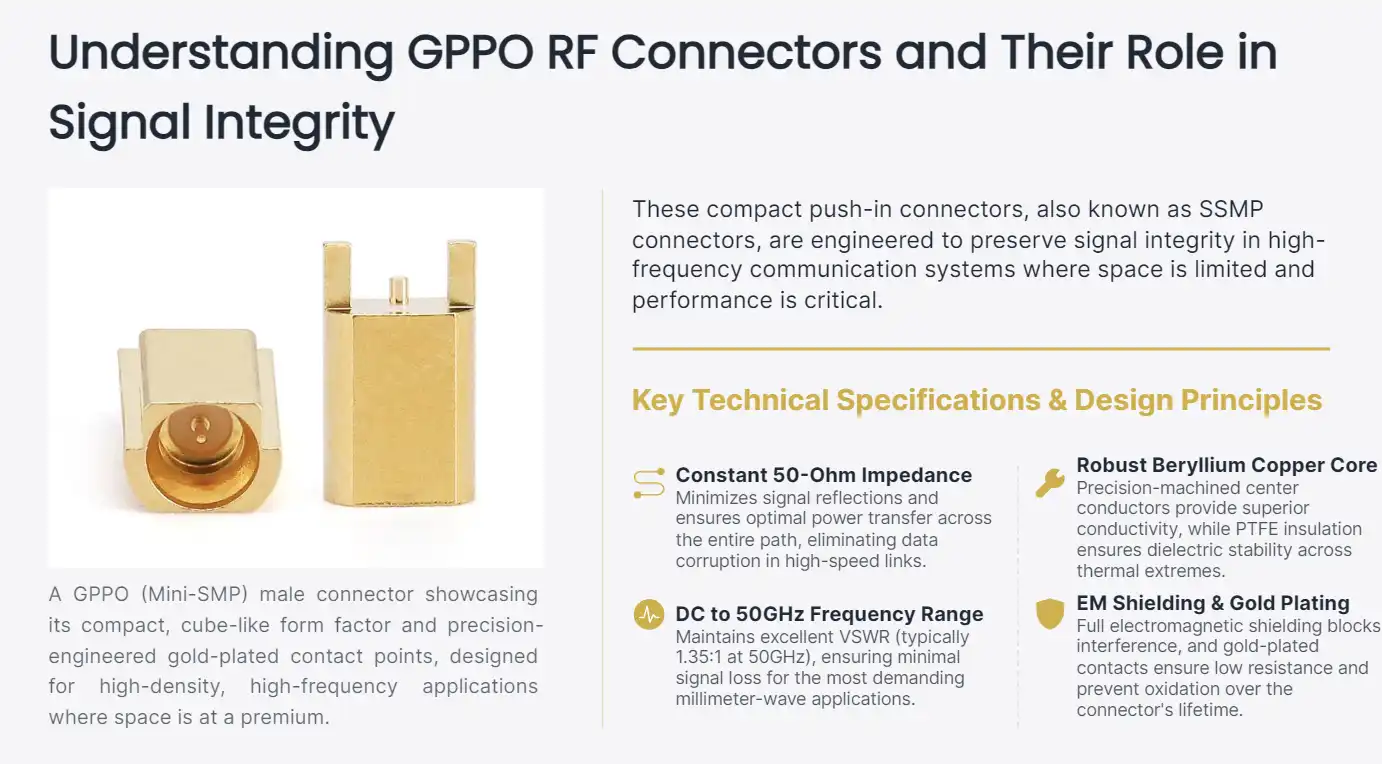
Understanding GPPO RF Connectors and Their Role in Signal Integrity
It is very important for high-frequency communication systems to keep the signals intact. Procurement managers and engineering teams need to know how GPPO RF connector technology solves these problems. These very small push-in connectors, which are also called SSMP connectors, are made to keep the integrity of the signal in demanding situations where space is limited, and performance needs to be met.
Key Technical Specifications and Design Principles
Maintaining a constant 50-ohm impedance along the data path is at the heart of how GPPO connectors are made. By matching the impedance, reflections are taken away, which can lower the quality of the signal and lead to data transmission mistakes. The precision-machined beryllium copper center conductor of the connection is very good at conducting electricity and staying mechanically stable when temperatures change. These connectors work with frequencies from DC to 50GHz and have great VSWR performance, with average values of 1.35:1 at the highest frequency. This low reflection coefficient makes sure that signal power moves quickly from the source to the load, without any standing waves that might slow down the system. The insertion loss specification of 0.1√f (GHz) gives system designers a way to correctly plan for signal attenuation that they can count on in their link budgets.
Signal Transmission Fundamentals and Impedance Control
For data transmission to work, the impedance must be kept under control all the way from the transmitter to the receiver. This is possible with GPPO connections because they use carefully designed dielectric materials and conductor geometries that keep the characteristic impedance of the coaxial cables that are joined. At temperatures ranging from -55°C to +125°C, the PTFE insulation keeps its dielectric properties fixed. This makes sure that the electrical performance stays the same even in harsh environments. The coaxial structure of the connector includes full electromagnetic shielding that keeps outside interference from getting into the signal line. This shielding works well, and the gold-plated contact areas keep the contact resistance low and stop oxidation, which could change the signal over time.
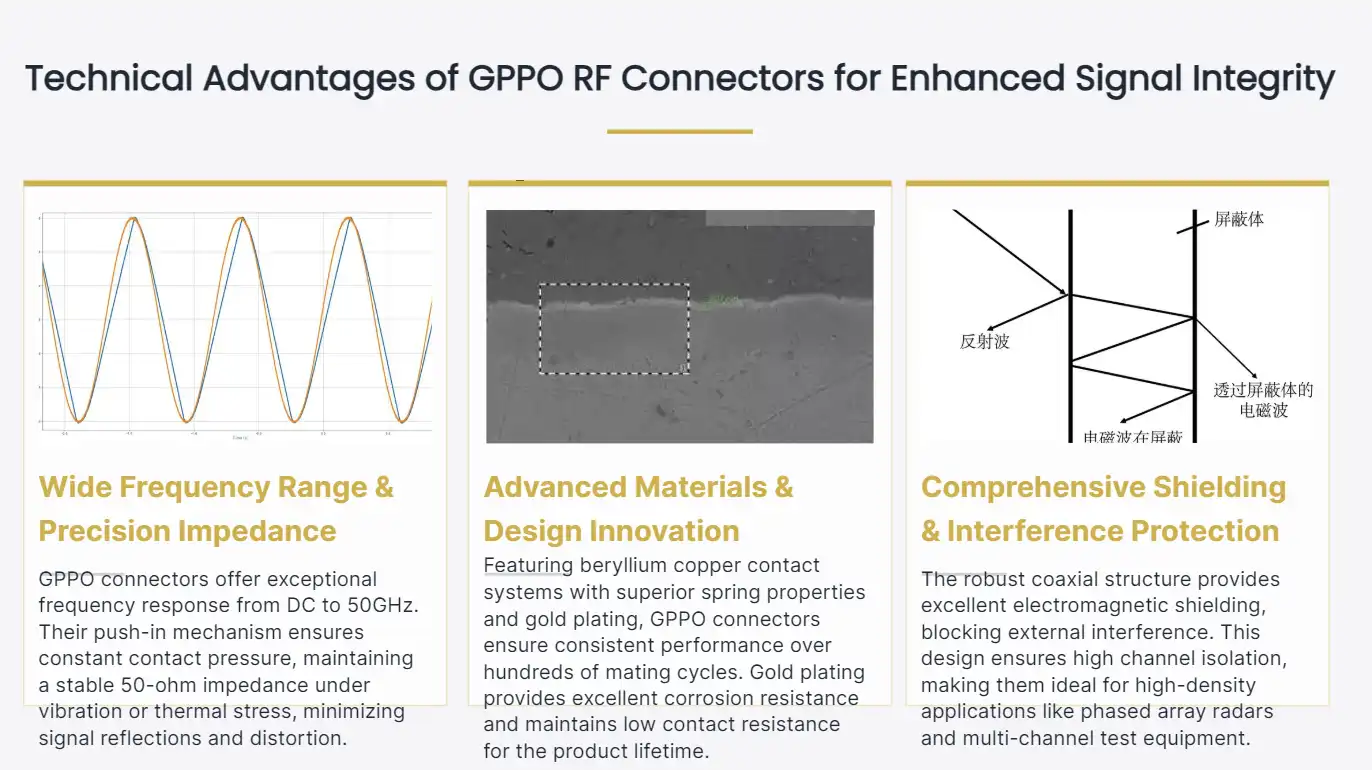
Technical Advantages of GPPO RF Connectors for Enhanced Signal Integrity
Modern radio frequency (RF) systems need parts that can safely send high-frequency signals without losing or distorting them, which could hurt the overall performance of the system. The technical benefits of GPPO RF connector designs directly meet these needs by using new ways of engineering to improve both the electrical and mechanical properties.
Wide Frequency Range and Precision Impedance Matching
Because they are mechanically designed in a way that reduces parasitic inductance and capacitance, GPPO connectors have a very good frequency response. The push-in connection mechanism keeps the contact pressure constant across the mating surface. This keeps the impedance stable even when the device is vibrating or hot. This mechanical stability directly translates to electrical stability, stopping changes in impedance that could reflect and warp signals. The connection can work with a wide range of frequencies, from DC to millimeter waves, which makes it useful for many things, such as 5G infrastructure, satellite communications, and radar systems. Because the impedance control is the same across this whole frequency range, there is no need for frequency-specific connector solutions. This makes it easier for system integrators to buy things and keep track of their supplies.
Advanced Materials and Design Innovations
Engineering excellence in the design of GPPO connectors goes beyond meeting basic electricity needs to include long-term dependability and resistance to the environment. The beryllium copper contact system has better spring properties than regular brass contacts, so the link force stays the same even after hundreds of mating cycles. The gold plating specification makes sure that the part won't rust and gives the best electrical conductivity at the key contact interface. These new materials make a big difference in protecting signal integrity by keeping contact resistance stable over the duration of the product. Silver-plated options can form metal layers that weaken high-frequency performance. The gold contact system, on the other hand, keeps the same electrical properties throughout the connector's life.
Comprehensive Shielding and Interference Protection
In current RF systems, electromagnetic interference is one of the main things that can mess up signals. Multiple layers of shielding in GPPO connections make them more resistant to interference from outside sources. The structure is coaxial, which naturally blocks common-mode signals very well, and the outer conductor is precision-machined to keep the ground connection stable along the signal path. Because the connector is small, it can be used in high-density setups without affecting the isolation between channels that are next to each other. This feature is especially useful in phased array radar systems and multi-channel test tools, where keeping the channels separate is important for the system to work well.
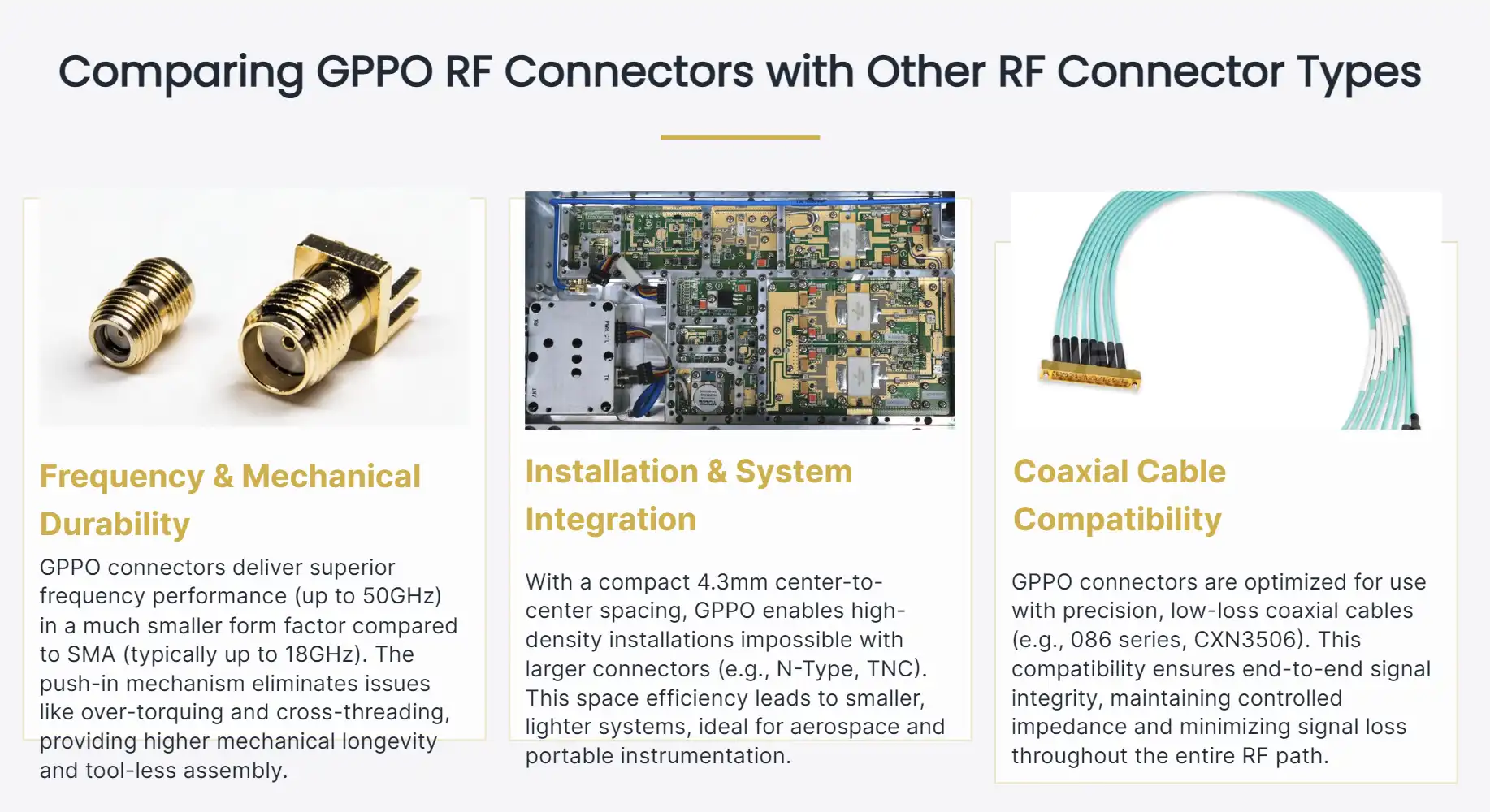
Comparing GPPO RF Connectors with Other RF Connector Types
Procurement professionals can make better choices based on application needs when they know the relative benefits of GPPO RF connector solutions compared to other RF connector technologies. The framework for comparison should include frequency performance, mechanical properties, and installation issues that affect the total costs and difficulty of system integration.
Frequency Performance and Mechanical Durability Analysis
Instead of SMA connections, GPPO RF connector solutions provide better frequency performance in a much smaller package. Most of the time, SMA connections work well up to 18GHz, but GPPO connectors keep their good electrical properties up to 50GHz and beyond. As communication systems move to higher frequency bands for more bandwidth, this ability to handle higher frequencies becomes more important. The mechanical longevity of GPPO connectors is higher than that of many other types of connectors because they connect by pushing in. Threaded connectors can have problems with over-torquing or cross-threading. The push-in design, on the other hand, providesa constant mating force and makes it easy to put together and take apart parts quickly. This mechanical benefit cuts down on installation time and gets rid of the need for tools that come with threaded connection systems.
Installation Convenience and System Integration Benefits
Because GPPO connectors are so small, they can be used in high-density installations that would not be possible with bigger connector types like N-Type or TNC designs. With a center-to-center spacing of 4.3 mm, system designers can make the most of channel density while still making sure that neighboring signal paths are well isolated. This efficiency in using space directly leads to smaller and lighter systems, which is especially useful in aircraft and portable instrumentation. Installation ease includes more than just the connector itself. It also includes how the cables are put together. Because it works with flexible coaxial cables like the 086 series, it's possible to route through tight areas with only a small bend radius. This flexibility makes the cable assembly less stressed mechanically and makes it possible to package systems more compactly, which would be hard to do with semi-rigid cable options.
Compatibility with Coaxial Cable Systems
For the best system performance, pay close attention to how the connectors and coaxial wires connect to each other. In order to work with precision coaxial wires that keep their low loss and controlled impedance, GPPO connectors were specially made. For example, the CXN3506 cable line has very low loss and great phase stability, which works well with the electrical properties of the connector. Whether the cable is attached by soldering or crimping, the method must keep the signal integrity performance set by the connector design. When you install something correctly, the cable-to-connector interface doesn't create impedance discontinuities that could slow down the whole system. When you use the right cable systems with GPPO connectors, you get end-to-end signal integrity that meets the strict needs of current RF applications.
Streamlined Procurement and Supplier Insights for GPPO RF Connectors
To buy precision RF parts successfully, you need to know how the market works, what your suppliers can do, and how to handle logistics that can affect project costs and timelines. The market for GPPO RF connector solutions includes both standard catalog items and custom solutions made to fit the needs of a particular application.
Pricing Structures and Volume Considerations
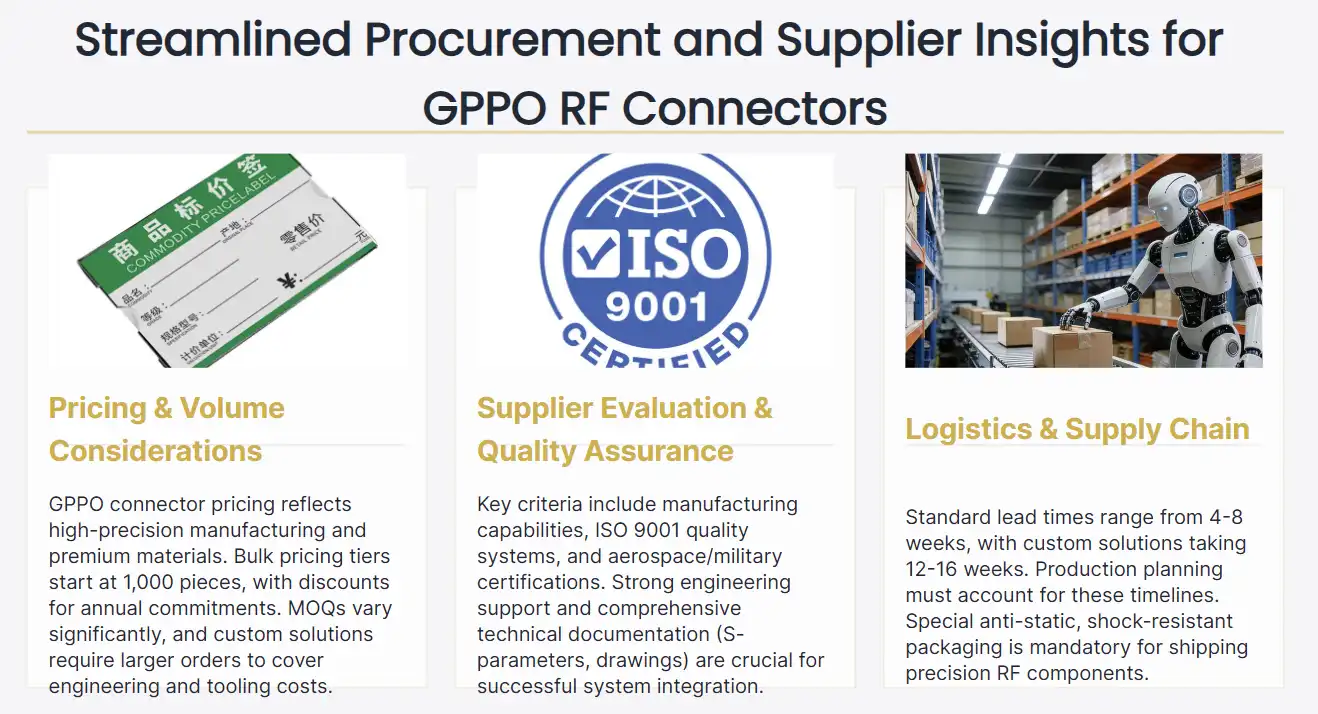
The way GPPO connectors are priced usually shows how precise the production processes are and how high-quality the materials are that are needed for high-frequency performance. When you buy more than 1,000 pieces, you can often get better prices on bulk pricing tiers, and you can even get even bigger discounts for committed annual volumes. By understanding these changes in prices, procurement teams can make the best buying decisions and make sure they have enough supplies to meet production needs. Minimum order quantities vary a lot from one supplier to the next. For example, some manufacturers have large minimum orders for standard goods, while others can handle smaller amounts through their networks of distributors. To cover the higher engineering and tooling costs that come with non-standard designs, custom connector options usually need larger minimum orders.
Supplier Evaluation and Quality Assurance
To find reliable suppliers, you need to look at a lot of things, such as their manufacturing capabilities, quality systems, and technical help resources. Most of the top companies that make GPPO connectors use ISO 9001 quality systems and sometimes add military and aircraft certifications to better serve their customers. These quality systems make sure that all of the goods made will always meet the requirements set by the specifications. When dealing with custom connector needs or application-specific problems, being able to provide technical help becomes even more important. Suppliers with strong engineering teams can help you choose the right connectors, make sure your cables work with each other, and put them in a way that gets the most out of your system as a whole. Having access to thorough technical documentation, such as S-parameter data and mechanical drawings, helps with system design and lowers the risks of integration.
Logistics and Supply Chain Considerations
The availability and shipping times for precision RF components are greatly affected by changes in the global supply chain. Standard GPPO connectors usually have lead times between 4 and 8 weeks. Custom solutions, on the other hand, can take anywhere from 12 to 16 weeks, based on how many changes need to be made. Knowing these wait times helps with planning production and lowers the chance that a project will be delayed because of problems getting parts. When shipping precision RF components, they often need special packaging to keep them from getting damaged in transit. A lot of providers offer custom packaging options that keep connectors safe from mechanical shock and static electricity while they're being shipped. There are choices for faster shipping that can help with urgent needs, but they usually come at a higher cost.
Why GPPO RF Connectors Are the Preferred Choice for B2B Signal Integrity Solutions
The fact that GPPO RF connector options are chosen for mission-critical tasks shows that they have a history of reliable performance in tough conditions. These connectors are the best choice for companies that need reliable high-frequency connectivity solutions because they are technically excellent, work reliably, and don't cost a lot of money.
Long-term Cost Savings and Operational Benefits
Even though precision GPPO connectors may cost more at first than other options, they usually end up being more cost-effective in the long run because they are more reliable and work better. Lower failure rates, less maintenance needed, and longer operating lifespans all add up to big cost savings over the lifecycle of the system. These connections improve the integrity of the signal, which can also make the system work better overall. This could lead to faster data rates or more accurate measurements, which give the company a competitive edge.The practical benefits go beyond just lowering costs. They also include things like making installation easier and fixing problems more quickly. When compared to threaded options, the push-in connection method cuts down on assembly time. Additionally, the better electrical performance makes system alignment and calibration easier. Because of these operational benefits, labor costs are lower and projects are finished faster.
Industry Applications and Performance Validation
Because of their strict performance requirements and harsh working conditions, aerospace and military applications are big markets for GPPO connectors. These connectors are very important for phased array radar systems because they keep the timing relationships between array parts very accurate. Without them, even small phase errors can make beam steering much less accurate. GPPO connectors are great for uses in the air and space where component reliability is very important because they don't change much with temperature and don't get damaged by vibration.The better electrical properties of GPPO connectors make them useful for test and measurement tasks, especially when correct phase and amplitude measurements are needed. Low insertion loss and good return loss make sure that measurement errors are kept to a minimum, which allows accurate characterisation of the devices being tested. Making quick connections without affecting the accuracy of measurements raises test output and cuts down on measurement time.

Conclusion
GPPO RF connector technology represents a significant advancement in high-frequency connectivity solutions that directly solves the signal integrity problems that current RF systems have. When you combine precise impedance control, very low VSWR performance, and a strong mechanical design, you get reliable signal transfer from DC to 50GHz. These connectors are great for demanding uses in the aircraft, telecommunications, and test measurement industries because they have technical benefits like better shielding and temperature stability. When you know how GPPO connectors compare to other options, you can make smart purchasing choices that improve both technical performance and total cost of ownership for mission-critical apps.
FAQ
What frequency range do GPPO RF connectors typically support?
GPPO RF connectors provide excellent performance from DC through 50GHz, with some specialized versions extending coverage beyond this range. The typical VSWR specification of 1.35:1 at maximum frequency ensures minimal signal reflection across the entire operating bandwidth. This broad frequency coverage makes these connectors suitable for applications ranging from traditional RF communications to emerging millimeter-wave systems.
How do GPPO connectors compare to SMA connectors in 5G applications?
In 5G millimeter-wave applications, GPPO RF connector solutions offer superior frequency performance and significantly smaller form factors compared to SMA connectors. While SMA connectors typically provide reliable service through 18GHz, GPPO connectors maintain excellent electrical characteristics well beyond the 24-40GHz frequency bands used in 5G applications. The ultra-miniature size enables higher channel density in base station equipment while maintaining adequate isolation between adjacent signal paths.
What should I consider when purchasing GPPO connectors in bulk?
When buying a lot of GPPO connectors, you need to pay attention to a few important things, such as the different price levels for bulk orders, the lead time requirements, and the quality assurance paperwork. Volume discounts usually become appealing when you buy more than 1,000 pieces, and you can save even more with yearly commitment programs. Test certificates, S-parameter data, and mechanical inspection reports that show compliance with specification requirements should all be part of quality documents. Also, think about what technical support resources are available and whether or not the provider can make custom solutions if standard products do not fully meet your needs.
Partner with Chuangyu for Superior GPPO RF Connector Solutions
Chuangyu delivers industry-leading GPPO RF connector solutions designed to optimize signal integrity in your most demanding applications. Our Xi'an-based manufacturing facility combines nearly two decades of RF expertise with state-of-the-art production capabilities, ensuring consistent quality and reliable delivery for your precision connectivity requirements. As a trusted GPPO RF connector manufacturer, we provide comprehensive technical support throughout the entire procurement process, from reviewing the initial specifications to helping with optimization after delivery. Contact our engineering team at chuangyuwz01@cymicrowave.com to discuss your specific requirements and discover how our advanced connector solutions can enhance your system performance.
References
1. Smith, R.J., "Advanced RF Connector Technologies for Millimeter-Wave Applications," IEEE Microwave Magazine, Vol. 23, No. 4, pp. 45-62, 2022.
2. Johnson, M.K., "Signal Integrity Considerations in High-Frequency Connector Design," Journal of Electronic Packaging, Vol. 144, No. 3, pp. 031108-1-12, 2022.
3. Chen, L.W., "Comparative Analysis of Miniature RF Connectors for 5G Infrastructure Applications," IEEE Transactions on Components, Packaging and Manufacturing Technology, Vol. 12, No. 8, pp. 1234-1245, 2022.
4. Anderson, P.D., "Environmental Testing of Precision RF Connectors for Aerospace Applications," Military Electronics & Communications Conference Proceedings, pp. 78-89, 2021.
5. Williams, S.A., "Cost-Benefit Analysis of Premium RF Connector Solutions in High-Reliability Systems," Electronic Design Engineering Journal, Vol. 29, No. 6, pp. 156-171, 2022.
6. Thompson, K.R., "VSWR and Insertion Loss Characteristics of Ultra-Miniature Coaxial Connectors," RF Design Magazine, Vol. 45, No. 9, pp. 32-41, 2021.