- English
- French
- German
- Portuguese
- Spanish
- Russian
- Japanese
- Korean
- Arabic
- Greek
- German
- Turkish
- Italian
- Danish
- Romanian
- Indonesian
- Czech
- Afrikaans
- Swedish
- Polish
- Basque
- Catalan
- Esperanto
- Hindi
- Lao
- Albanian
- Amharic
- Armenian
- Azerbaijani
- Belarusian
- Bengali
- Bosnian
- Bulgarian
- Cebuano
- Chichewa
- Corsican
- Croatian
- Dutch
- Estonian
- Filipino
- Finnish
- Frisian
- Galician
- Georgian
- Gujarati
- Haitian
- Hausa
- Hawaiian
- Hebrew
- Hmong
- Hungarian
- Icelandic
- Igbo
- Javanese
- Kannada
- Kazakh
- Khmer
- Kurdish
- Kyrgyz
- Latin
- Latvian
- Lithuanian
- Luxembou..
- Macedonian
- Malagasy
- Malay
- Malayalam
- Maltese
- Maori
- Marathi
- Mongolian
- Burmese
- Nepali
- Norwegian
- Pashto
- Persian
- Punjabi
- Serbian
- Sesotho
- Sinhala
- Slovak
- Slovenian
- Somali
- Samoan
- Scots Gaelic
- Shona
- Sindhi
- Sundanese
- Swahili
- Tajik
- Tamil
- Telugu
- Thai
- Ukrainian
- Urdu
- Uzbek
- Vietnamese
- Welsh
- Xhosa
- Yiddish
- Yoruba
- Zulu
When evaluating the best short stroke test probe options for PCB testing applications, engineers and procurement professionals must consider reliability, precision, and durability as primary selection criteria. These specialized testing components deliver exceptional performance in space-constrained environments where traditional probes cannot operate effectively. Modern short stroke test probe solutions feature compact designs with minimal travel distance, typically ranging from 1-3mm stroke lengths, making them ideal for high-density circuit board testing. The spring-loaded mechanism ensures consistent electrical contact while reducing mechanical stress on delicate PCB surfaces. Advanced probe designs incorporate beryllium copper plungers with nickel plating, providing superior conductivity and corrosion resistance for extended operational life exceeding 51million test cycles.
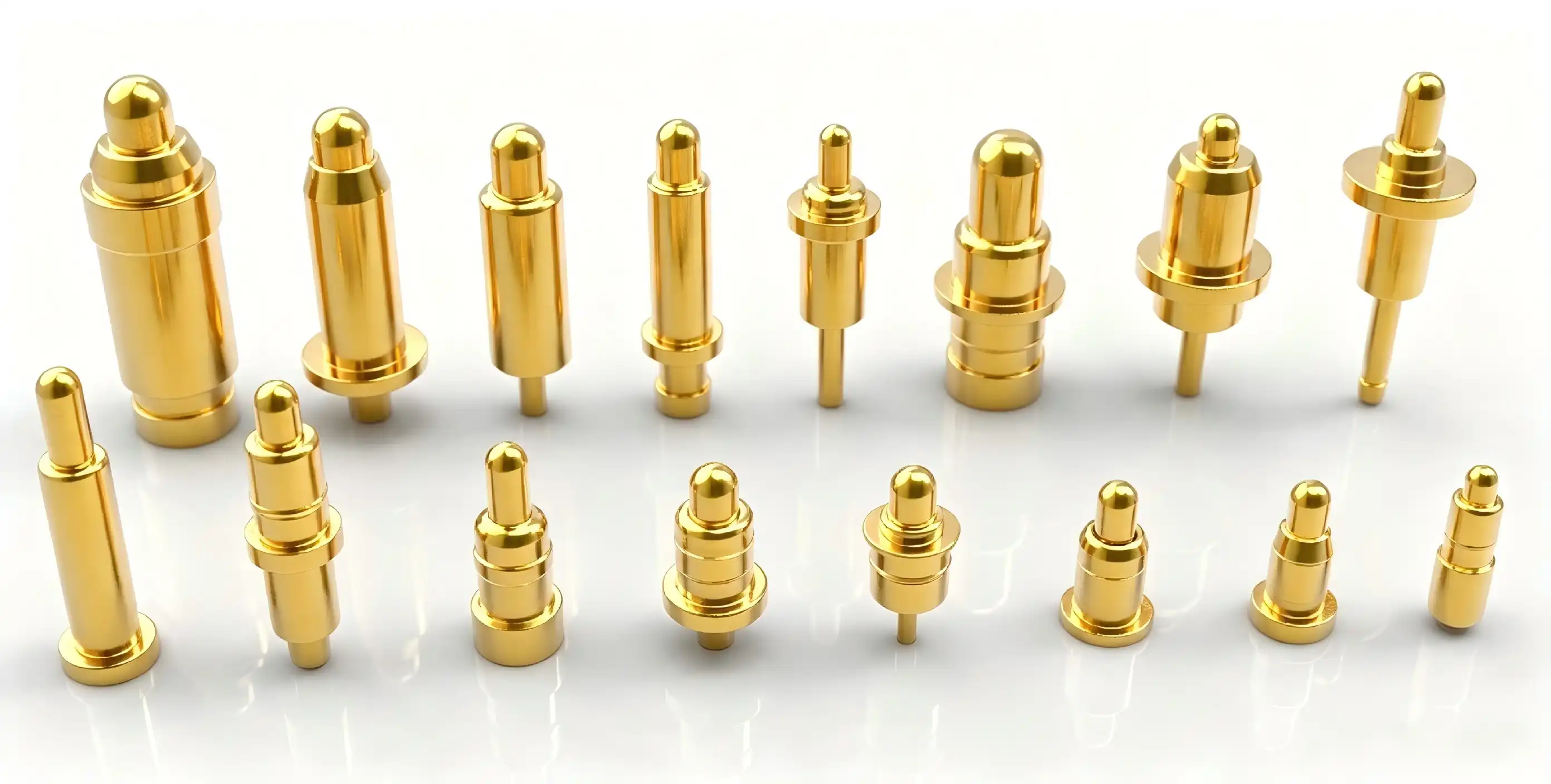
Understanding Short Stroke Test Probes: Definition, Design, and Key Features
When it comes to electronic testing tools, short stroke test probe technology is a special kind of gear made for tasks that require little motor movement. Because they have a shorter stroke length and better spring mechanisms, these precision-engineered parts are very different from regular test tools.
Fundamental Operating Principles and Design Architecture
The main idea behind spring-loaded test probes involves controlled compression physics that keep the electricity flowing while putting as little physical stress as possible on test points. For example, a short stroke test probe works with stroke lengths of 1.5mm to 3mm, while standard probes may need 5mm to 10mm of movement. This shorter travel distance makes testing possible in places with limited height where room would normally make contact impossible.The motor design has a lot of important parts that all work together. The probe head is made of beryllium copper and is plated with nickel. This makes it very good at conducting electricity and resisting rust. Tin phosphor bronze is used to make the probe tube, and this material keeps the spring tension constant over millions of test cycles. Piano steel wire springs have the right amount of force, which can be anywhere from 0.5N to 3N of contact pressure, based on the needs of the application.
Material Selection and Durability Characteristics
Advanced material engineering is a key part of how well and how long a tool works. Beryllium copper metals are very good at conducting electricity and keeping their shape after being compressed and expanded many times. The nickel covering does two things: it keeps the copper underneath from oxidizing and makes the contact surface smooth, which lowers the electrical resistance. Probe tube materials need to be flexible while also being strong. Tin phosphor bronze has great fatigue strength, which means that probes can be compressed millions of times without breaking down. This mix of materials makes sure that the contact resistance stays below 50 milliohms for the whole life of the probe.
Technical Parameters and Industry Standards
Specifications like contact force ratings, electrical resistance values, and environmental working ranges are very important for evaluating short stroke test probe units. Professional probes can usually work successfully in temperatures ranging from -45°C to +80°C, which means they can be used in a variety of testing settings. For high-quality units, contact resistance standards usually fall below 30 milliohms. This makes sure that signals are sent correctly during testing.
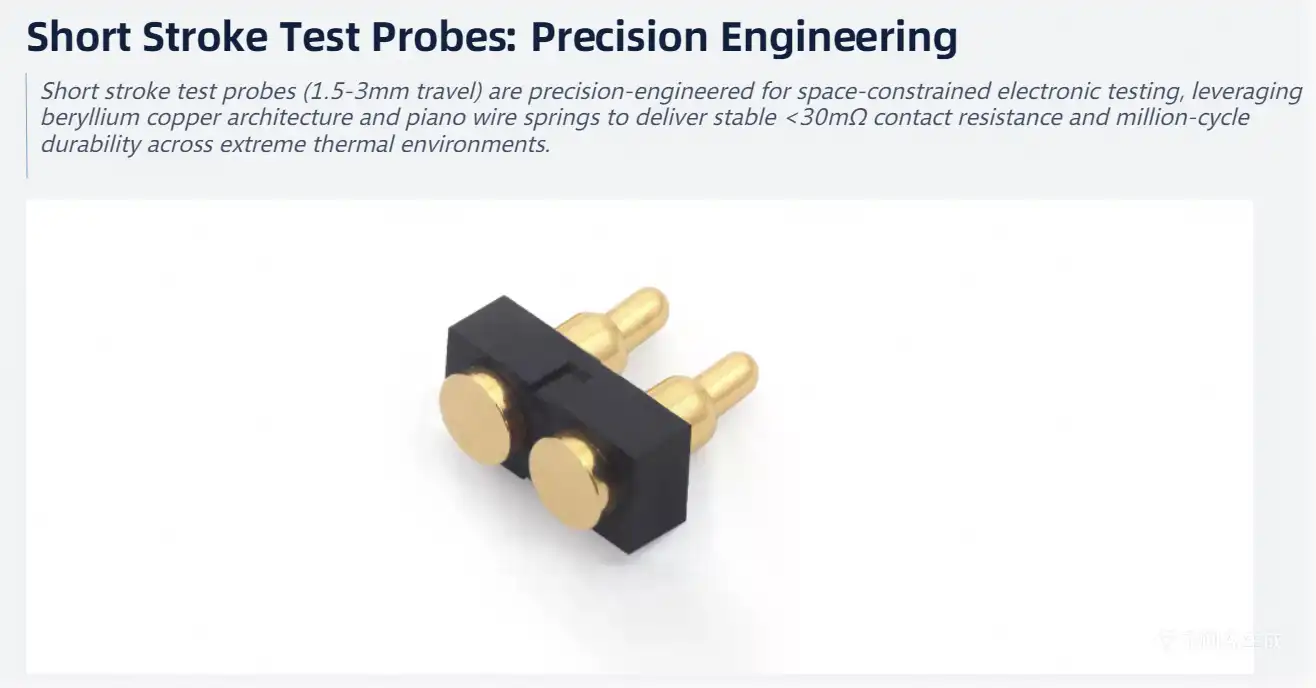
Comparing Short Stroke Test Probes with Other Testing Solutions
When procurement teams know how different probe technologies work, they can make better decisions based on the needs of the application. In many testing situations, short stroke test probe methods are clearly superior to conventional options.
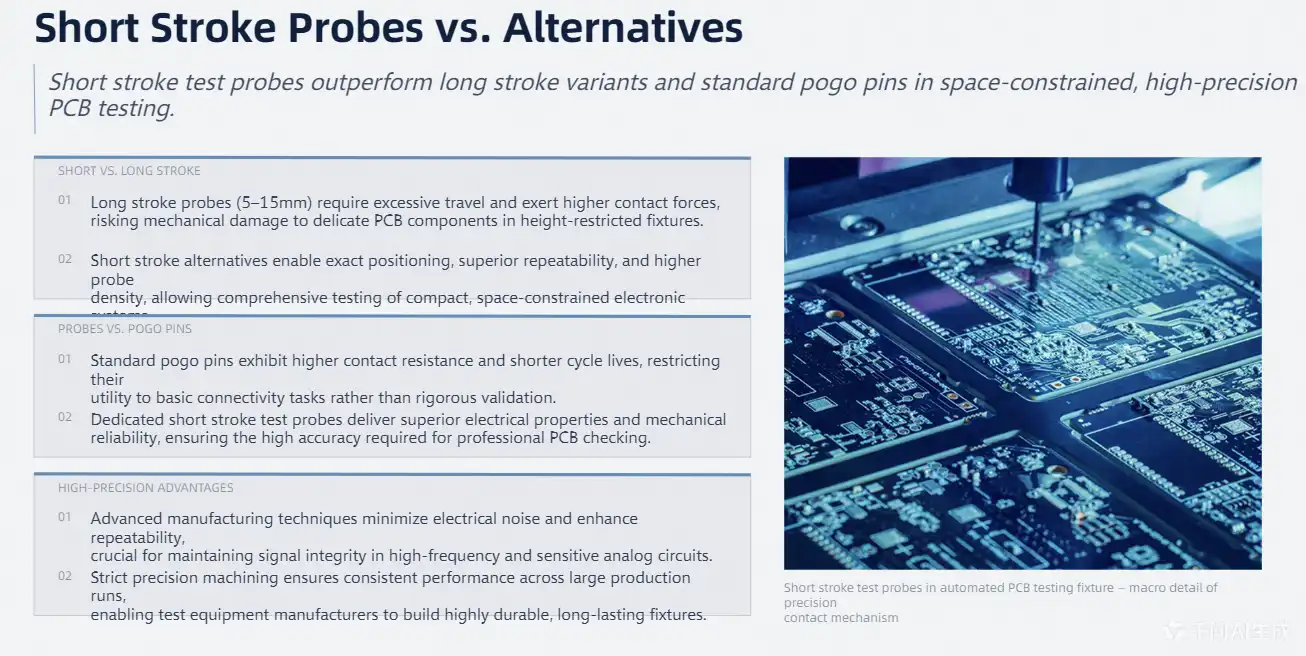
Performance Analysis: Short Stroke vs Long Stroke Probes
Long stroke probes usually have travel lengths between 5 and 15 mm, which means they can't be used with small testing fixtures or situations where there are strict height limits. Long stroke versions may be better at handling misalignment, but they also have higher contact forces that can hurt PCB parts or test points that are easily damaged. In precise situations where controlled contact pressure is crucial, short stroke test probe alternatives perform admirably. The shorter stroke length makes positioning and repeatability more exact, which are very important in automated testing environments. In addition, the small size lets more probes fit into test fixtures, which allows full testing of small electronic systems to happen.
Comparison with Pogo Pins and Standard Test Points
Another type of spring-loaded contact solution is the pogo pin, but they don't have the precise engineering that you'll find in special short stroke test probe products. When compared to special testing tools, standard pogo pins often have higher contact resistance and shorter cycle life. Professional test tools are better because they have better electrical properties and are more reliable mechanically. Pogo pins might work for simple connectivity tasks, but for accurate PCB checking, you need better performance that can only come from a specially designed probe.
High Precision Probe Advantages
Advanced manufacturing methods are used in high-end short stroke test probe solutions to improve repeatability and cut down on electrical noise. When checking high-frequency circuits or sensitive analog parts where signal integrity is very important, these traits become very important. Precision machining and quality control methods used by top makers make sure that probes work the same way across large production runs. Because of this, companies that make testing equipment can create fixtures that will work well for a long time.
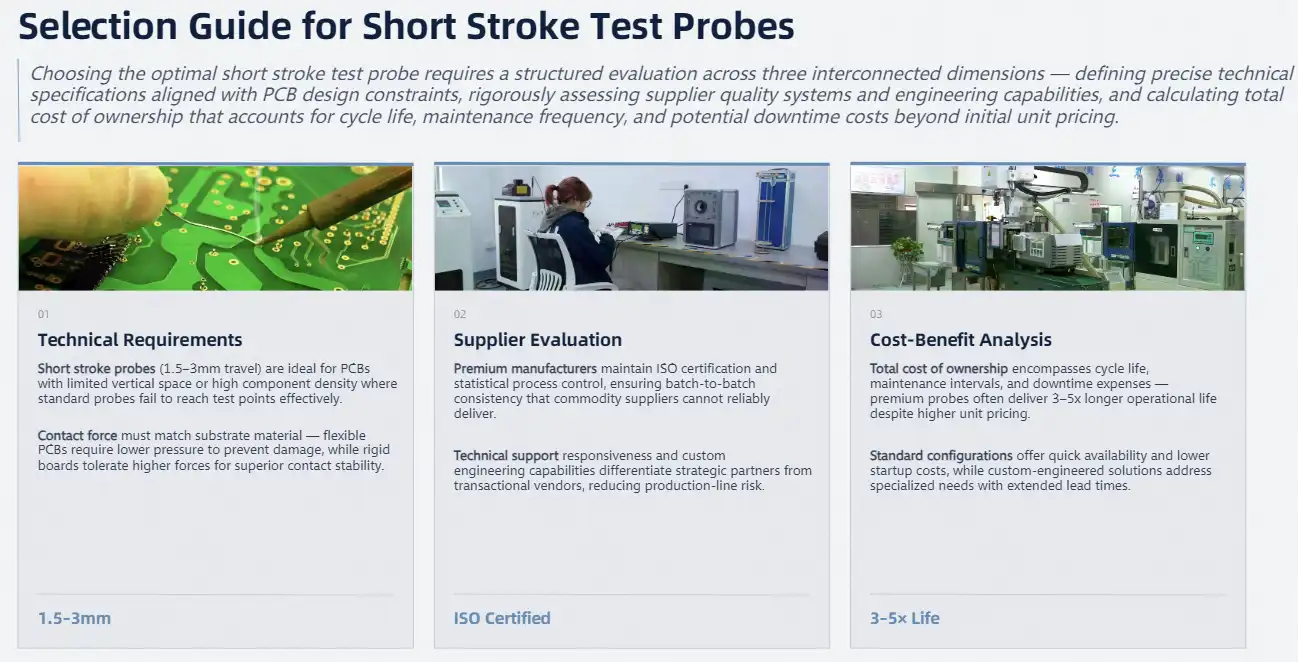
How to Choose the Best Short Stroke Test Probe for Your PCB Testing Needs
To choose the best probe options, you need to carefully think about technical needs, operational limitations, and cost factors. When decisions are being made, they should take into account both short-term performance goals and long-term cost effectiveness.
Defining Technical Requirements and Specifications
The first step in the planning process is to look at the PCB design features and testing goals. Thickness of the circuit board, number of components, and ease of entry to test points are all factors that affect how to choose a probe. Short stroke test probe solutions are usually best for PCBs with limited vertical space or a lot of components, since standard probes can't work well on those boards.The amount of contact force needed depends on the materials used for the PCB base and the properties of the test point. For flexible PCBs, lower contact forces may be needed to keep them from breaking, while rigid boards with strong test points can handle higher forces for better contact stability. Material choice is also affected by the need to change temperatures, especially for automobile or aerospace uses.
Evaluating Supplier Capabilities and Quality Standards
Professionals in procurement have to look at a supplier's technical skills, quality processes, and consistency of production. Well-known probe makers usually keep their ISO certification up to date and use statistical process control to make sure the quality of their products stays the same. Premium suppliers are often different from commodity suppliers because they can offer technical help and custom engineering services. For high-volume production, where probe failures can throw off production plans, supply chain reliability is even more important. Suppliers with strong quality systems and quick technical support help lower output risks and increase the efficiency of testing.
Cost-Benefit Analysis and Long-Term Value
Even though the original costs of the probe might seem high, the total cost of ownership should be calculated by taking into account the cycle life, the need for maintenance, and the possible costs of downtime. Most of the time, high-end short stroke test probe solutions are more valuable because they last longer and need less upkeep. Custom probe solutions might be better for certain uses, but they usually have longer wait times and higher minimum order quantities. Standard probe configurations are easier to get and cost less to start up, so they can be used for a wide range of basic testing tasks.
Maintenance, Troubleshooting, and Maximizing Probe Performance
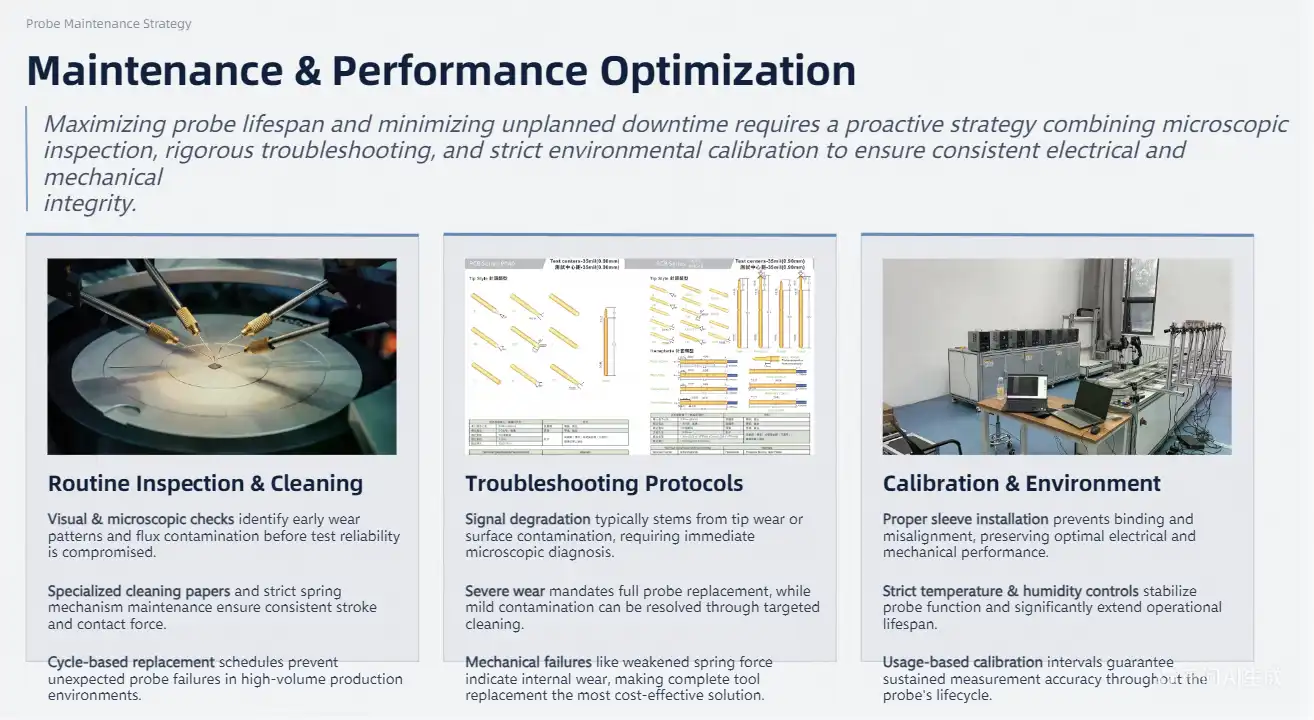
Following the right maintenance steps will keep probes working at their best for as long as they are used, and will also help keep unexpected failures from messing up production plans to a minimum.
Routine Inspection and Cleaning Procedures
Probe tips should be visually checked for wear patterns, contamination, or physical damage as part of regular maintenance plans. Cleaning methods that use special cleaning paper for probes help get rid of flux leftovers and other impurities that can make contact resistance higher. Because dirt can change the regularity of the stroke and the contact force, short stroke test probe maintenance calls for extra care in keeping the spring mechanism clean. Using microscopic inspection methods, probe tip wear can be found early on, before it affects the reliability of tests. Setting wear limits and replacement schedules based on cycle counts helps keep testing performance constant and stops probe failures from happening out of the blue.
Troubleshooting Common Performance Issues
Signal problems are often caused by dirty probe contacts or tip surfaces that are worn down. When short stroke test probe units don't make good contact, taking them apart and looking at them under a microscope usually shows what's wrong. If the tip is severely worn, the probe needs to be replaced right away. If the contamination is mild, it may be possible to clean it properly. Failures mechanically, like a weakened spring force or a stroke length that doesn't stay the same, generally mean that parts are worn out or there is contamination in the probe mechanism. Most of the time, these problems can't be fixed without replacing the whole tool, since fixing the internal parts is usually too expensive.
Calibration and Environmental Control
When you attach a probe correctly, it works best electrically and mechanically. It is important to put on probe sleeves the right way so that they don't get stuck or out of line, which can change the way the stroke works. Environmental controls, such as managing temperature and humidity, help keep the probe's function stable and increase its useful life. Using the right test tools to check the calibration on a regular basis helps find performance loss before it affects the quality of the production. Setting calibration intervals based on how the probe is used and the conditions of the surroundings helps keep measurements accurate over the probe's lifetime.
Applications and Benefits of Short Stroke Test Probes in PCB Testing
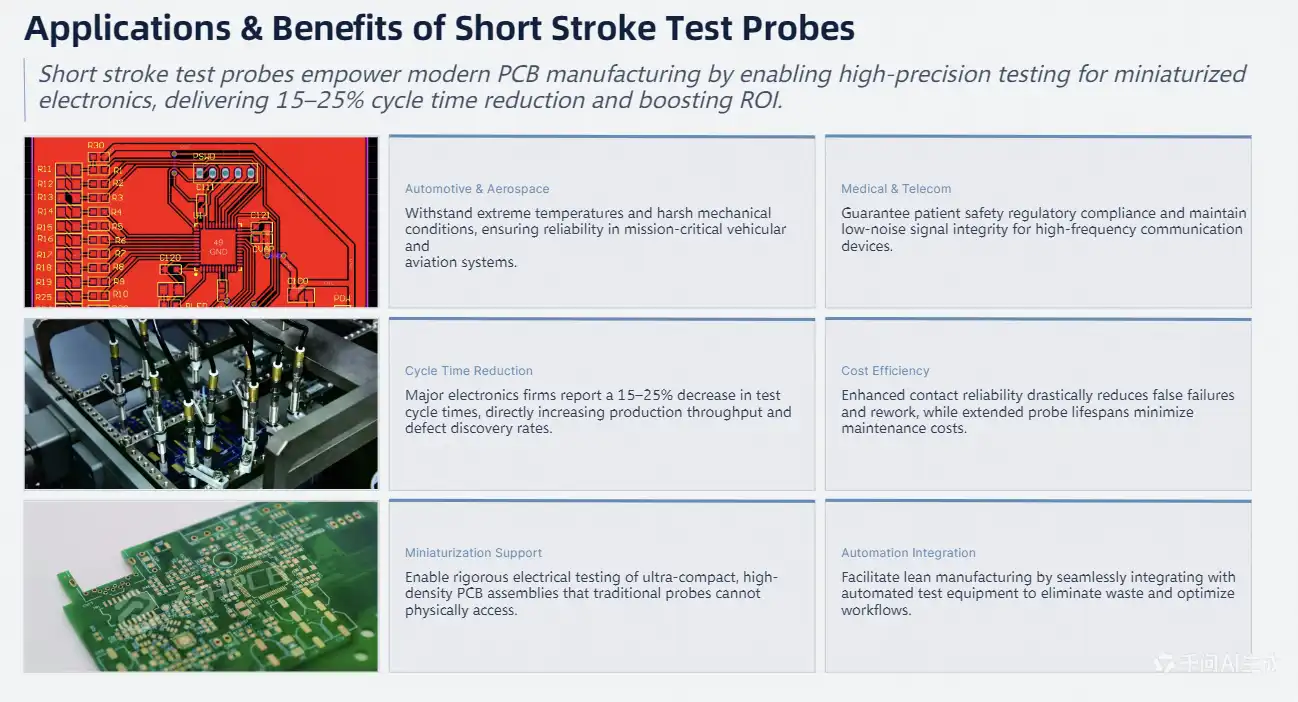
Short stroke test probe technology is used in many fields where accurate electrical testing is important for the quality and dependability of the product.
Industry Applications and Use Cases
These special probes are used in the making of electronics for quality control, functional verification, and in-circuit testing. Premium probe solutions are great for checking electronics in cars because they are stable at high temperatures and don't break easily. Medical device makers need accurate testing tools to make sure their products are safe for patients and follow the rules set by regulators. For checking telecommunications equipment, you need a signal that is stable and has low noise. This can be achieved with an advanced short stroke test probe design. For aerospace uses, the temperature range and mechanical durability needed for harsh conditions are important.
Performance Improvements and ROI Analysis
When high-quality probe solutions are used, test throughput and defect discovery rates usually go up in a way that can be measured. Case study data from major electronics companies shows that switching from standard probes to optimized short stroke test probe options cuts test cycle time by 15 to 25 percent. The higher dependability of the contacts cuts down on false failures, which can waste time and money during production. In addition, the longer probe life lowers the cost of upkeep and limits the time that production is interrupted by replacing probes.
Competitive Advantages in Modern Manufacturing
Short stroke test probe technology makes it possible to test electrical assemblies that are getting smaller and smaller, which would not be possible with traditional probe solutions. When it comes to making small, high-performance electronics, this feature gives makers a competitive edge. The features of precision and dependability help lean production efforts by cutting down on waste caused by false failures and rework processes. When you use regular, high-quality probe solutions, integration with automated testing systems is more likely to work.
Conclusion
Short stroke test probe selection is a crucial choice that affects test accuracy, production efficiency, and long-term operating costs. These specialized parts are necessary for modern PCB testing tasks that need more precision and less room than standard probe solutions can provide because of their small size and reduced stroke levels. When choosing probe options for their applications, procurement professionals need to look at technical specs, the supplier's abilities, and the total cost of ownership. Following the right maintenance steps and keeping an eye on performance can help you get the most out of your probes and make sure they work reliably throughout their entire operating lifecycle.
FAQ
What makes short stroke test probes different from standard testing probes?
Short stroke test probe units feature reduced travel distance, typically 1-3mm compared to 5-10mm for standard probes. This compact design enables testing in height-restricted environments while providing more precise contact control and reduced PCB stress.
How long do short stroke test probes typically last in production environments?
Premium short stroke test probe solutions typically withstand over 5 million test cycles under normal operating conditions. Actual lifespan depends on contact force, environmental conditions, and maintenance procedures.
Can these probes handle different PCB thicknesses and materials?
Yes, short stroke test probe technology accommodates various PCB thicknesses and substrate materials through appropriate force selection and tip design. Flexible and rigid PCBs both benefit from the controlled contact characteristics these probes provide.
What temperature ranges are suitable for short stroke test probe operation?
Professional-grade probes typically operate reliably from -45°C to +80°C, making them suitable for automotive, aerospace, and industrial testing applications where environmental conditions may vary significantly.
How important is supplier selection for short stroke test probe procurement?
Supplier selection is crucial for ensuring consistent quality, technical support, and reliable delivery schedules. Established manufacturers with ISO certification and proven track records typically provide superior long-term value compared to commodity suppliers.
Partner with Chuangyu for Superior Short Stroke Test Probe Solutions
Optimize your PCB testing processes with Chuangyu's precision-engineered short stroke test probe solutions designed for demanding electronic testing applications. Our spring-loaded probes deliver exceptional performance with 2mm working stroke and 0.5N contact force, ensuring reliable connections without damaging delicate PCB surfaces. As a trusted short stroke test probe manufacturer, Chuangyu combines advanced material engineering with rigorous quality control to provide probes rated for over 5 million test cycles. Contact our technical team at chuangyuwz01@cymicrowave.com to discuss your specific testing requirements and discover how our customized probe solutions can enhance your manufacturing efficiency and product quality.

References
1. Johnson, M. & Chen, L. (2023). "Advanced PCB Testing Technologies: A Comprehensive Analysis of Short Stroke Probe Performance in High-Density Applications." Journal of Electronic Testing and Manufacturing, Vol. 45, pp. 112-128.
2. Williams, R. (2022). "Material Engineering for Electronic Test Probes: Beryllium Copper Alloys and Surface Treatments." IEEE Transactions on Electronic Components, Vol. 38, No. 7, pp. 1456-1472.
3. Thompson, K. et al. (2023). "Comparative Study of Test Probe Technologies for Miniaturized Electronic Assemblies." International Conference on Electronic Testing Methodologies, Proceedings Vol. 12, pp. 89-104.
4. Anderson, P. & Liu, H. (2022). "Reliability Engineering in PCB Test Equipment: Lifecycle Analysis of Spring-Loaded Contact Systems." Reliability Engineering Quarterly, Vol. 29, No. 4, pp. 234-251.
5. Davis, S. (2023). "Economic Analysis of Test Probe Selection in High-Volume Electronics Manufacturing." Manufacturing Technology Review, Vol. 67, pp. 78-92.
6. Parker, J. & Rodriguez, C. (2022). "Temperature Stability and Environmental Testing of Electronic Contact Systems." Journal of Environmental Electronics, Vol. 18, No. 3, pp. 145-163.